What Does the Dollar Index Mean?
What Does the Dollar Index Mean?
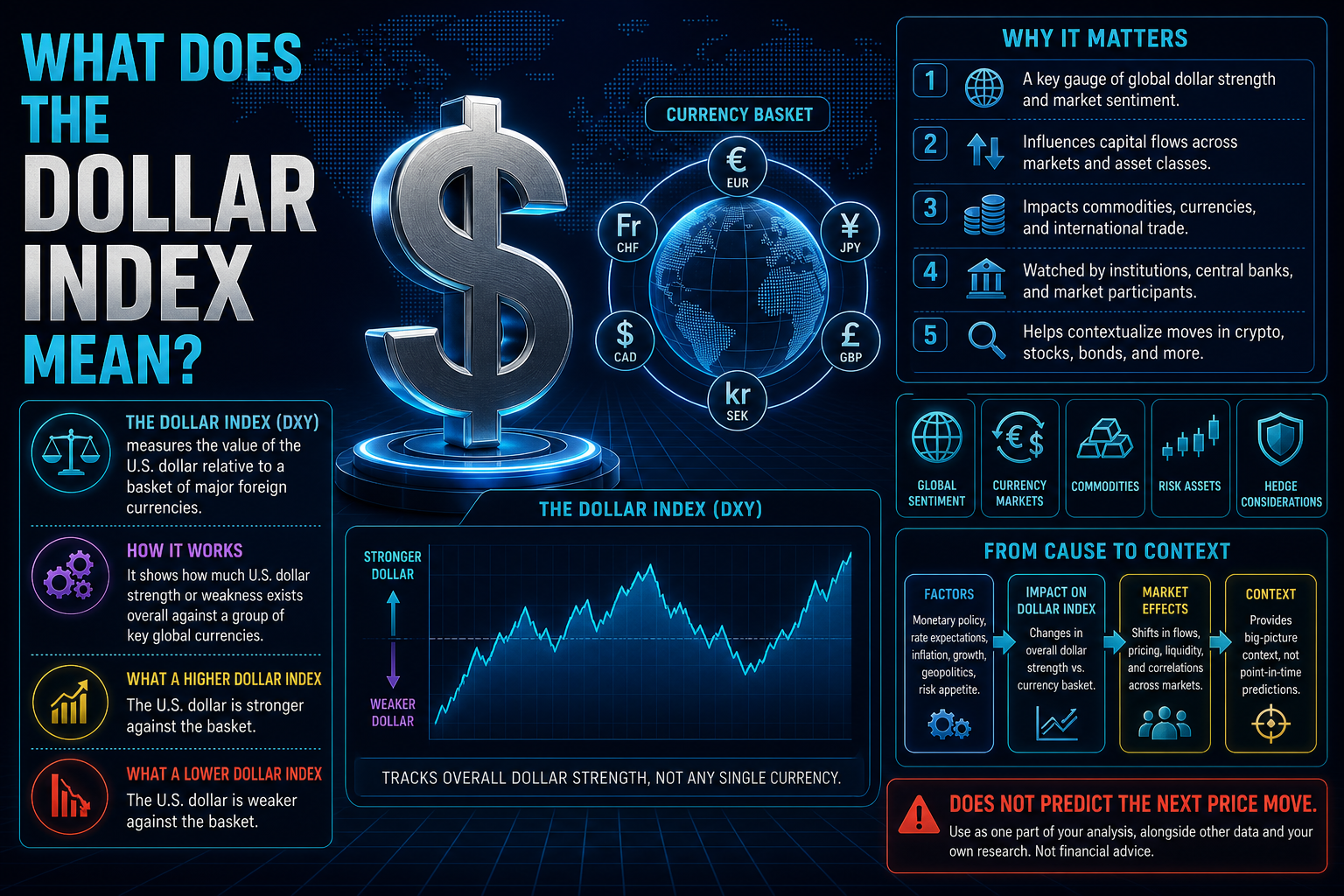
The Dollar Index measures the U.S. dollar’s value against a basket of major currencies. It is a broad indicator of dollar strength or weakness, rather than the exchange rate with one currency.
Why it matters
The dollar can respond to interest-rate expectations, growth differences, global risk sentiment, and demand for liquidity. Dollar moves can influence commodity prices, international capital flows, and broader financial conditions.
Crypto context
A stronger dollar can sometimes coincide with tighter financial conditions and pressure on risk assets, while a weaker dollar can coincide with easier conditions. The relationship is variable and crypto may diverge for its own reasons.
Key takeaway
The Dollar Index provides a view of broad dollar strength and is useful macro context, not a crypto price forecast.
Reading the wider context
The index is influenced by the currencies in its basket, so it is not a complete picture of every foreign-exchange relationship. Traders commonly compare dollar moves with Treasury yields, policy expectations, relative economic data, and global demand for liquidity.
A stronger or weaker dollar can have different implications depending on the reason behind the move. Looking at equities, commodities, volatility, and crypto flows can help identify whether a move reflects broad risk conditions or a more specific currency driver.
Common signals people watch
- Dollar performance against major currencies
- Treasury yields and policy expectations
- Global risk appetite
- Equity and commodity reactions
- Crypto price and flow confirmation
A practical way to use the concept
Rather than reacting to one headline or one market session, many readers follow the trend over several periods. They compare market participation, liquidity, and the reaction in related assets. This makes it easier to tell the difference between a temporary move and a broader change in conditions.
No single market indicator can explain all crypto movements. Macro relationships can change quickly, especially around economic releases and major policy events. The concept is most valuable as a question to investigate, not an answer by itself.
What can change the reading
Market interpretation can change when new inflation or labor data appears, when policy guidance shifts, or when investors adjust their demand for liquidity. This is why dollar strength is usually read as an evolving backdrop rather than a fixed signal.
It is also useful to distinguish a move in one trading session from a sustained trend. Price action, volume, and the response in related markets can provide confirmation or show that the initial interpretation is changing.
Comments (0)
Join the discussion
Sign in or create a free account to leave a comment.
No comments yet. Be the first to comment!