What Are Ethereum Validators?
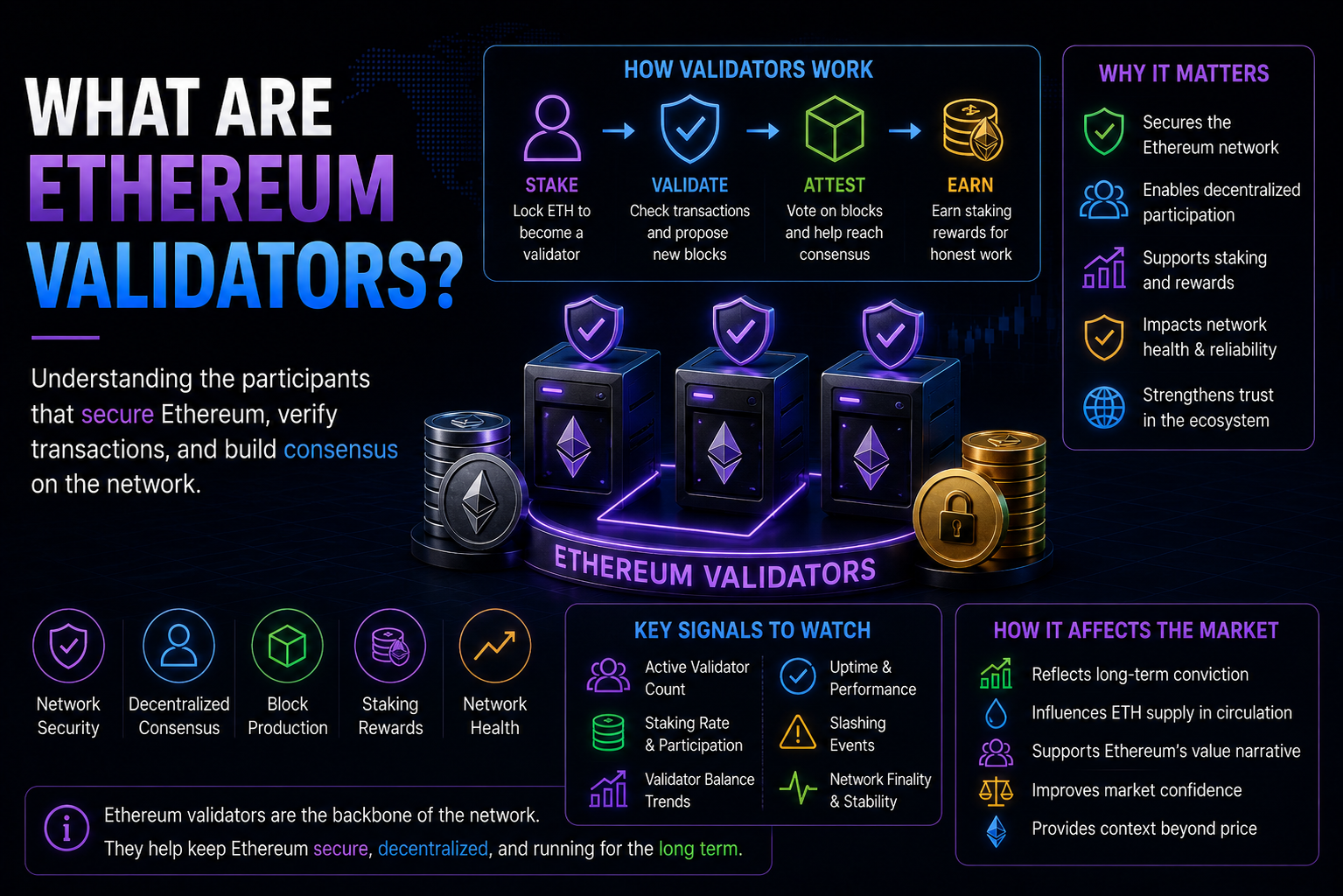
What Is an Ethereum Validator?
Ethereum validators help keep the Ethereum network running securely. They verify transactions, help create new blocks, and support the blockchain without relying on traditional mining.
Crypto readers often watch validator activity because it reflects the health, participation, and security of the Ethereum network. It can also provide useful context when reading broader market updates.
Simple definition
An Ethereum validator is a participant that helps verify transactions and create new blocks on the Ethereum blockchain.
Instead of using powerful computers to compete for blocks, validators lock up ETH through staking and help maintain the network by following Ethereum's proof-of-stake system.
Why Ethereum validators matter
Validators are one of the main reasons the Ethereum network can remain secure and decentralized. The more healthy participation the network has, the more difficult it becomes for bad actors to interfere with transaction validation.
They also help the blockchain continue operating smoothly by confirming transactions and helping blocks reach final approval.
How traders usually read it
Healthy validator participation is usually viewed as a positive sign because it suggests that many participants are helping secure the Ethereum network.
However, validator activity alone does not determine ETH's price. Traders usually combine it with price action, staking activity, liquidity, market sentiment, and broader market conditions.
Why it matters for crypto
Ethereum is one of the largest blockchain networks, so its validator system is closely watched by investors, developers, and analysts.
When Daily Pulse discussions mention Ethereum network health or staking participation, validator activity may help explain the broader context. Traders may also compare Ethereum's network strength with other market signals such as ETF flows, liquidity, or overall market sentiment when evaluating conditions.
Validators are not a standalone market signal
Strong validator participation does not guarantee higher ETH prices, and lower participation does not automatically predict weakness.
Validator data is most useful when read alongside Ethereum price action, staking participation, transaction activity, liquidity, and the overall market environment.
Example in a market update
A market update may note that Ethereum validator participation remains steady, suggesting the network continues to show healthy long-term support despite short-term price volatility.
Another update may mention that validator participation has changed little while ETH price moves sharply, reminding readers that network fundamentals and price can move independently over shorter periods.
Common signals traders watch
- Validator participation across the Ethereum network
- Ethereum staking activity
- ETH price action alongside validator trends
- Overall network health and transaction activity
- Broader market sentiment and liquidity conditions
Key takeaway
Ethereum validators help secure the network and provide valuable context about Ethereum's long-term health, but they should always be viewed alongside other market signals.
Comments (0)
Join the discussion
Sign in or create a free account to leave a comment.
No comments yet. Be the first to comment!