What Does Whale Distribution Mean?
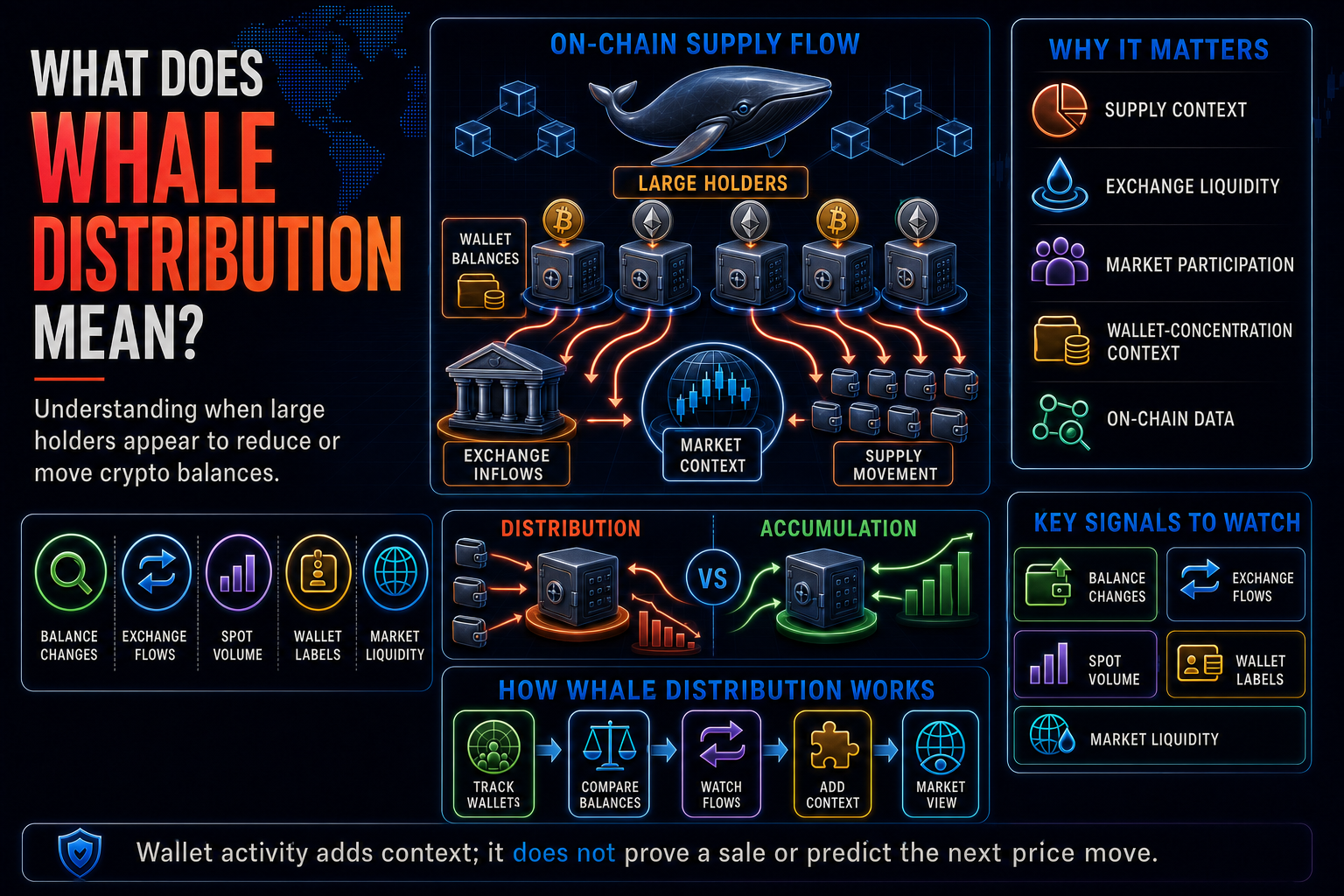
What Does Whale Distribution Mean?
Whale distribution describes a period when large crypto holders appear to be reducing balances, moving coins to other wallets, or sending assets toward trading venues. Traders use the term to discuss supply movement from large holders, but the data does not always reveal whether a sale is taking place.
Simple definition
Whale distribution is a pattern in which large holders appear to reduce or redistribute their crypto holdings.
A whale is a broad term for a wallet, entity, or investor that controls a large amount of an asset. Distribution may show up as falling balances in a large-holder wallet group, transfers to exchanges, or supply moving from a large address to many other addresses.
Why whale distribution matters
Whale distribution matters because large holders can influence the supply available to the market, especially in assets with limited liquidity. Their balance changes may provide context for exchange reserves, market participation, and potential selling liquidity.
It is more informative as a pattern over time than as a reaction to one large transfer. The size of the market, the asset's liquidity, and the identity of the address all affect how meaningful the activity may be.
How whale distribution is tracked
On-chain analysts may monitor large-holder balance changes, transfers into exchange addresses, changes in exchange reserves, and how supply is distributed among wallet cohorts. They may compare this information with spot volume, market depth, and price structure.
Address labels require caution. A wallet may represent an exchange, a custodian, a fund, a market maker, or many users. A transfer to an exchange is not proof that assets will be sold.
How traders usually read it
A continuing decline in large-holder balances may be read as a sign that some large participants are reducing or redistributing exposure. Repeated large inflows to exchanges may also be watched because they can increase the supply available on trading venues.
Traders usually compare whale distribution with spot demand, liquidity, exchange flows, derivatives positioning, and broader market conditions. This helps avoid treating one on-chain pattern as a complete explanation of the market.
Whale distribution versus whale accumulation
Whale accumulation refers to large holders appearing to increase or retain balances. Whale distribution refers to large holders appearing to reduce balances or move supply outward.
Neither term proves a future price move. Both are on-chain context signals that require reliable wallet labels and supporting market data.
Why it matters for crypto
Public blockchain data can make some large-balance and transfer patterns visible. This gives crypto traders a way to observe how supply moves between wallets, exchanges, and other known address groups.
Not all crypto activity is visible or easy to attribute. Custody arrangements, internal exchange movements, over-the-counter trades, and derivatives positions can all complicate the interpretation.
Whale distribution is not a standalone signal
Whale distribution does not guarantee that price will fall, and accumulation does not guarantee that it will rise. Large holders may move assets for custody, operational, hedging, tax, or portfolio-management reasons.
It is most useful when read alongside wallet-label confidence, exchange liquidity, spot demand, trading volume, price structure, and broader market context.
Example in a market update
If large-holder balances are declining while exchange inflows are increasing, a market update may describe whale distribution as an on-chain pattern to monitor alongside market liquidity.
If a large transfer reaches an exchange but spot demand remains firm, an update may note that the transfer alone does not establish the next market move.
Common signals traders watch
- Large-holder wallet-balance changes
- Transfers into exchange addresses
- Supply movement across wallet cohorts
- Spot volume and order-book liquidity
- Wallet-label confidence and market context
Key takeaway
Whale distribution is a pattern of large holders reducing or redistributing crypto balances and can add context about supply, exchange flows, and market liquidity.
Comments (0)
Join the discussion
Sign in or create a free account to leave a comment.
No comments yet. Be the first to comment!