What Is Whale Activity?
What Does Whale Activity Mean?
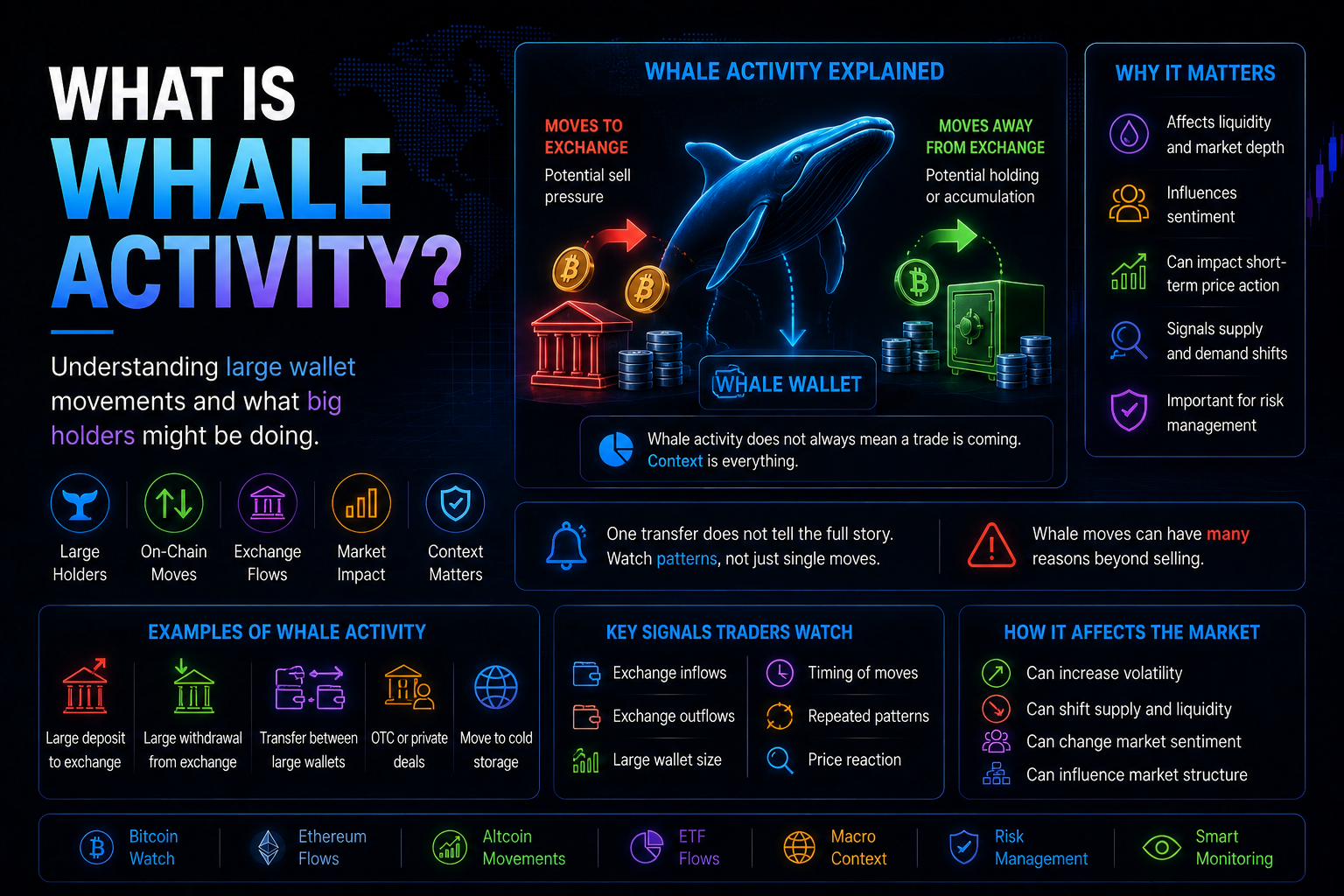
Whale activity describes moves made by very large crypto holders. Crypto traders watch whale activity because large wallets can affect liquidity, market sentiment, Bitcoin, Ethereum, altcoins, and short-term market structure.
Simple definition
Whale activity means large crypto wallet movements, large trades, or behavior from holders with a major amount of a coin or token.
A whale is not a specific person or institution. It is a general market term for a wallet or holder large enough that its activity may matter to the market.
Why whale activity matters
Whale activity matters because large holders can influence how traders read supply, demand, liquidity, and confidence.
If large wallets are moving coins to exchanges, traders may wonder whether sell pressure is increasing. If large wallets are moving coins away from exchanges, traders may read it as a sign that holders are reducing near-term selling activity, depending on context.
How traders usually read it
Whale activity is usually read based on direction, size, timing, and destination. A large move to an exchange can look cautious, while a large withdrawal from an exchange can look more constructive.
The meaning depends on context. A whale transfer does not always mean a sale is coming, and a large wallet movement does not always explain price action by itself.
Why it matters for crypto
Crypto markets can be sensitive to whale activity because liquidity is not always evenly spread across exchanges, wallets, and trading pairs.
Traders may watch whale activity alongside Bitcoin price action, Ethereum flows, ETF flows, exchange flows, volume, volatility, and broader market sentiment to understand whether large holders are supporting or pressuring the market.
Whale activity is not a standalone signal
Whale activity should not be treated as a complete market signal. Large wallet movement can happen for many reasons, including custody changes, exchange transfers, internal wallet management, or portfolio rebalancing.
It is most useful when read alongside price action, exchange flows, order book conditions, volume, liquidity, volatility, ETF flows, and market sentiment.
Example in a market update
If Bitcoin is holding steady while large wallets move coins away from exchanges, traders may read whale activity as less immediately bearish.
If Bitcoin is weakening while large wallets move coins toward exchanges, traders may read whale activity as a possible sign of rising sell pressure.
Common signals traders watch
- Whether large wallets are sending coins to exchanges
- Whether large wallets are withdrawing coins from exchanges
- Whether whale moves happen during high volatility
- Whether price action confirms or ignores the wallet movement
- Whether whale activity appears alongside changes in volume, liquidity, or sentiment
Key takeaway
Whale activity helps traders see what large holders may be doing, but it needs context before it can support a market read.
Comments (0)
Join the discussion
Sign in or create a free account to leave a comment.
No comments yet. Be the first to comment!