What Does Volume Mean?
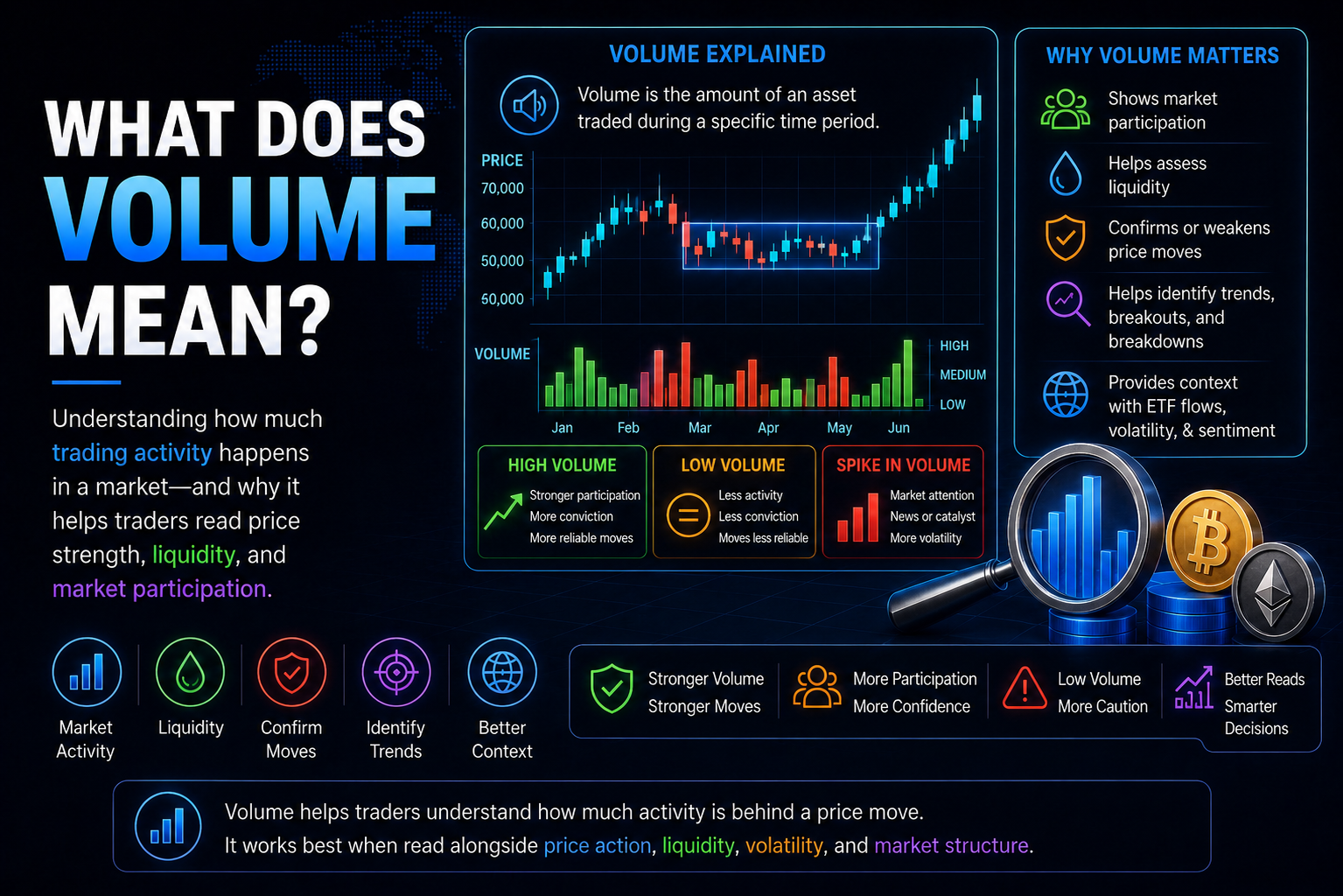
What Is Trading Volume?
Volume shows how much of an asset is traded over a period of time. Crypto traders watch volume because it can help explain whether price moves are supported by active participation or happening in a thinner market.
Simple definition
Volume means the amount of an asset traded during a specific time period.
In crypto, volume can refer to Bitcoin, Ethereum, an altcoin, an exchange, a trading pair, or the broader market. Higher volume usually means more activity, while lower volume usually means less activity.
Why Volume matters
Volume matters because price alone does not show how many traders are involved. A price move with strong volume may show broader participation, while a price move on weak volume may be easier to question.
Volume can also help traders understand liquidity, conviction, and market attention. When more activity enters a market, price moves may carry more weight, but the meaning still depends on context.
How traders usually read it
Rising volume during an upward move usually suggests stronger buying interest or broader participation. Rising volume during a decline may suggest stronger selling pressure or defensive activity.
Low volume can mean the market is quiet, uncertain, or waiting for a catalyst. It can also make price moves less reliable because fewer trades may be driving the move.
Why it matters for crypto
Crypto markets can move quickly, so volume helps traders judge whether Bitcoin, Ethereum, or altcoin price action has real participation behind it.
Crypto traders may read volume alongside ETF flows, liquidity, Bitcoin dominance, volatility, exchange activity, and market structure. Volume can help show whether a move is broad, selective, or thin.
Volume is not a standalone signal
Volume should not be used by itself to decide whether a market is strong or weak. High volume can appear during rallies, selloffs, liquidations, news reactions, or short-term volatility.
Volume is most useful when read alongside price action, support and resistance, volatility, liquidity, ETF flows, order book conditions, sentiment, and broader market structure.
Example in a market update
If Bitcoin breaks above resistance while volume increases, traders may read the move as having stronger participation.
If Bitcoin rises while volume stays weak, traders may describe the move as less convincing until participation improves.
Common signals traders watch
- Whether volume is rising or falling during a price move
- Whether Bitcoin and Ethereum volume support the broader market tone
- Whether altcoin volume is broadening or staying selective
- Whether volume confirms a breakout, breakdown, or range-bound move
- Whether volume appears with higher volatility, ETF flows, or major headlines
Key takeaway
Volume helps traders understand how much activity is behind a market move, but it works best when read alongside price action, liquidity, volatility, sentiment, and market structure.
Comments (0)
Join the discussion
Sign in or create a free account to leave a comment.
No comments yet. Be the first to comment!