What Does Volatility Compression Mean?
What Does Volatility Compression Mean?
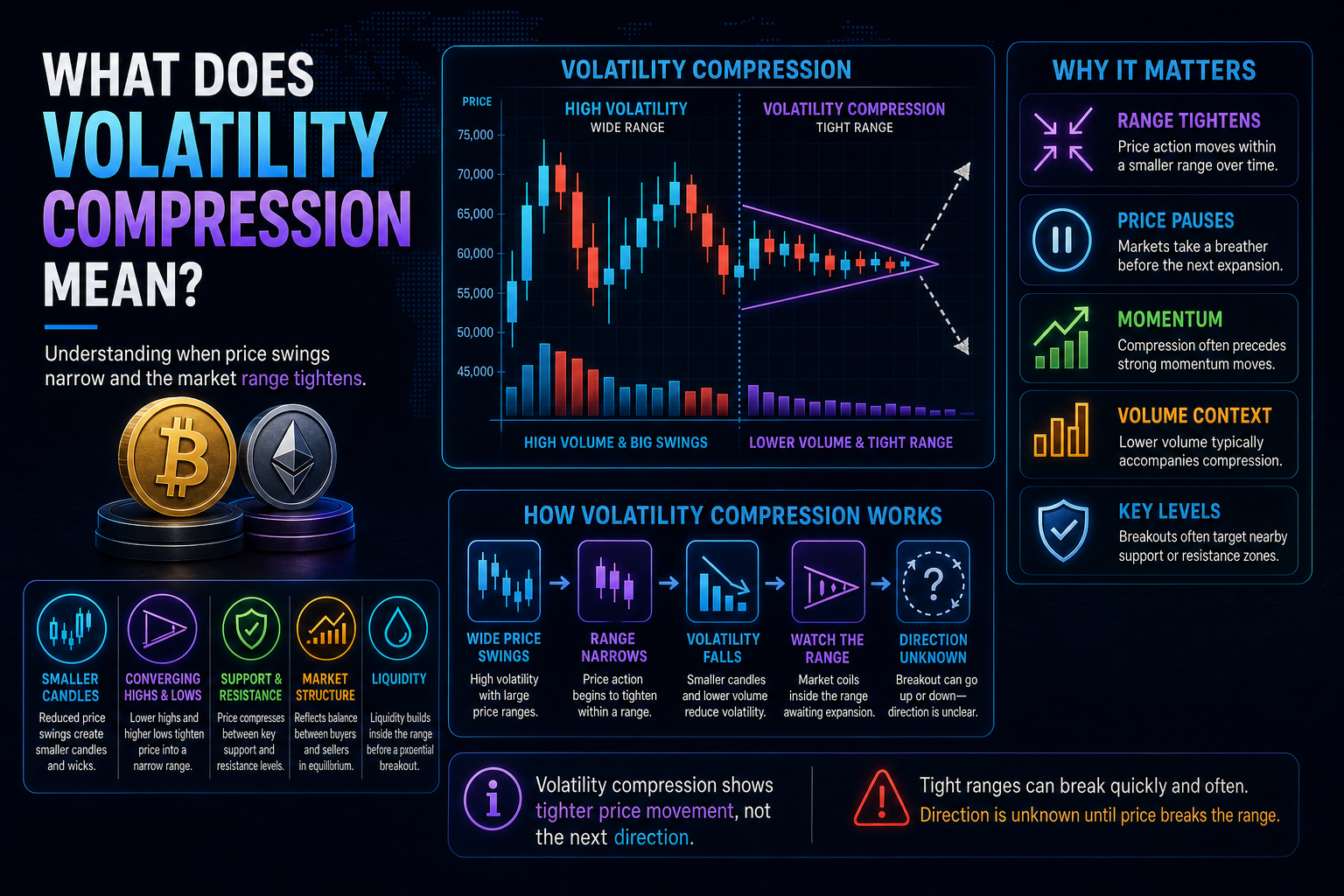
Volatility compression is a period when price swings become smaller and the trading range narrows. In crypto, traders use the term when an asset begins moving in a tighter area after larger moves or during a period of market indecision.
Simple definition
Volatility compression means the size of price moves is decreasing and price is becoming more tightly contained.
It can appear when buyers and sellers are temporarily balanced. The market may form a narrow range, a triangle, a pennant, or another pattern where the distance between highs and lows becomes smaller.
Why volatility compression matters
Volatility compression matters because quieter price action can change how traders read the market. It may show that a strong move has paused, that the market is consolidating, or that price is approaching an important decision area.
Compression is often followed by an expansion in price movement, but it does not tell traders which direction that expansion will take.
How volatility compression forms
Compression can form after a sharp rally or decline when price begins to pause. It can also develop in a longer sideways market when buyers and sellers repeatedly meet near the same levels.
On a chart, traders may notice shorter candles, lower average price ranges, converging trend lines, or a tighter distance between support and resistance.
How traders usually read it
Traders often compare the compressed range with the trend that came before it. They may also watch volume, momentum, nearby price levels, and whether price eventually breaks beyond the range.
A tighter range is context, not a directional signal. The same compression can appear before an upward move, a downward move, or more sideways trading.
Volatility compression versus low volume
Volatility compression describes the size of price movement. Low volume describes how much trading activity is taking place. They can occur together, but they are not the same thing.
For example, price can trade in a narrow range with low volume, or it can remain compressed while active buyers and sellers trade within that range.
Why volatility compression matters in crypto
Crypto markets are known for periods of rapid movement followed by quieter consolidation. Volatility compression in Bitcoin or Ethereum can influence how traders read wider market participation, while compression in altcoins may reflect more selective liquidity.
Because price can expand quickly once a tight range ends, traders usually read compression together with market structure and the broader market environment.
Volatility compression is not a standalone signal
Volatility compression does not guarantee a breakout or predict the next direction. It only shows that price movement has become tighter than before.
It is most useful when read alongside the prior trend, support and resistance, trading volume, momentum, liquidity, and broader market conditions.
Example in a market update
If Bitcoin trades in a smaller range for several sessions after a strong move, a market update may describe volatility as compressing while the market waits for fresh direction.
If an altcoin's highs and lows keep converging near a key level, an update may note volatility compression and say that traders are watching how price responds when the range ends.
Common signals traders watch
- Smaller candles or a narrower daily range
- Highs and lows moving closer together
- Converging trend lines or a tight range
- Changes in trading volume and momentum
- A break beyond nearby support or resistance
Key takeaway
Volatility compression is a tightening of price movement that can show a market is consolidating, but it does not determine the next direction.
Comments (0)
Join the discussion
Sign in or create a free account to leave a comment.
No comments yet. Be the first to comment!