What Does Volatility Mean?
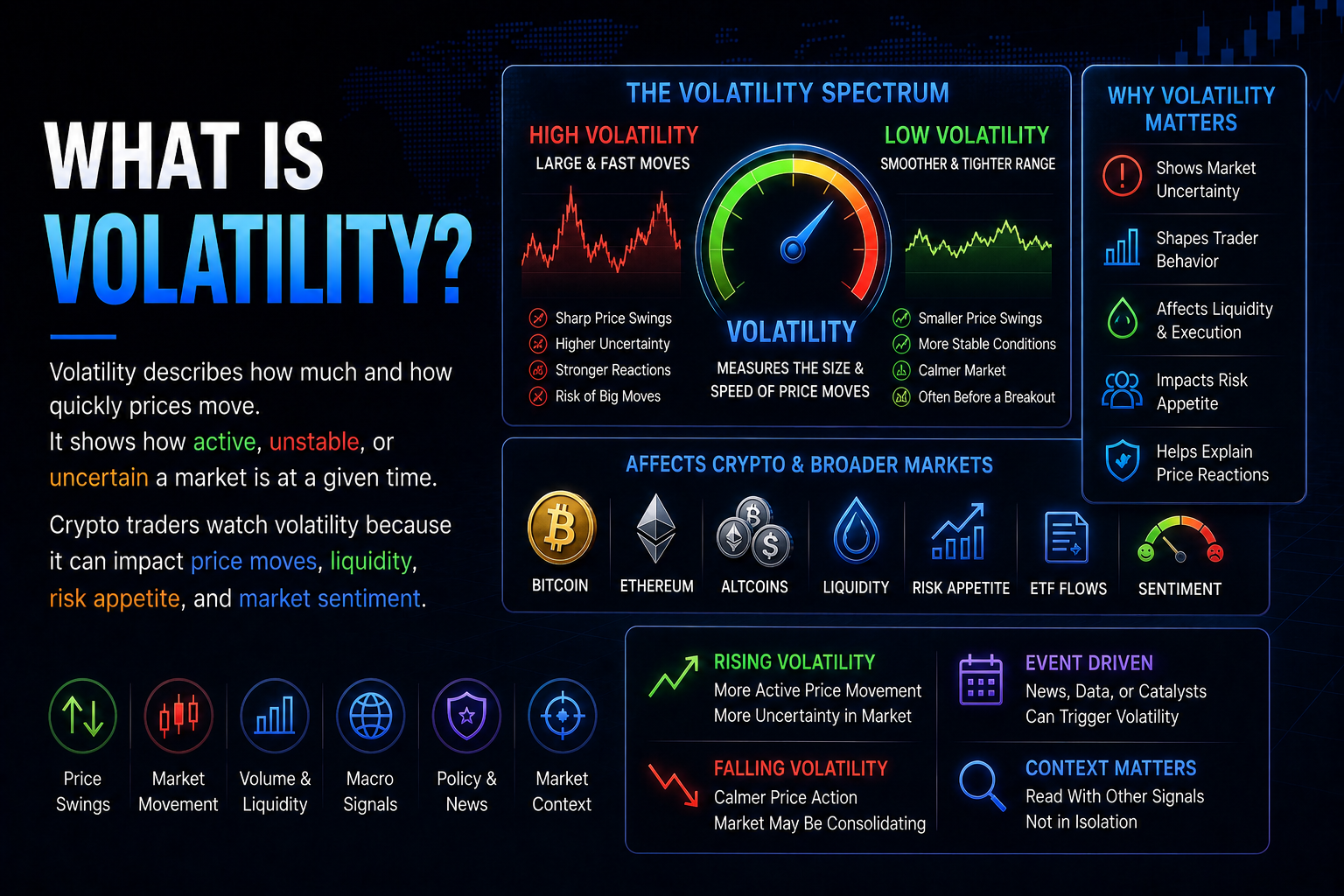
What Is Volatility?
Volatility describes how much and how quickly prices move. Crypto traders watch volatility because it can affect Bitcoin, Ethereum, altcoins, liquidity, risk appetite, and market sentiment. Higher volatility usually means the market is moving more sharply or reacting to uncertainty.
Simple definition
Volatility means the size and speed of price movement in a market.
A market with high volatility moves sharply up or down. A market with low volatility moves more calmly or within a tighter range.
Why volatility matters
Volatility matters because it helps traders understand how unstable, active, or uncertain a market feels.
When volatility rises, traders may become more cautious because price swings can become larger. When volatility falls, markets may feel calmer, but low volatility can also mean traders are waiting for a stronger catalyst.
How traders usually read it
Rising volatility usually means price movement is becoming more active or uncertain.
Falling volatility usually means the market is becoming calmer. The meaning depends on context because volatility can rise during selloffs, rallies, major news events, or sudden shifts in liquidity.
Why it matters for crypto
Crypto can be more volatile than many traditional markets. Bitcoin, Ethereum, and altcoins may move quickly when risk appetite changes, liquidity shifts, ETF flows surprise the market, or macro signals affect trader behavior.
Crypto traders may use volatility as part of a broader read, especially when it appears alongside price action, volume, Bitcoin dominance, VIX, Treasury yields, the U.S. dollar, and market sentiment.
Volatility is not a prediction
Volatility should not be used as a standalone price signal. Higher volatility does not automatically mean the market will fall, and lower volatility does not automatically mean the market will rise.
Volatility is most useful when read alongside price direction, volume, liquidity, ETF flows, macro signals, support and resistance, and broader market sentiment.
Example in a market update
If Bitcoin is rising while volatility is falling, traders may read the setup as more constructive and calmer.
If Bitcoin is holding steady while volatility is rising, traders may read the setup as more selective because uncertainty or event risk may be increasing.
Common signals traders watch
- Whether volatility is rising or falling
- Whether price swings are becoming larger or smaller
- Whether Bitcoin and Ethereum are holding key levels during volatility shifts
- Whether volume and liquidity confirm the move
- Whether volatility is tied to macro data, ETF flows, policy news, or market sentiment
Key takeaway
Volatility helps traders understand how sharply prices are moving, and those moves can shape risk appetite, liquidity, and crypto market behavior.
Comments (0)
Join the discussion
Sign in or create a free account to leave a comment.
No comments yet. Be the first to comment!