What Is the U.S. Dollar Index?
What Does the U.S. Dollar Index Mean?
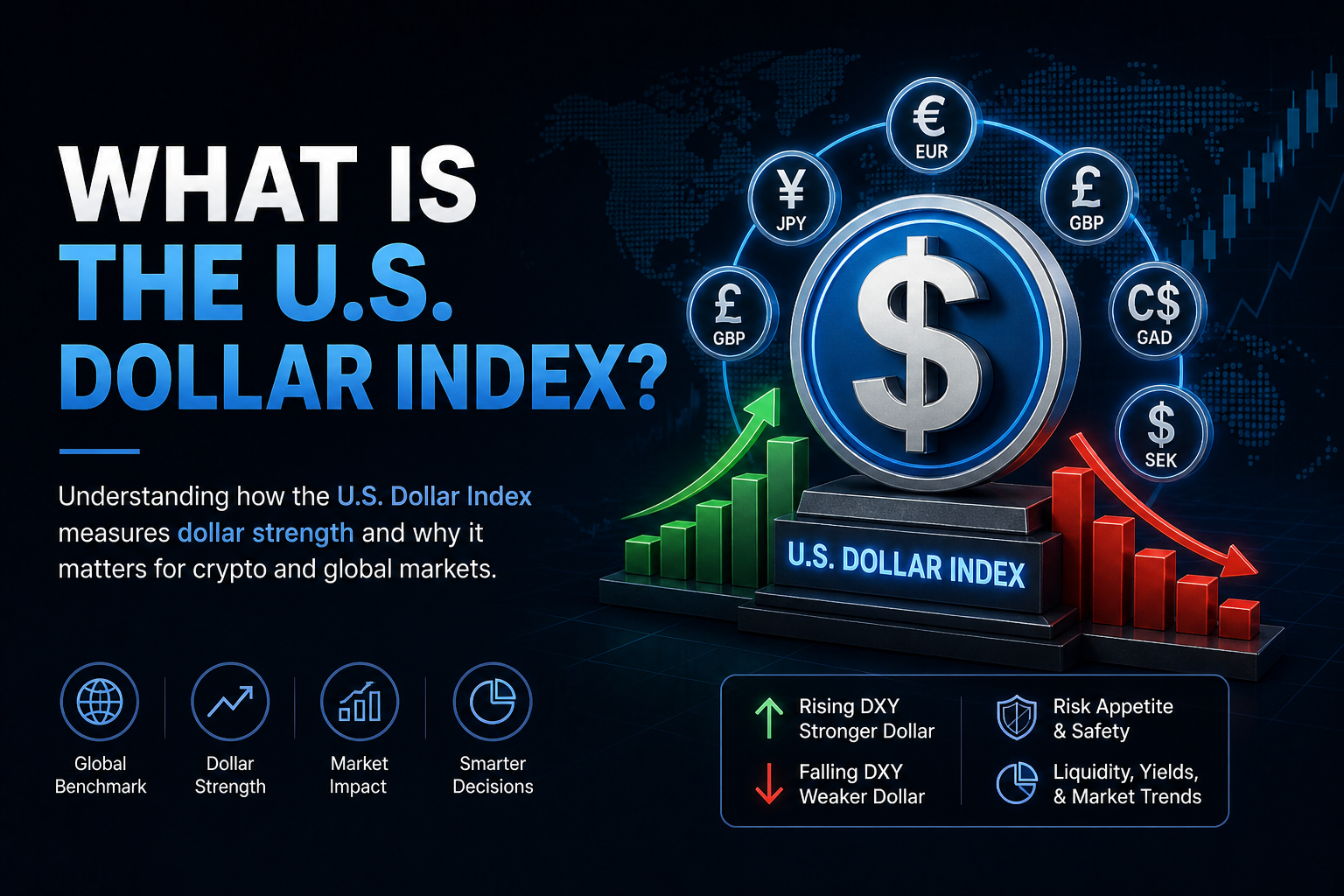
The U.S. Dollar Index measures the value of the U.S. dollar against a basket of major global currencies. Traders watch it because the dollar can influence risk appetite across markets, including Bitcoin, crypto, stocks, commodities, and global assets.
Simple definition
The U.S. Dollar Index shows whether the U.S. dollar is getting stronger or weaker compared with other major currencies.
It is often used as a quick way to understand dollar strength in the broader macro backdrop.
Why the U.S. Dollar Index matters
The U.S. dollar is one of the most important currencies in global markets. When the dollar moves sharply, it can affect how investors think about risk, liquidity, inflation, interest rates, and global demand.
Because many assets are priced in dollars, a stronger or weaker dollar can influence market behavior far beyond currency markets.
How traders usually read it
A rising U.S. Dollar Index usually means the dollar is strengthening against other major currencies.
A falling U.S. Dollar Index usually means the dollar is weakening against other major currencies.
The meaning depends on context. A stronger dollar can sometimes signal confidence in the U.S. economy, but it can also pressure risk assets if investors are moving toward safety or expecting tighter financial conditions.
Why it matters for crypto
Crypto often reacts to changes in dollar strength because Bitcoin and many crypto assets are priced against the dollar.
When the dollar strengthens, crypto can face pressure because global liquidity may feel tighter and investors may become less willing to hold higher-risk assets.
When the dollar weakens, crypto can sometimes benefit because risk appetite and liquidity conditions may improve.
Dollar strength is not a prediction
The U.S. Dollar Index should not be used as a standalone price signal. Bitcoin can rise while the dollar is firm, and crypto can fall even when the dollar weakens.
The index is most useful when read alongside yields, ETF flows, volatility, equities, liquidity, and market sentiment.
Example in a market update
If the U.S. Dollar Index is rising, Treasury yields are higher, and Bitcoin is losing support, traders may read that as a more cautious macro backdrop.
If the U.S. Dollar Index is easing, yields are stable, and Bitcoin is holding higher levels, traders may read that as a more supportive backdrop for risk assets.
U.S. Dollar Index vs USDX or DXY
The U.S. Dollar Index is often referred to as DXY in market commentary.
Some data vendors may use labels like USDX. Depending on the vendor, the exact scale or symbol may differ, so traders should pay attention to the source and how the data is being displayed.
Common signals traders watch
- Whether the dollar is rising or falling
- Whether the move is sharp or gradual
- Whether yields are moving in the same direction
- Whether stocks and crypto are reacting negatively or positively
- Whether the move reflects risk appetite or risk avoidance
Key takeaway
The U.S. Dollar Index helps traders understand dollar strength, and dollar strength can shape risk appetite, liquidity conditions, and crypto market behavior.
Comments (0)
Join the discussion
Sign in or create a free account to leave a comment.
No comments yet. Be the first to comment!