What Does Unemployment Rate Mean?
What Is the Unemployment Rate?
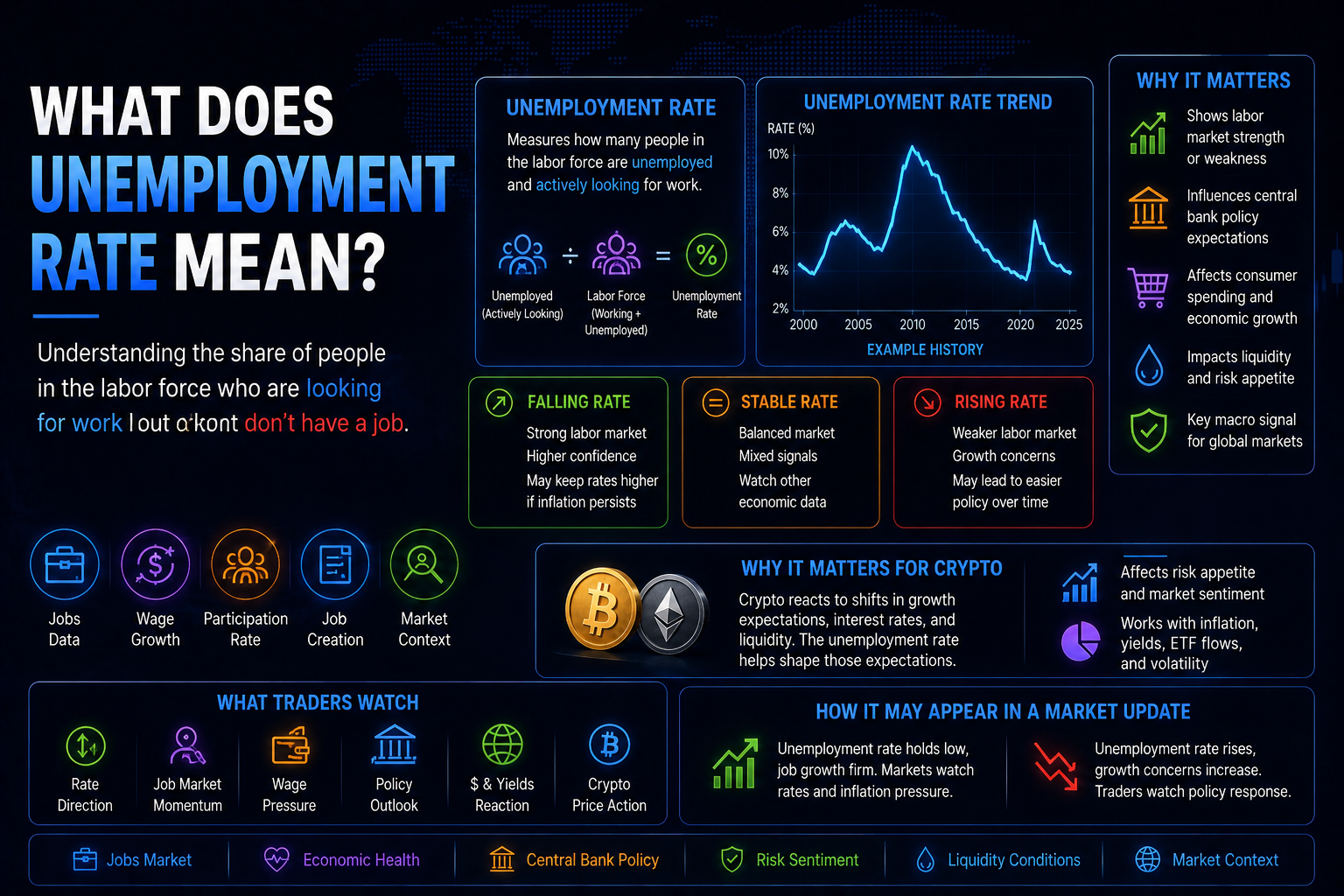
The unemployment rate shows the share of people in the labor force who are looking for work but do not currently have a job. Traders watch the unemployment rate because it can shape expectations around the economy, interest rates, liquidity, risk appetite, Bitcoin, Ethereum, and broader market sentiment.
Simple definition
The unemployment rate measures how many people in the labor force are unemployed and actively looking for work.
It is one of the most watched labor market indicators because it helps show whether the job market is strong, weakening, or moving into a more uncertain phase.
Why unemployment rate matters
The unemployment rate matters because jobs are closely tied to consumer spending, business confidence, wage pressure, and the broader economic cycle.
A very low unemployment rate may suggest a strong labor market, but it can also keep inflation pressure in focus. A rising unemployment rate may suggest the economy is cooling, which can affect how traders think about growth, central bank policy, and risk assets.
How traders usually read it
A lower unemployment rate is usually read as a sign of labor market strength. That can support confidence, but it may also make traders think interest rates could stay higher if inflation pressure remains a concern.
A higher unemployment rate is usually read as a sign that the labor market is weakening. Depending on the context, traders may see that as negative for growth or as a reason central banks may become less restrictive over time.
Why it matters for crypto
Crypto can react to the unemployment rate because Bitcoin, Ethereum, and altcoins are often sensitive to shifts in macro expectations, liquidity, interest rates, and risk appetite.
Crypto traders may use the unemployment rate as part of a broader macro read, especially when it appears alongside inflation data, Treasury yields, the U.S. dollar, ETF flows, volatility, and Bitcoin market structure.
The unemployment rate is not a standalone signal
The unemployment rate should not be used by itself to explain market direction. A strong jobs market does not always mean risk assets will rise, and a weaker jobs market does not always mean they will fall.
It is most useful when read alongside wage growth, job creation, inflation, central bank policy, Treasury yields, the U.S. dollar, liquidity, volatility, and price action.
Example in a market update
If the unemployment rate stays low while inflation remains sticky, traders may read the setup as a sign that rate-cut expectations could stay limited.
If the unemployment rate rises while inflation is easing, traders may read the setup as a sign that the economy is cooling and liquidity expectations could shift.
Common signals traders watch
- Whether the unemployment rate is rising, falling, or stable
- Whether job creation is strong or slowing
- Whether wage growth is adding inflation pressure
- Whether Treasury yields and the U.S. dollar are reacting
- Whether Bitcoin and broader crypto are responding with stronger or weaker risk appetite
Key takeaway
The unemployment rate helps traders understand labor market strength, economic cooling, and macro conditions that can shape liquidity, risk appetite, and crypto market behavior.
Comments (0)
Join the discussion
Sign in or create a free account to leave a comment.
No comments yet. Be the first to comment!