What Are Transaction Fees?
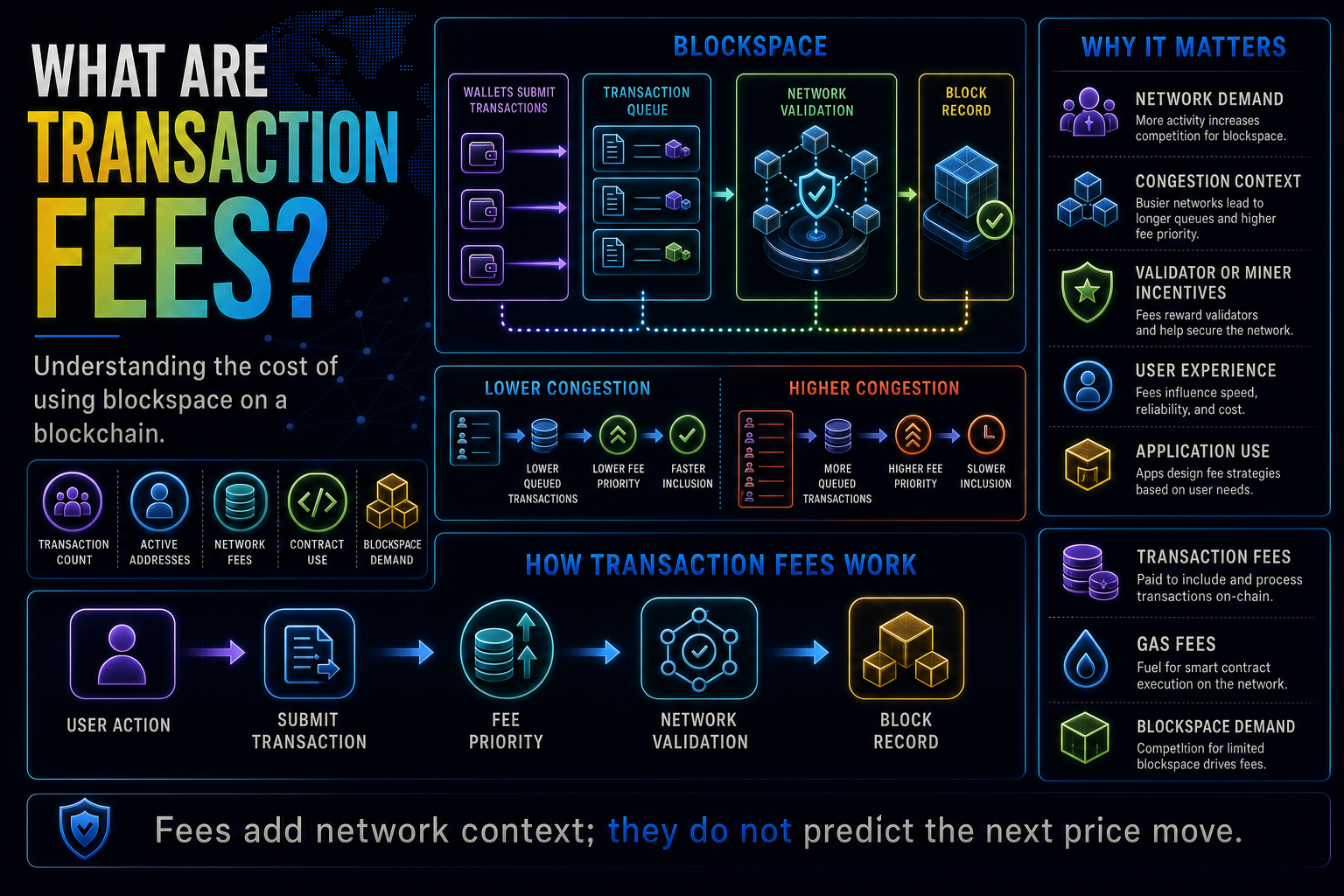
What Are Transaction Fees?
Transaction fees are the costs paid to send a transaction or interact with an application on a blockchain. They help compensate the network participants that process, validate, and record activity on the chain.
Simple definition
Transaction fees are payments made to use blockspace on a blockchain.
When a user sends crypto, swaps tokens, uses a smart contract, or performs another network action, the transaction usually includes a fee. The fee is paid in the network's native asset or according to that network's rules.
Why transaction fees matter
Transaction fees matter because they affect the cost and speed of using a blockchain. When many users compete to have transactions processed, fees may rise as demand for limited blockspace increases.
Fees can also provide context about network demand and the economics of validators or miners. The meaning depends on the network, the type of activity, and whether high fees are temporary or persistent.
How transaction fees work
Blockchains have limited capacity to process activity during a given period. Users may offer fees to encourage validators or miners to include their transactions in a block. Networks use different fee models, so the exact process varies.
Simple transfers may use less blockspace than complex smart-contract interactions. Network congestion, transaction size, contract complexity, and a user's chosen priority can all affect the fee.
How traders usually read them
Rising fees may be read as a sign of stronger demand for blockspace or temporary network congestion. Lower fees may indicate less congestion, but they do not always mean that a network has less useful activity.
Traders usually compare fees with transaction count, active addresses, smart-contract use, application activity, and network conditions. This helps distinguish broad usage from a short-lived burst of transactions.
Transaction fees versus gas fees
Transaction fee is a broad term for the cost of using a blockchain. Gas fee is commonly used on networks where transactions consume computational resources measured through a gas system.
Both refer to a cost of network use, but the terminology and calculation methods vary. Bitcoin is often discussed in terms of transaction fees, while smart-contract networks may emphasize gas and execution costs.
Why they matter for crypto
Transaction fees connect user demand with the economic incentives of a blockchain. On Bitcoin, fees can contribute to miner revenue. On proof-of-stake networks, fees may support validators, be distributed, or be handled under the network's design.
Fees also affect the user experience. If fees become expensive during congestion, some users may delay transactions, choose another network, or use a lower-cost layer.
Transaction fees are not a standalone signal
Higher fees do not guarantee that a crypto asset will rise, and lower fees do not guarantee it will fall. Fees can be influenced by temporary events, automated activity, network design, and technical changes.
Transaction fees are most useful when read alongside transactions, active addresses, network usage, liquidity, application activity, and broader market conditions.
Example in a market update
If fees rise alongside transaction activity and smart-contract use, a market update may note stronger demand for blockspace while checking whether the activity is broad or concentrated.
If fees decline after a congestion period, an update may describe the network as less crowded without assuming that user demand has disappeared.
Common signals traders watch
- Average and median transaction-fee trends
- Transaction count and pending network activity
- Active addresses and smart-contract use
- Blockspace demand and congestion conditions
- Network design, liquidity, and broader market context
Key takeaway
Transaction fees are the cost of using blockchain blockspace and can add context about network demand, congestion, and validator or miner incentives.
Comments (0)
Join the discussion
Sign in or create a free account to leave a comment.
No comments yet. Be the first to comment!