What Are Tokenized Funds?
What Are Tokenized Funds?
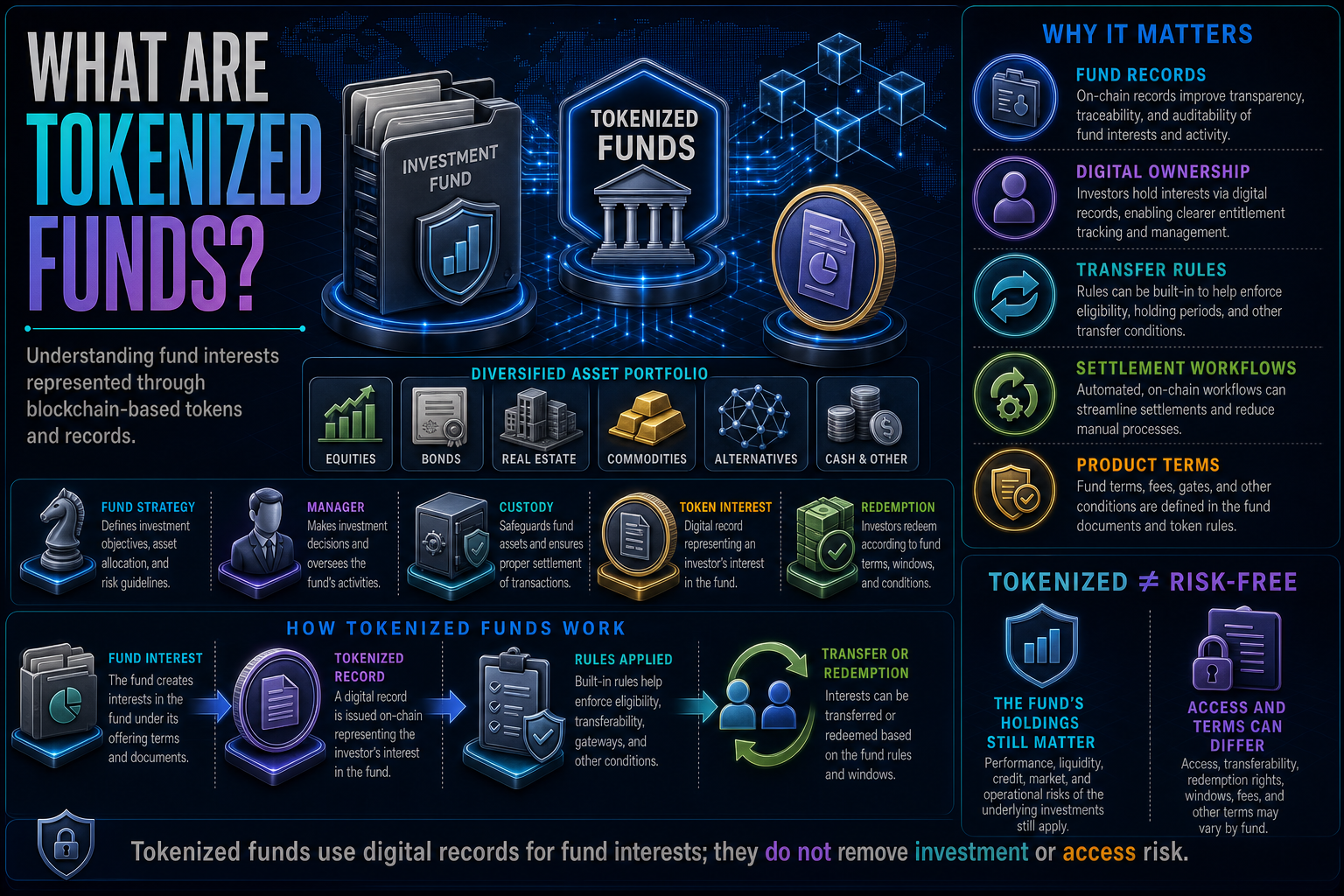
Tokenized funds are investment funds or fund interests represented through digital tokens or blockchain-based records.
Simple definition
A tokenized fund uses digital infrastructure for parts of its ownership, recordkeeping, transfer, or settlement process. The fund itself still has an underlying portfolio, manager, legal documents, and operating terms.
Why tokenized funds matter
They show how blockchain systems can be used within traditional fund administration. Possible benefits can include digital recordkeeping, streamlined distribution, and programmable transfer rules where the structure allows.
How people usually read them
The important question is what the token represents. People often review the fund strategy, the legal rights of token holders, the manager and custodian, eligibility rules, fees, and redemption process.
Why it matters for crypto
Tokenized funds are a bridge between on-chain infrastructure and managed investment products. They can also bring familiar fund risks and restrictions into a blockchain-based environment.
Not a standalone signal
Tokenization does not change the quality of a fund’s underlying investments or remove risk. A tokenized fund may still be subject to market risk, liquidity limits, fees, and investor eligibility requirements.
Example in a market update
If a fund begins issuing ownership records on a blockchain, an update may refer to it as a tokenized fund.
Common signals people watch
- Fund strategy and underlying holdings
- What the token represents
- Fund manager and custodian roles
- Transfer and redemption rules
- Investor access requirements
Tokenization and fund operations
Tokenization may change how a fund records ownership or handles parts of distribution and settlement. It does not replace the fund manager’s investment decisions, the custodian’s role, or the documents that set the product’s rules.
It can also introduce new operational considerations, such as wallet permissions, blockchain compatibility, and transfer controls. These sit alongside the fund’s established market, liquidity, and management risks.
Questions to keep in mind
What does the token represent, what does the fund hold, and what limits apply to transfer or redemption? A clear answer to these questions explains a tokenized fund better than technology alone.
The tokenized layer should be considered alongside the fund’s established structure. Technology can improve administration, but it does not by itself determine the quality, liquidity, or performance of the portfolio.
The same principle applies across products: similar technology can sit on top of very different investment strategies, investor rights, and operating arrangements.
Key takeaway
Tokenized funds use blockchain-based records or tokens for fund interests, while the fund’s underlying strategy and legal terms remain central.
Comments (0)
Join the discussion
Sign in or create a free account to leave a comment.
No comments yet. Be the first to comment!