What Is a Stop-Loss Cascade?
What Is a Stop-Loss Cascade?
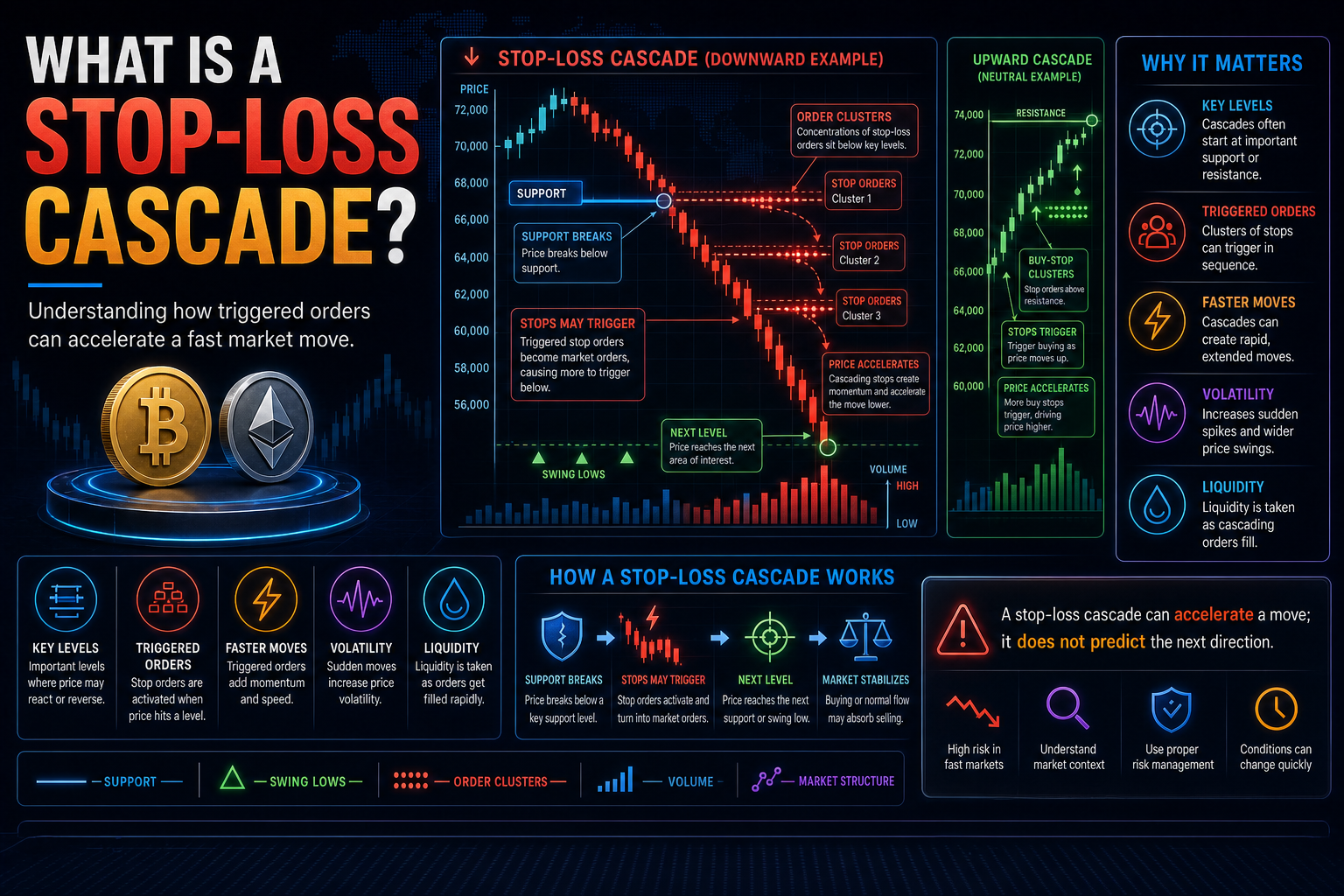
A stop-loss cascade is a rapid price move that can happen when falling or rising prices trigger a series of stop orders. In crypto, the term is commonly used for a sharp decline where one level breaks, triggers more selling, and pushes price toward the next level.
Simple definition
A stop-loss cascade is a chain reaction in which triggered stop orders add to an already fast price move.
When price reaches a level where many protective exit orders may be placed, those orders can become active. If the resulting trades push price into another cluster of orders, the move can accelerate.
Why stop-loss cascades matter
Stop-loss cascades matter because they can help explain why a market suddenly moves much faster than it was moving before. They are often associated with rising volatility, larger candles, and a quick break through visible price levels.
The same general idea can apply in both directions. Falling price may trigger sell stops, while rising price may trigger buy stops or short-covering activity.
How a stop-loss cascade forms
A cascade may begin when price breaks an important support or resistance level. Orders near that level can add new buying or selling pressure, which may carry price to another level where more orders are available.
The move can be stronger when liquidity is thin, the market is already volatile, or many traders are watching the same recent highs and lows.
How traders usually read it
Traders often look at the levels price moved through, the speed of the move, volume, and whether price stabilizes after reaching a new area. Market structure can help show whether the cascade was a temporary acceleration or part of a wider trend.
A rapid move does not always mean a cascade occurred. Price can also move quickly because of a large order, changing liquidity, or a broader shift in market sentiment.
Stop-loss cascade versus liquidation cascade
A stop-loss cascade refers to a chain of triggered stop orders. A liquidation cascade refers to forced position closures in leveraged markets when margin requirements are no longer met.
The two can happen around the same time, but they describe different market mechanics. Both can contribute to sudden volatility and fast price movement.
Why stop-loss cascades matter in crypto
Crypto markets can experience sharp moves around key Bitcoin, Ethereum, and altcoin levels. A stop-loss cascade may be more noticeable when liquidity is limited, volatility is rising, or derivatives activity is adding to the move.
Market updates may use the term to describe a rapid move through several levels, while still noting that the exact mix of orders is not visible from price alone.
Stop-loss cascades are not standalone signals
A stop-loss cascade does not determine where price will move next. It describes a possible mechanism behind a fast move, not a guaranteed continuation or reversal.
It is most useful when read alongside market structure, liquidity, trading volume, volatility, support and resistance, and the wider market environment.
Example in a market update
If Bitcoin falls through a well-watched support level and then drops quickly through several nearby lows, a market update may describe the move as a possible stop-loss cascade.
If Ethereum moves above a recent high and accelerates as short positions close and buy stops trigger, an update may describe it as an upward stop-order cascade.
Common signals traders watch
- A break through a visible support or resistance level
- Large candles and a rapidly widening price range
- Rising trading volume during the move
- Several recent highs or lows close together
- Whether price stabilizes after the move
Key takeaway
A stop-loss cascade is a chain reaction of triggered orders that can accelerate price movement, but it does not predict the next market direction.
Comments (0)
Join the discussion
Sign in or create a free account to leave a comment.
No comments yet. Be the first to comment!