What Is Stablecoin Regulation?
What Does Stablecoin Regulation Mean?
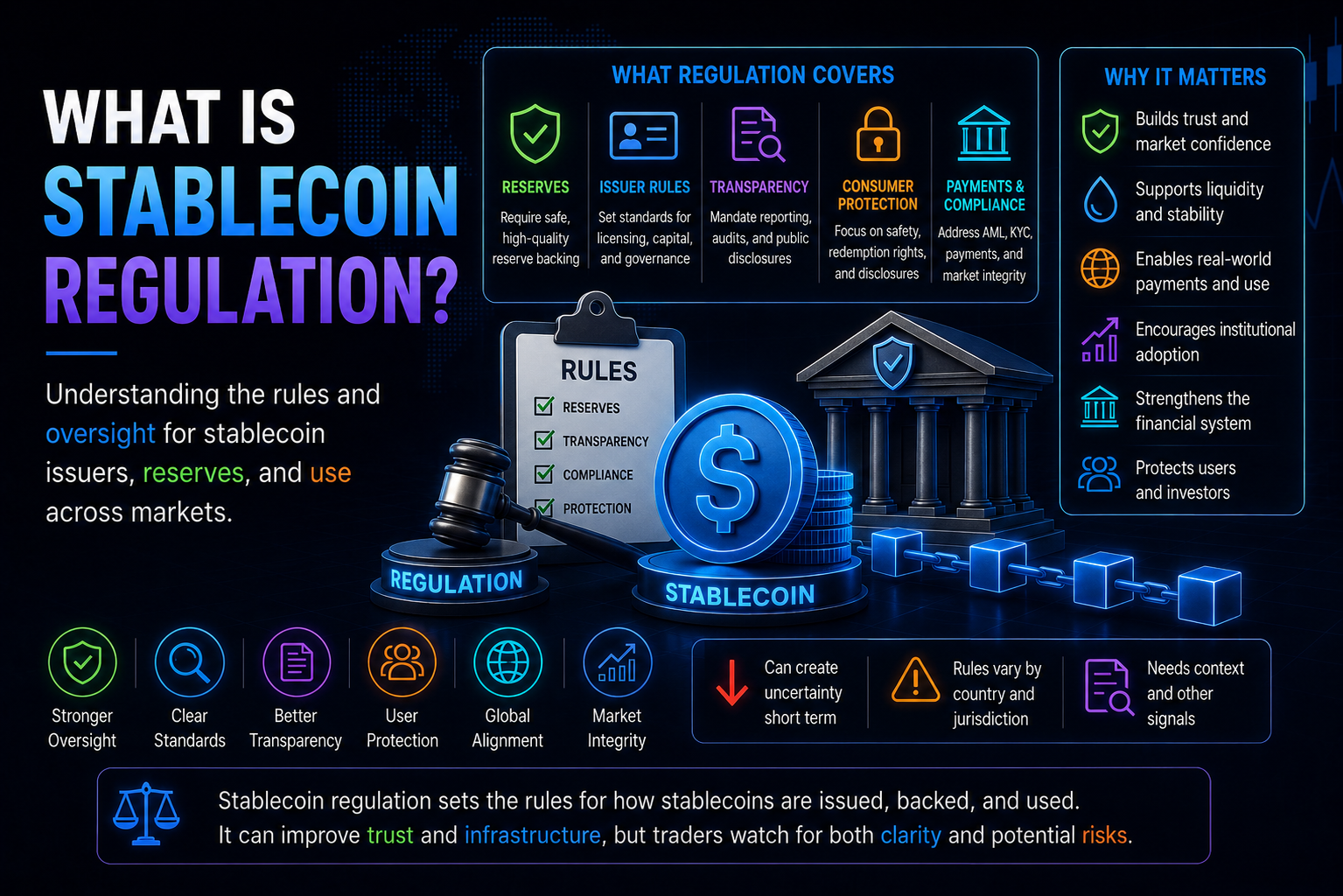
Stablecoin regulation refers to rules and oversight around stablecoins, their issuers, their reserves, and how they can be used. Crypto traders watch stablecoin regulation because stablecoins are closely connected to liquidity, payments, exchanges, market confidence, and broader crypto infrastructure.
Simple definition
Stablecoin regulation means rules that guide how stablecoins are issued, backed, managed, and used.
A stablecoin is a crypto asset designed to hold a steadier value, often by tracking a currency like the U.S. dollar. Regulation may focus on reserve quality, issuer responsibilities, consumer protection, reporting, compliance, payments, and market oversight.
Why stablecoin regulation matters
Stablecoin regulation matters because stablecoins are often used as a bridge between traditional money and crypto markets. They can support trading, payments, settlement, liquidity, and movement between exchanges or platforms.
Clearer rules may improve confidence for some market participants. Unclear or restrictive rules may create uncertainty, slow adoption, or make traders more cautious.
How traders usually read it
Traders usually read stablecoin regulation based on whether it appears to support clarity or create friction. Clear oversight may be read as constructive if it helps institutions, payment companies, or exchanges use stablecoins with more confidence.
At the same time, regulation can be read cautiously if headlines suggest tighter restrictions, enforcement pressure, uncertainty for issuers, or possible changes to how stablecoins operate. The meaning depends on the details and the broader market backdrop.
Why it matters for crypto
Stablecoins matter for crypto because they are widely used in trading, liquidity, transfers, payments, and market infrastructure. When stablecoin rules change or become a major headline, traders may watch how that affects confidence and market access.
Crypto traders may read stablecoin regulation alongside Bitcoin price action, Ethereum activity, ETF flows, liquidity conditions, policy risk, exchange behavior, and overall market sentiment.
Stablecoin regulation is not a standalone signal
Stablecoin regulation should not be used as a standalone price signal. A supportive rule headline does not guarantee stronger crypto prices, and a cautious policy headline does not guarantee weaker prices.
Stablecoin regulation is most useful when read alongside liquidity, payment activity, exchange flows, Bitcoin and Ethereum price action, ETF flows, market structure, and broader policy risk.
Example in a market update
If payment companies are expanding stablecoin settlement options while regulators provide clearer rules, a market update may say stablecoin regulation is helping the infrastructure story.
If stablecoin oversight headlines create uncertainty while Bitcoin is weak and volatility is rising, a market update may say stablecoin regulation is adding policy risk to the crypto tape.
Common signals traders watch
- Whether stablecoin rules are becoming clearer or more uncertain
- Whether stablecoin issuers face new oversight or compliance pressure
- Whether payment companies and institutions continue using stablecoin rails
- Whether stablecoin supply and liquidity are expanding or shrinking
- Whether Bitcoin, Ethereum, and broader sentiment confirm or reject the policy signal
Key takeaway
Stablecoin regulation helps shape how stablecoins are issued, backed, and used, and traders watch it because it can affect liquidity, payments, confidence, and crypto market structure.
Comments (0)
Join the discussion
Sign in or create a free account to leave a comment.
No comments yet. Be the first to comment!