What Are Stablecoin Payment Rails?
What Are Stablecoin Payment Rails?
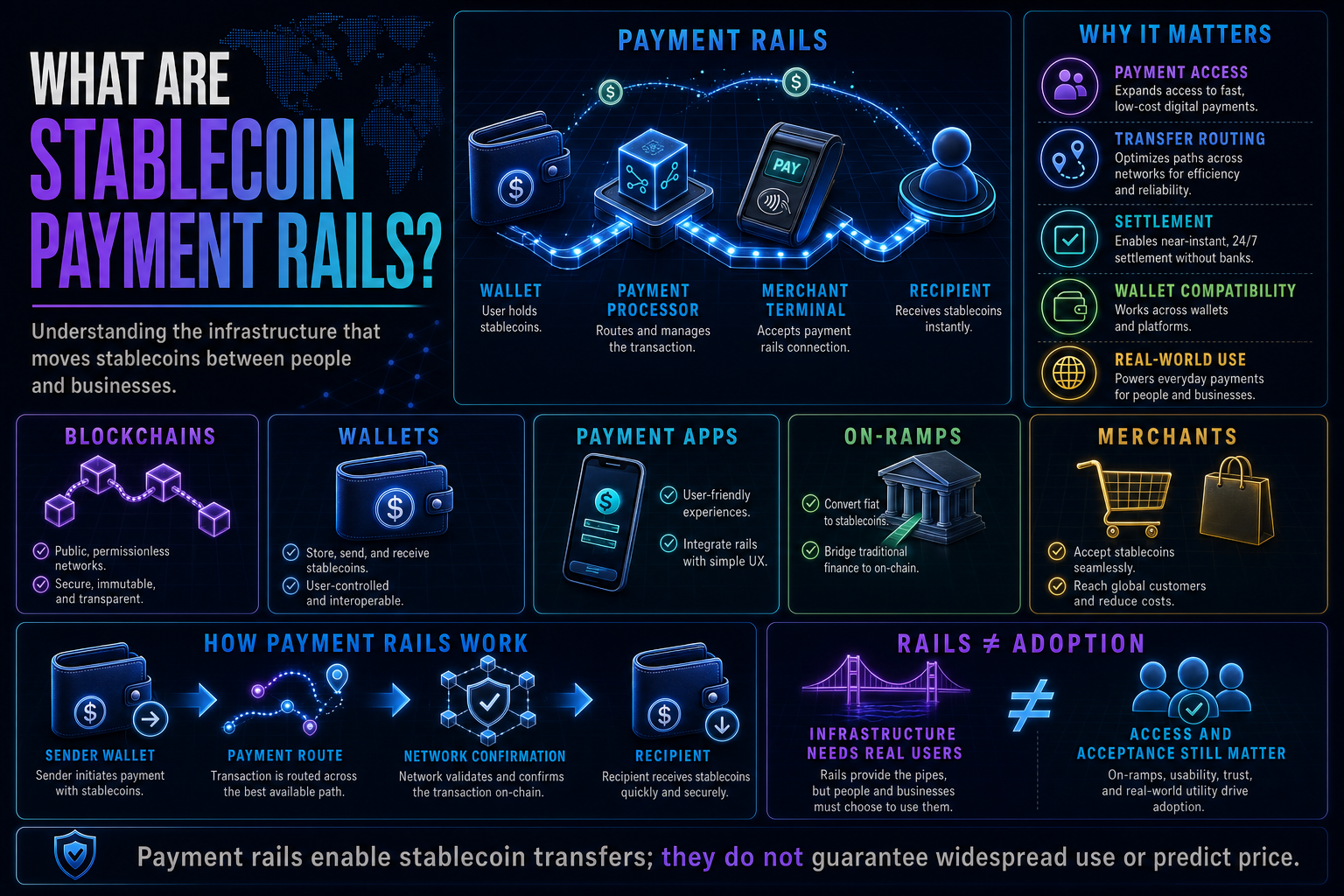
Stablecoin payment rails are the networks, wallets, applications, and services that allow stablecoins to move between people and businesses.
Simple definition
Payment rails are the pathways a payment uses. For stablecoins, they can include blockchains, wallet software, exchange services, payment processors, and on-ramp or off-ramp providers.
Why they matter
The rail affects how a stablecoin payment is initiated, confirmed, received, and converted when needed. Different rails can vary in speed, cost, access, interoperability, and user experience.
How people usually read them
A mature payment rail may have reliable wallet support, useful integrations, and clear settlement processes. But practical use also depends on local access, compliance requirements, stablecoin availability, and the needs of the sender and receiver.
Why it matters for crypto
Payment rails are the infrastructure layer behind stablecoin transfers. They can connect on-chain value with merchants, payroll systems, remittances, exchange settlement, and other applications.
Not a standalone signal
A new rail or integration does not guarantee widespread use. Adoption depends on real users, available liquidity, trust, regulation, and whether the service solves a practical problem.
Example in a market update
If stablecoin transfers are becoming easier across wallets and payment applications, an update may describe the payment infrastructure as expanding.
Common signals people watch
- Wallet and merchant integrations
- Transfer reliability and costs
- Network compatibility
- On-ramp and off-ramp access
- Actual transaction activity
How rails work together
A stablecoin payment commonly uses more than one rail. A sender may use a wallet, a blockchain may record the transfer, and the receiver may use a payment application or service to accept or convert the funds.
Interoperability is therefore important. A technically capable network is less useful if the sender and receiver cannot access compatible wallets, understand the same asset, or use a shared settlement path.
Questions to keep in mind
Can both sides use the same stablecoin and network, how is the transfer confirmed, and what happens if a payment needs support or reversal? Practical payment rails are defined by these real-world details.
Payment rails can therefore be judged by the complete journey, not simply by a transaction appearing on a blockchain. Reliable access, clear status, and recipient usability are equally important.
They should also be evaluated across normal and stressed conditions, because a payment system is only useful when participants can continue to rely on it when activity changes.
Key takeaway
Stablecoin payment rails are the infrastructure that lets stablecoins move, settle, and be used for payments.
Comments (0)
Join the discussion
Sign in or create a free account to leave a comment.
No comments yet. Be the first to comment!