What Is a Stablecoin Issuer?
What Is a Stablecoin Issuer?
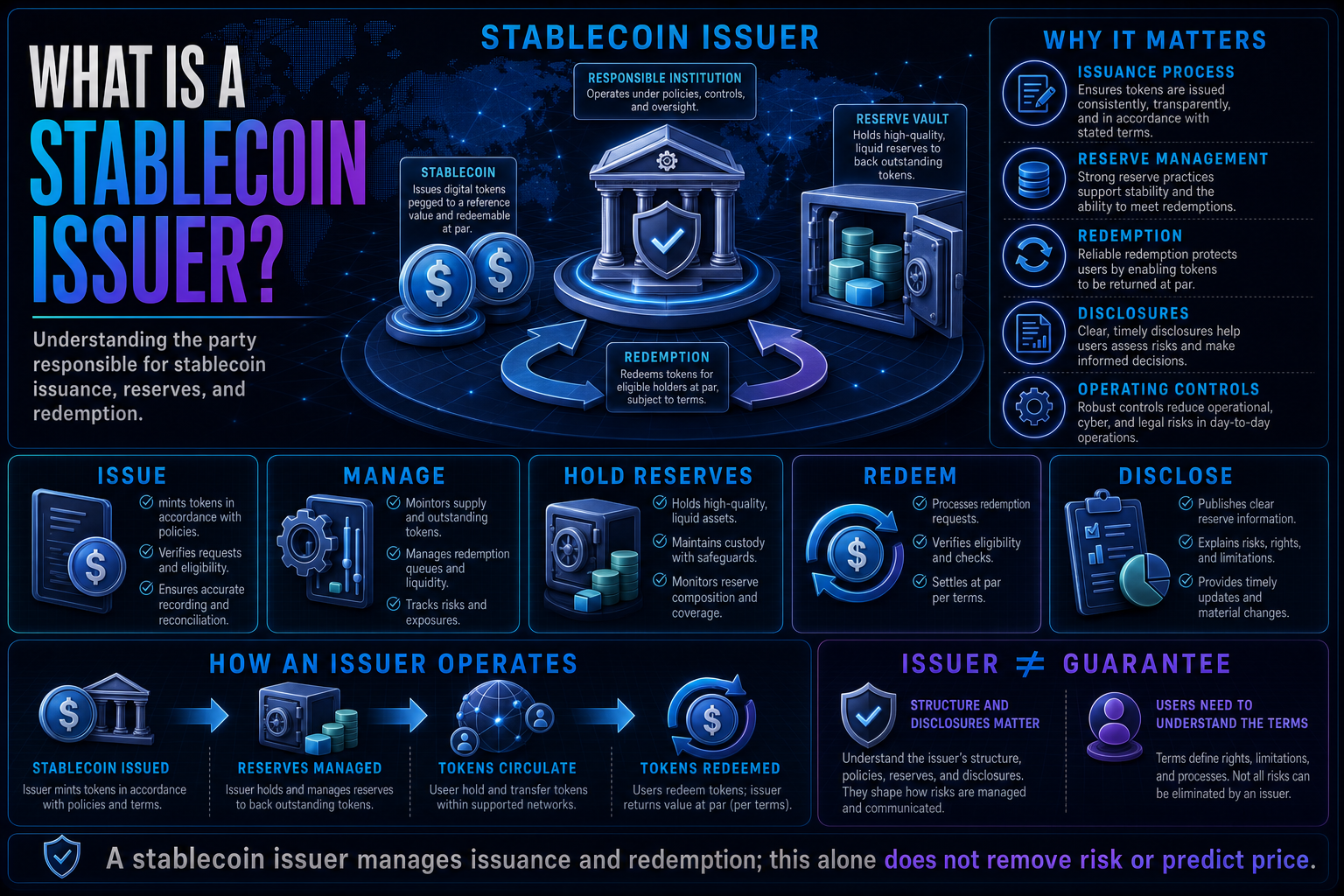
A stablecoin issuer is the organization or arrangement responsible for creating, managing, and supporting a stablecoin.
Simple definition
The issuer may handle the stablecoin’s issuance and redemption process, reserve management, disclosures, operational systems, and relationships with service providers.
Why it matters
A stablecoin’s design is only one part of the picture. The issuer’s policies, reserve approach, redemption process, and operational controls can all affect how users understand and assess the stablecoin.
How people usually read it
People may look at what the issuer says it does, what information it publishes, how redemption works, and which jurisdictions or service providers are involved. These details can differ greatly between stablecoins.
Why it matters for crypto
Stablecoin issuers connect on-chain tokens with reserve assets and real-world operations. They are central to the stablecoin’s ability to issue, redeem, and maintain its intended structure.
Not a standalone signal
Knowing the issuer does not by itself establish safety or suitability. It is one starting point for understanding stablecoin structure and risks.
Example in a market update
If a stablecoin releases updated reserve information or changes its redemption process, an update may identify the issuer as the party responsible for that change.
Common signals people watch
- Issuer disclosures and transparency
- Reserve and custody arrangements
- Issuance and redemption process
- Operational and governance controls
- Applicable oversight framework
Why the issuer relationship matters
For many stablecoins, the issuer is responsible for the link between digital tokens and reserve assets or redemption arrangements. That means the issuer’s processes can affect how tokens enter circulation, how they are removed, and what information users can review.
The issuer may also rely on banks, custodians, auditors, exchanges, and technology providers. Understanding these roles helps show that a stablecoin is an operating system of relationships, not just a token on a blockchain.
Questions to keep in mind
Who issues the token, what does the issuer promise to do, and how is that promise supported by reserves, policies, and disclosures? These are central questions when reading about any issuer.
Clear issuer information helps users understand the roles behind a token. It does not replace the need to read the stablecoin’s terms and consider the limits of the arrangement.
Comparing issuers also requires care because products may use different reserve designs, redemption processes, disclosures, and service relationships even when they appear similar.
Key takeaway
A stablecoin issuer is the party responsible for the stablecoin’s creation, management, reserves, and redemption operations.
Comments (0)
Join the discussion
Sign in or create a free account to leave a comment.
No comments yet. Be the first to comment!