What Does Spot Demand Mean?
What Does Spot Demand Mean?
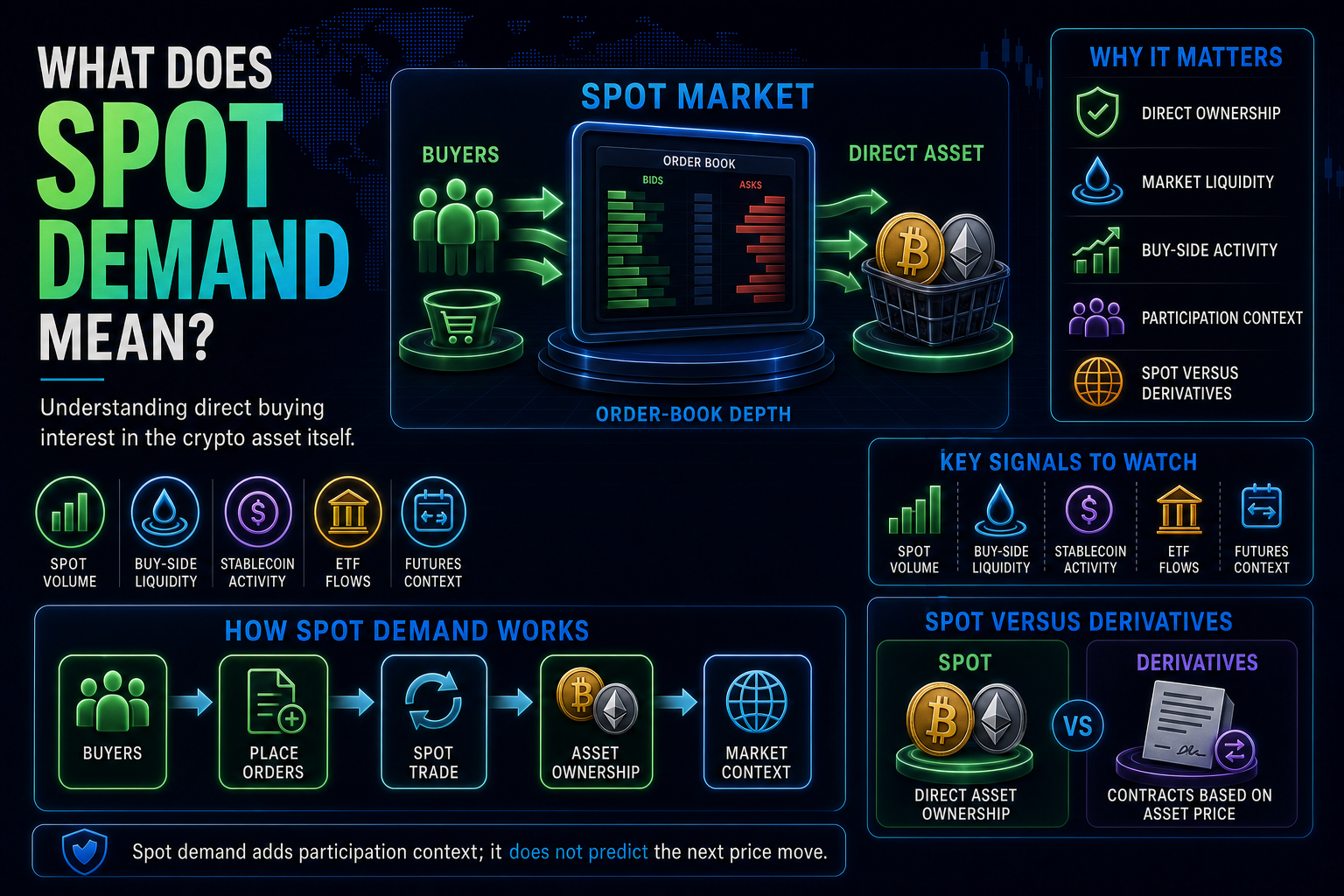
Spot demand describes buying interest for an asset in the spot market, where buyers and sellers trade the asset itself for immediate settlement. In crypto, it refers to demand to buy Bitcoin, Ethereum, or another token directly rather than only gaining exposure through derivatives.
Simple definition
Spot demand is the willingness of buyers to purchase an asset for direct ownership in the spot market.
When a buyer purchases an asset on a spot exchange, the buyer receives the asset and the seller receives payment. This differs from a futures or options contract, which is a derivative linked to the asset rather than the asset itself.
Why spot demand matters
Spot demand matters because it relates to direct buying and selling in the underlying market. Stronger spot participation can help show that market activity is supported by buyers acquiring the asset rather than only traders using leverage or derivatives.
It can also affect how easily orders are absorbed. When demand and liquidity are deeper, larger trades may have less effect on the market price than they would in a thinner market.
How traders usually read it
Traders may look for rising spot volume, improving order-book depth, steady buying across exchanges, or flows into spot-based products as signs of improving spot demand. These signals can show participation, but they do not explain every buyer's motive.
They often compare spot activity with derivatives activity. A market move supported mainly by leveraged futures positions can behave differently from one accompanied by broad direct spot buying.
Spot demand versus derivatives demand
Spot demand involves buying the underlying crypto asset. Derivatives demand involves interest in contracts such as futures, perpetuals, or options that track or reference the asset.
Both can influence market conditions, but they carry different settlement, leverage, and liquidation dynamics. Comparing them can help traders understand where participation is concentrated.
Why it matters for crypto
Spot markets are central to crypto because they are where tokens are exchanged for direct ownership. Bitcoin and Ethereum spot demand can be observed through exchange activity, stablecoin purchasing power, ETF flows, and other measures of direct market participation.
Crypto markets can also be heavily influenced by derivatives. Looking at both spot and derivatives activity can provide a more complete view of liquidity, positioning, and market structure.
Spot demand is not a standalone signal
Strong spot demand does not guarantee that price will rise, and weaker spot demand does not guarantee it will fall. Supply, liquidity, selling activity, derivatives positioning, macro conditions, and sentiment can all change the result.
Spot demand is most useful when read alongside spot volume, order-book depth, stablecoin flows, ETF activity, price structure, and derivatives-market conditions.
Example in a market update
If Bitcoin rises while spot volume and exchange buying activity are also improving, a market update may describe the move as showing firmer spot-demand participation.
If prices move higher while futures open interest rises but spot activity remains limited, an update may note that derivatives positioning appears more active than direct spot demand.
Common signals traders watch
- Spot trading volume across exchanges
- Order-book depth and buy-side liquidity
- Stablecoin balances and purchasing activity
- ETF flows and other spot-based exposure
- Futures open interest relative to spot activity
Key takeaway
Spot demand is direct buying interest in the underlying crypto asset and helps explain how much market participation is taking place outside derivatives.
Comments (0)
Join the discussion
Sign in or create a free account to leave a comment.
No comments yet. Be the first to comment!