What Are Smart Contracts?
What Does Smart Contract Mean?
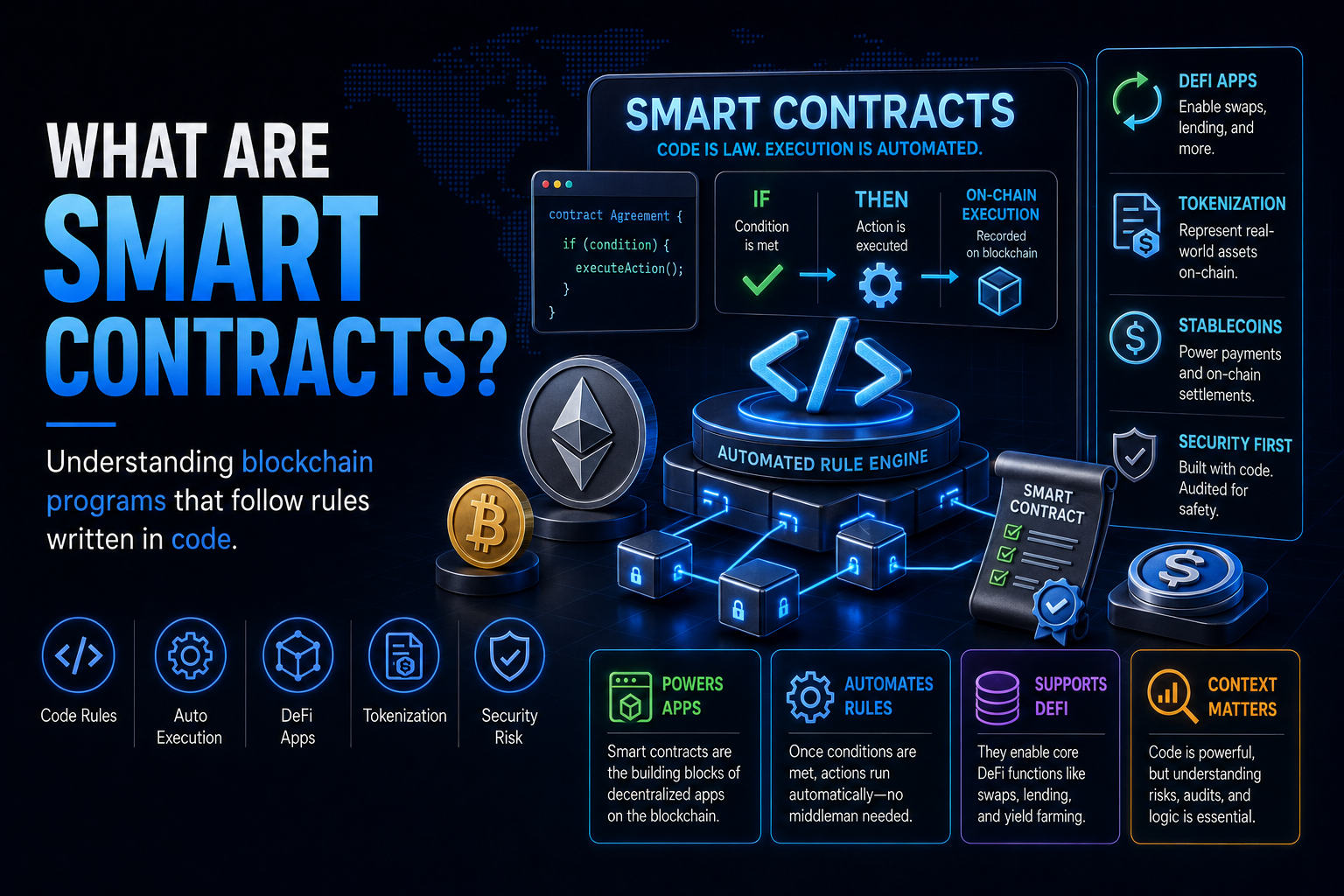
Smart contracts are programs that run on a blockchain and follow rules written into code. Crypto readers watch smart contracts because they power many parts of Ethereum, DeFi, NFTs, tokenization, stablecoins, and broader blockchain activity.
Simple definition
Smart contracts are blockchain-based programs that can automatically perform an action when certain conditions are met.
The name can be confusing because a smart contract is not always a legal contract. In crypto, it usually means code that helps manage transfers, swaps, lending, staking, tokens, or other blockchain actions.
Why smart contracts matter
Smart contracts matter because they allow blockchain apps to run without every action needing a traditional middleman. They can help automate rules, move assets, and create financial tools that operate directly on-chain.
They also matter because errors in smart contract code can create risk. If a contract is poorly designed, exploited, or misunderstood, it can affect users, liquidity, sentiment, and trust in a crypto project.
How traders usually read it
When smart contract activity is growing, traders may read it as a sign that a blockchain ecosystem is being used more actively.
When smart contract risk appears in headlines, traders may become more cautious. The meaning depends on context because smart contracts can signal adoption, but they can also introduce technical and security risk.
Why it matters for crypto
Smart contracts are especially important for Ethereum and many Layer 1 and Layer 2 networks because they support decentralized apps, DeFi platforms, token launches, NFT markets, stablecoin systems, and tokenized assets.
Crypto traders may use smart contract activity as part of a broader market read, especially when it appears alongside network usage, developer activity, liquidity, ETF flows, regulation, security headlines, and market sentiment.
Smart contracts are not a standalone signal
Smart contracts should not be used as a standalone price signal. A project using smart contracts does not automatically mean it is safe, useful, or likely to gain demand.
Smart contract activity is most useful when read alongside security audits, total usage, liquidity, user growth, transaction activity, developer updates, regulation, and broader market structure.
Example in a market update
If Ethereum activity rises and DeFi usage improves, a market update may say smart contract demand is helping support ecosystem attention.
If a protocol faces a smart contract exploit or security concern, a market update may say smart contract risk is weighing on sentiment even if broader crypto prices are stable.
Common signals traders watch
- Whether smart contract activity is increasing or slowing
- Whether Ethereum and other smart contract platforms are gaining usage
- Whether DeFi, stablecoins, NFTs, or tokenized assets are driving demand
- Whether smart contract security headlines are affecting sentiment
- Whether liquidity and market structure support the activity
Key takeaway
Smart contracts help blockchains run automated apps and financial tools, but they should always be read alongside usage, liquidity, security, and broader market context.
Comments (0)
Join the discussion
Sign in or create a free account to leave a comment.
No comments yet. Be the first to comment!