What Is Slippage?
What Does Slippage Mean?
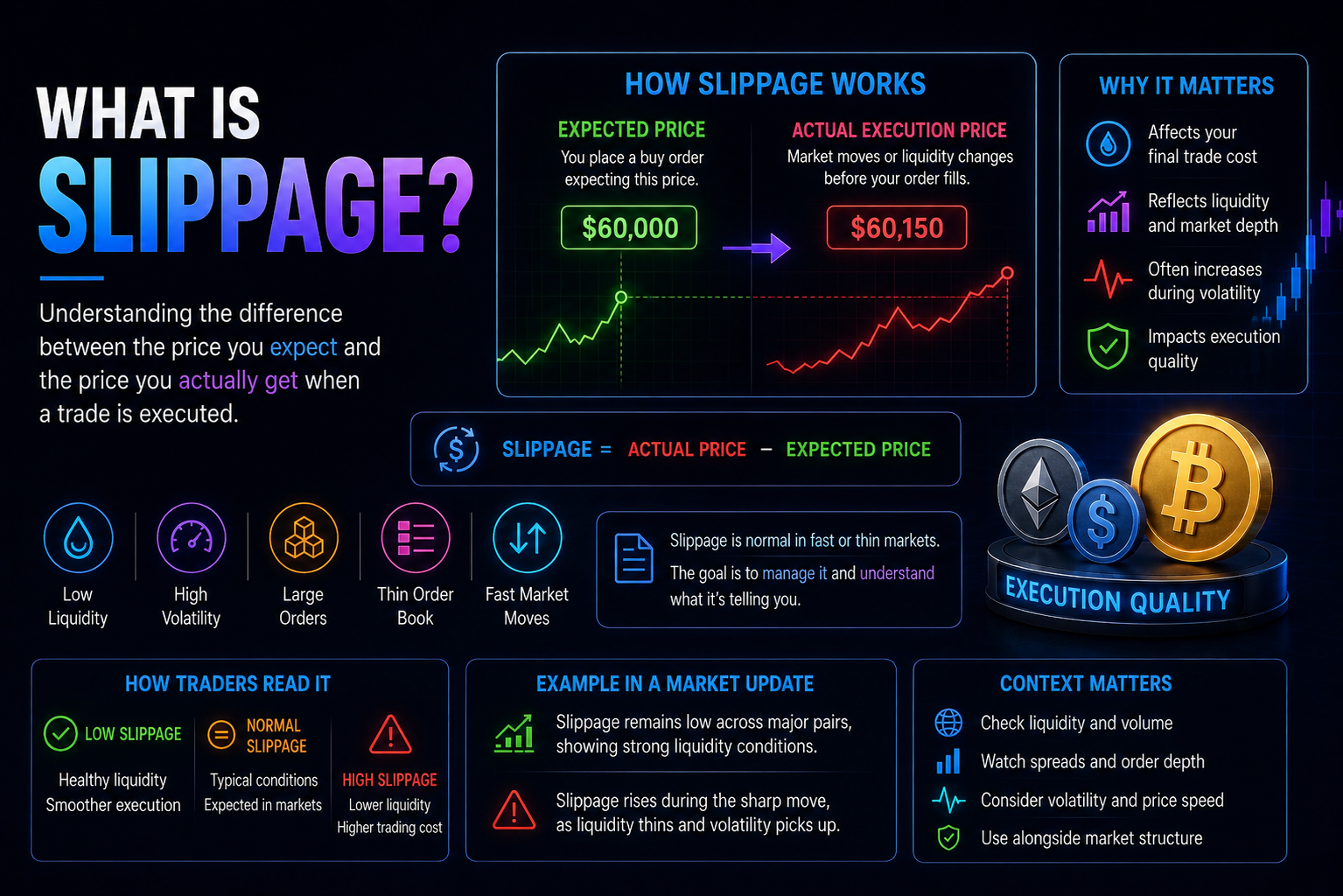
Slippage happens when a trade is executed at a different price than the price a trader expected. Crypto traders watch slippage because it can affect trade costs, liquidity conditions, execution quality, and overall market efficiency.
Slippage can occur in any market, but it is often more noticeable when prices are moving quickly or when liquidity is limited.
Simple definition
Slippage is the difference between the expected trade price and the actual execution price.
A trader may place an order expecting one price, but the market may move or available liquidity may change before the trade is fully completed.
Why slippage matters
Slippage matters because it affects the final cost of entering or exiting a position.
Large amounts of slippage may indicate lower liquidity, higher volatility, or stronger buying and selling pressure in a market.
How traders usually read it
Low slippage is usually viewed as a sign of healthy liquidity and efficient market conditions.
High slippage may suggest that liquidity is thinner or that prices are moving quickly. The meaning depends on context because slippage can rise during both bullish and bearish market moves.
Why it matters for crypto
Crypto markets can experience periods of rapid price movement, which may increase slippage for Bitcoin, Ethereum, and other digital assets.
Crypto traders may monitor slippage alongside liquidity, trading volume, spreads, volatility, and market structure to better understand execution conditions.
How to read slippage in context
Slippage should not be treated as a standalone market signal. High slippage does not automatically mean a market is bullish or bearish.
It is most useful when viewed alongside liquidity, spreads, volume, volatility, order flow, and broader market conditions.
Example in a market update
A market update may note that slippage remains low across major crypto assets, suggesting liquidity conditions are relatively stable.
Another update may mention rising slippage during a sharp market move, indicating that execution conditions have become less efficient as volatility increases.
Common signals traders watch
- Whether slippage is increasing or decreasing
- Available liquidity in the market
- Trading volume and order activity
- Spread size between buyers and sellers
- Overall market volatility and price speed
Key takeaway
Slippage measures the gap between an expected trade price and the actual execution price, making it an important indicator of liquidity and market conditions.
Comments (0)
Join the discussion
Sign in or create a free account to leave a comment.
No comments yet. Be the first to comment!