What Are Settlement Rails?
What Are Settlement Rails?
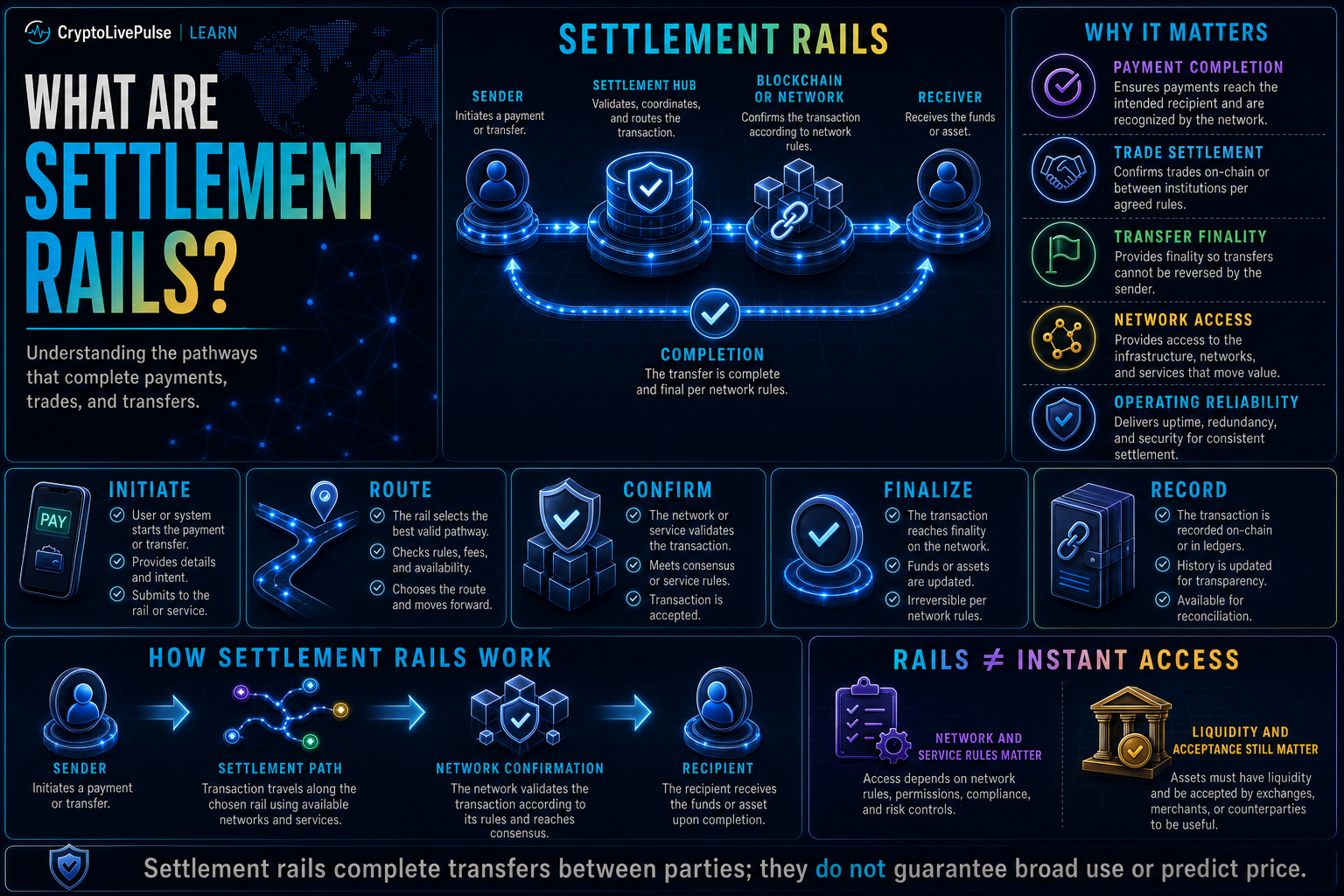
Settlement rails are the networks and processes used to complete a payment, trade, or transfer between parties.
Simple definition
A settlement rail is the path through which value moves from one party to another and is confirmed as complete. It can include traditional payment systems, blockchains, stablecoin networks, and platform-based systems.
Why they matter
The rail affects how a transaction is routed, when it is finalized, what records are produced, and what dependencies exist. Reliable settlement is an important part of payments, trading, and financial operations.
How people usually read them
People compare settlement rails by finality, availability, cost, speed, interoperability, and the practical ability of counterparties to receive the value being transferred.
Why it matters for crypto
Blockchain and stablecoin networks can act as settlement rails for on-chain trades, payments, and transfers. They can connect wallets and applications, but may also introduce network, bridge, custody, and access considerations.
Not a standalone signal
A fast or technically capable rail does not guarantee broad usage. Real-world settlement also depends on liquidity, integrations, compliance, service quality, and the needs of participants.
Example in a market update
If a financial service begins settling activity through a blockchain or stablecoin network, an update may describe that network as a settlement rail.
Common signals people watch
- Confirmation and finality process
- Network reliability and access
- Interoperability with other systems
- Costs and operational limits
- Actual settlement activity
Settlement is a practical process
A settlement rail is more than a technical network. It includes the rules and services that determine when a transfer is treated as complete, how exceptions are handled, and whether the parties can use the received value.
For crypto settlement, technical confirmation may be fast while practical completion still depends on wallet support, asset acceptance, compliance processes, and access to liquidity or conversion services.
Questions to keep in mind
When is the transfer considered final, can both sides use the settlement asset, and what happens if a service is unavailable? These details define the usefulness of a settlement rail.
A settlement rail also creates records that businesses and platforms may need to reconcile. Clear records and reliable completion processes can be as important as the route itself.
This is why settlement design is often assessed through both technical confirmation and the operational steps required before users can treat the transfer as complete.
Key takeaway
Settlement rails are the pathways and processes that complete transfers, payments, and trades between parties.
Comments (0)
Join the discussion
Sign in or create a free account to leave a comment.
No comments yet. Be the first to comment!