What Is Sector Rotation?
What Does Sector Rotation Mean?
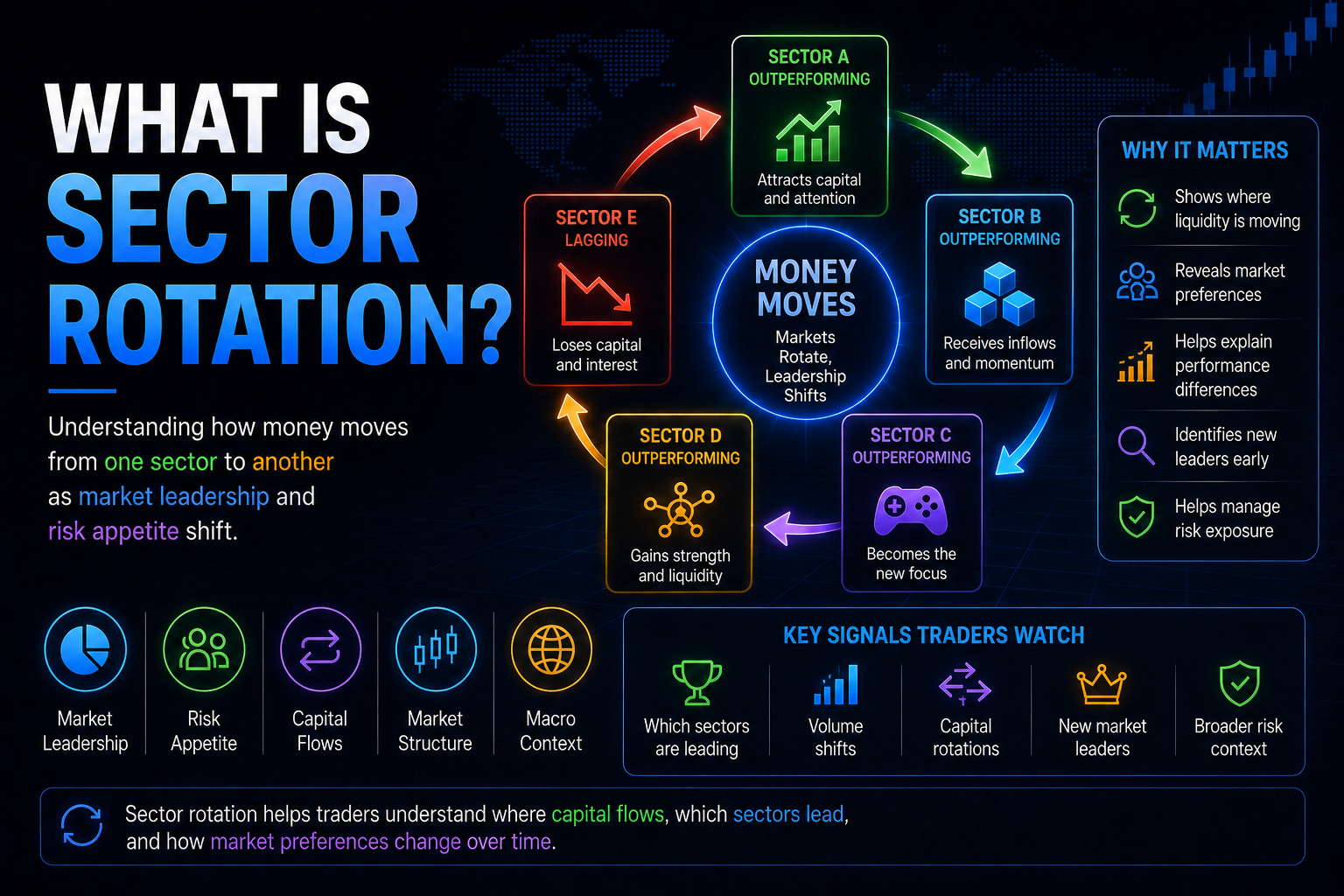
Sector rotation describes money moving from one part of the market to another. Traders watch sector rotation because it can reveal changing preferences, risk appetite, liquidity flows, and market leadership.
In crypto and traditional markets, prices may not move evenly. Sometimes one group of assets attracts attention while another group slows down, and sector rotation helps explain that shift.
Simple definition
Sector rotation means capital moving from one market sector into another.
A sector is simply a group of related assets. In crypto, examples may include Bitcoin, Ethereum, AI tokens, gaming tokens, infrastructure projects, or other categories that traders follow.
Why sector rotation matters
Sector rotation matters because it helps explain where liquidity and investor attention are moving.
A market may appear mixed on the surface, but sector rotation can reveal that money is not leaving the market entirely. Instead, it may be shifting from one area into another.
How traders usually read it
Traders often view sector rotation as a sign that market participants are actively repositioning capital.
The interpretation depends on context. Rotation into higher-risk sectors may suggest stronger risk appetite, while rotation toward larger and more established assets may suggest a more defensive approach.
Why it matters for crypto
Crypto markets often experience visible sector rotation because liquidity can move quickly between Bitcoin, Ethereum, and different groups of altcoins.
Crypto traders may watch sector rotation to understand whether market leadership is shifting, whether liquidity is broadening across the market, or whether capital is concentrating in a smaller group of assets.
How to read sector rotation in context
Sector rotation should not be treated as a standalone market signal. Money moving into one sector does not automatically mean that trend will continue.
It is most useful when read alongside price action, volume, liquidity conditions, Bitcoin dominance, sentiment, ETF flows, and broader market structure.
Example in a market update
A market update may note that sector rotation is favoring Bitcoin while many altcoins remain quiet, suggesting capital is concentrating in larger assets.
Another update may report sector rotation into selected altcoin categories while Bitcoin trades sideways, suggesting liquidity is spreading into different parts of the market.
Common signals traders watch
- Which sectors are attracting the strongest price performance
- Whether trading volume is increasing in a specific sector
- Whether liquidity is broadening or concentrating
- Whether Bitcoin or Ethereum are leading market activity
- Whether sentiment is shifting toward different asset groups
Key takeaway
Sector rotation helps traders understand where capital, liquidity, and market attention are moving across different groups of assets.
Comments (0)
Join the discussion
Sign in or create a free account to leave a comment.
No comments yet. Be the first to comment!