What Is the Russell 2000?
What Does Russell 2000 Mean?
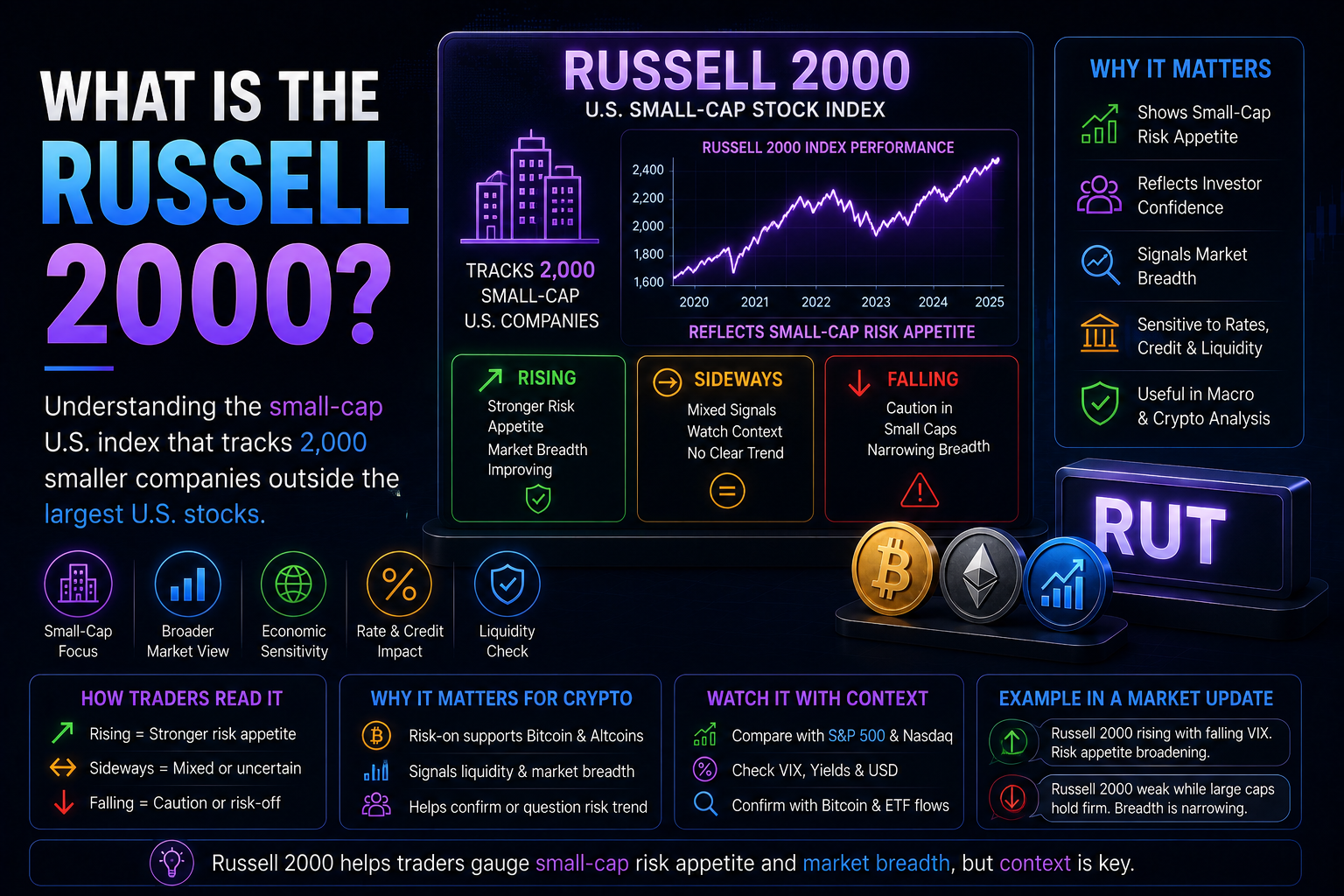
Russell 2000 usually refers to a U.S. stock market index that tracks smaller public companies. Crypto readers watch the Russell 2000 because it can help show risk appetite, liquidity conditions, investor confidence, and how smaller, more sensitive parts of the stock market are reacting.
Simple definition
The Russell 2000 is a stock market index that tracks many small-cap U.S. companies.
Small-cap means smaller public companies compared with large companies in major indexes like the S&P 500 or Dow Jones. When people say “small caps are moving,” they may be talking about the Russell 2000.
Why Russell 2000 matters
Russell 2000 matters because small-cap stocks can be more sensitive to changes in growth expectations, interest rates, financing conditions, and investor confidence.
When the Russell 2000 is strong, traders may read it as a sign that risk appetite is broadening beyond large companies. When it is weak, traders may see caution under the surface even if large-cap indexes look firm.
How traders usually read it
A rising Russell 2000 usually suggests stronger appetite for smaller and more economically sensitive stocks.
A falling Russell 2000 usually suggests more caution toward smaller companies or weaker market breadth. The meaning depends on context because small caps can react strongly to rates, credit conditions, earnings expectations, liquidity, and broader market sentiment.
Why it matters for crypto
Crypto traders may watch the Russell 2000 because Bitcoin, Ethereum, and altcoins can also be sensitive to risk appetite and liquidity. If small caps are strong, traders may see a more supportive backdrop for risk assets, though crypto does not always move the same way.
The Russell 2000 can be useful in a broader market read alongside SPY, Nasdaq, Dow Jones, VIX, Treasury yields, the U.S. dollar, ETF flows, liquidity, and market sentiment.
Russell 2000 is not a standalone signal
Russell 2000 should not be used as a standalone crypto signal. A stronger small-cap index does not guarantee stronger Bitcoin or altcoins, and a weaker index does not guarantee weaker crypto.
Russell 2000 is most useful when read alongside larger stock indexes, volatility, Treasury yields, the U.S. dollar, liquidity, ETF flows, Bitcoin dominance, and broader market structure.
Example in a market update
If the Russell 2000 rises while VIX falls and Bitcoin holds steady, a market update may say risk appetite is broadening across markets.
If the Russell 2000 falls while large-cap indexes stay firm, a market update may say market breadth is uneven and traders are watching whether risk appetite is narrowing.
Common signals traders watch
- Whether the Russell 2000 is rising, falling, or moving sideways
- Whether small caps are outperforming or lagging large-cap indexes
- Whether VIX is rising or falling at the same time
- Whether Treasury yields and the U.S. dollar are helping or pressuring risk assets
- Whether Bitcoin, Ethereum, and altcoins confirm or ignore the small-cap signal
Key takeaway
Russell 2000 helps traders read small-cap risk appetite and market breadth, but crypto traders should compare it with volatility, yields, liquidity, sentiment, and Bitcoin market structure.
Comments (0)
Join the discussion
Sign in or create a free account to leave a comment.
No comments yet. Be the first to comment!