What Is Risk Sentiment?
What Is Risk Sentiment?
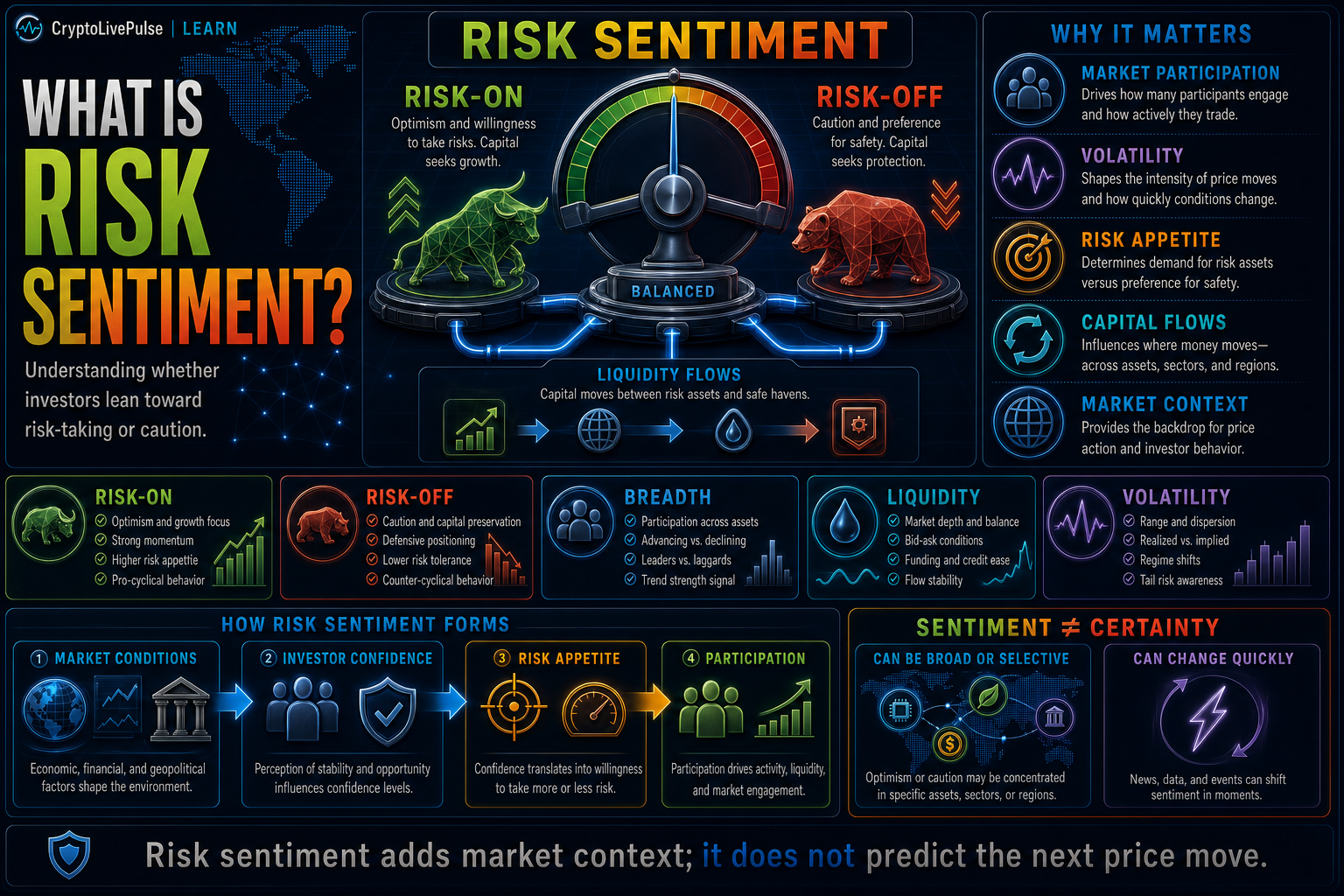
Risk Sentiment is the general willingness of investors to hold assets that may offer greater potential return but also carry greater uncertainty or volatility.
Simple definition
It is a macro term used to explain the environment around markets. The term provides context, but it does not tell the whole story about a particular crypto asset, project, or price move.
Why risk sentiment matters
Risk sentiment helps describe whether markets are leaning toward confidence and risk-taking or toward caution and capital preservation. It can influence participation across crypto, equities, credit, and other markets.
Macro terms are useful because crypto markets are part of a wider financial system. Broader conditions can influence liquidity, capital flows, sentiment, and how participants respond to crypto-specific developments.
How traders usually read it
Improving risk sentiment is often associated with broader willingness to take exposure, while weaker sentiment may be associated with more selective or defensive positioning. These are tendencies, not direct forecasts.
What can change the reading
Sentiment can change with liquidity, rates, economic data, policy developments, market volatility, and major asset performance. It can also differ across sectors at the same time.
The same macro development may have different effects depending on positioning, liquidity, timing, and what markets already expect. Looking at several related indicators is more useful than relying on one headline.
Why it matters for crypto
Crypto participants may compare macro conditions with market liquidity, stablecoin activity, Bitcoin and Ethereum performance, volatility, and broader participation. This helps distinguish a crypto-specific move from a change in the wider market environment.
Risk Sentiment is not a standalone signal
Risk Sentiment does not guarantee that crypto will rise or fall. It is a framework for understanding conditions and potential influences, not a prediction or an instruction to take a particular action.
Example in a market update
If participation broadens across higher-volatility assets, an update may describe risk sentiment as improving.
Common signals people watch
- Market breadth
- Volatility
- Credit and liquidity conditions
- Currency trends
- Relative performance of risk assets
Questions to keep in mind
What is changing, why is it changing, and does the broader market evidence support the same reading? These questions help put risk sentiment into useful context without treating it as a forecast.
Risk sentiment can be broad or selective. Participation may improve in one part of the market while investors remain cautious about other assets or sectors.
Key takeaway
Risk sentiment describes the market’s general appetite for risk-taking versus caution.
Comments (0)
Join the discussion
Sign in or create a free account to leave a comment.
No comments yet. Be the first to comment!