What Is a Risk Reward Ratio?
What Is a Risk Reward Ratio?
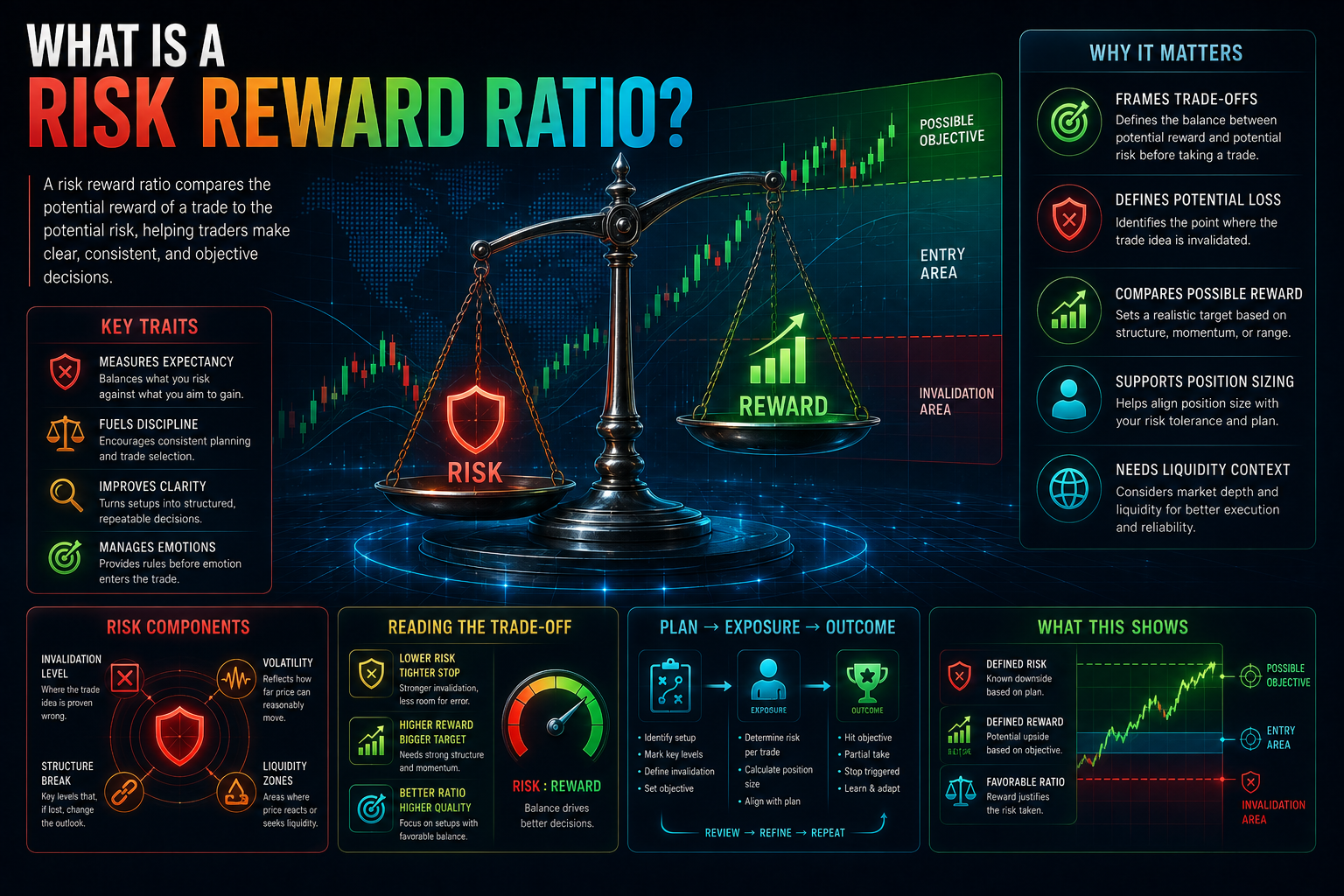
A risk reward ratio compares a planned downside with a possible upside before taking market exposure. It is a way to frame a trade-off, rather than a prediction about where price will go.
Simple definition
The risk side is the amount a person may be willing to lose if an idea is invalidated. The reward side is the potential gain if the idea works as expected. The ratio compares those two planned amounts.
Why a risk reward ratio matters
Markets are uncertain, and focusing only on possible upside can hide the downside. Thinking about risk and reward before entering a position can encourage clearer assumptions about price levels, exposure, and what would make the original idea no longer valid.
The ratio is only one part of the picture. A large possible reward does not make an idea safer, and a favorable-looking ratio does not tell anyone how likely the outcome is.
How markets usually read it
The ratio is generally used as a planning tool before a trade or allocation decision. Participants may compare the planned entry, invalidation level, possible objective, position size, and available liquidity. Those details help show whether a trade-off is realistic under current market conditions.
Why it matters for crypto
Crypto can move quickly, trade around the clock, and experience uneven liquidity. Slippage, fees, leverage, liquidations, and rapid volatility can make the actual outcome different from the planned one. A ratio can organize an idea, but it cannot control execution or market conditions.
A risk reward ratio is not a standalone signal
A ratio does not predict market direction, estimate the probability of success, or replace research. It is most useful alongside market structure, liquidity, volatility, position sizing, and an understanding of the asset being traded.
Common signals people watch
- The planned downside if the original idea is invalidated
- The possible upside and whether it is realistic
- Liquidity, spreads, fees, and expected slippage
- How leverage changes the size of potential gains and losses
- Whether the position size fits the planned risk
Reading the wider context
A trade-off that appears balanced on a chart may behave differently during fast or stressed conditions. An exit can be harder to execute when market depth falls, and leverage can magnify a move before a plan can be adjusted.
For that reason, traders commonly compare the ratio with volatility, time horizon, liquidity, and their broader exposure. Context helps turn a simple comparison into a more realistic view of uncertainty.
Key takeaway
A risk reward ratio compares a possible loss with a possible gain. It supports disciplined planning, but it does not predict prices or guarantee an outcome.
Comments (0)
Join the discussion
Sign in or create a free account to leave a comment.
No comments yet. Be the first to comment!