What Does Risk-On and Risk-Off Mean?
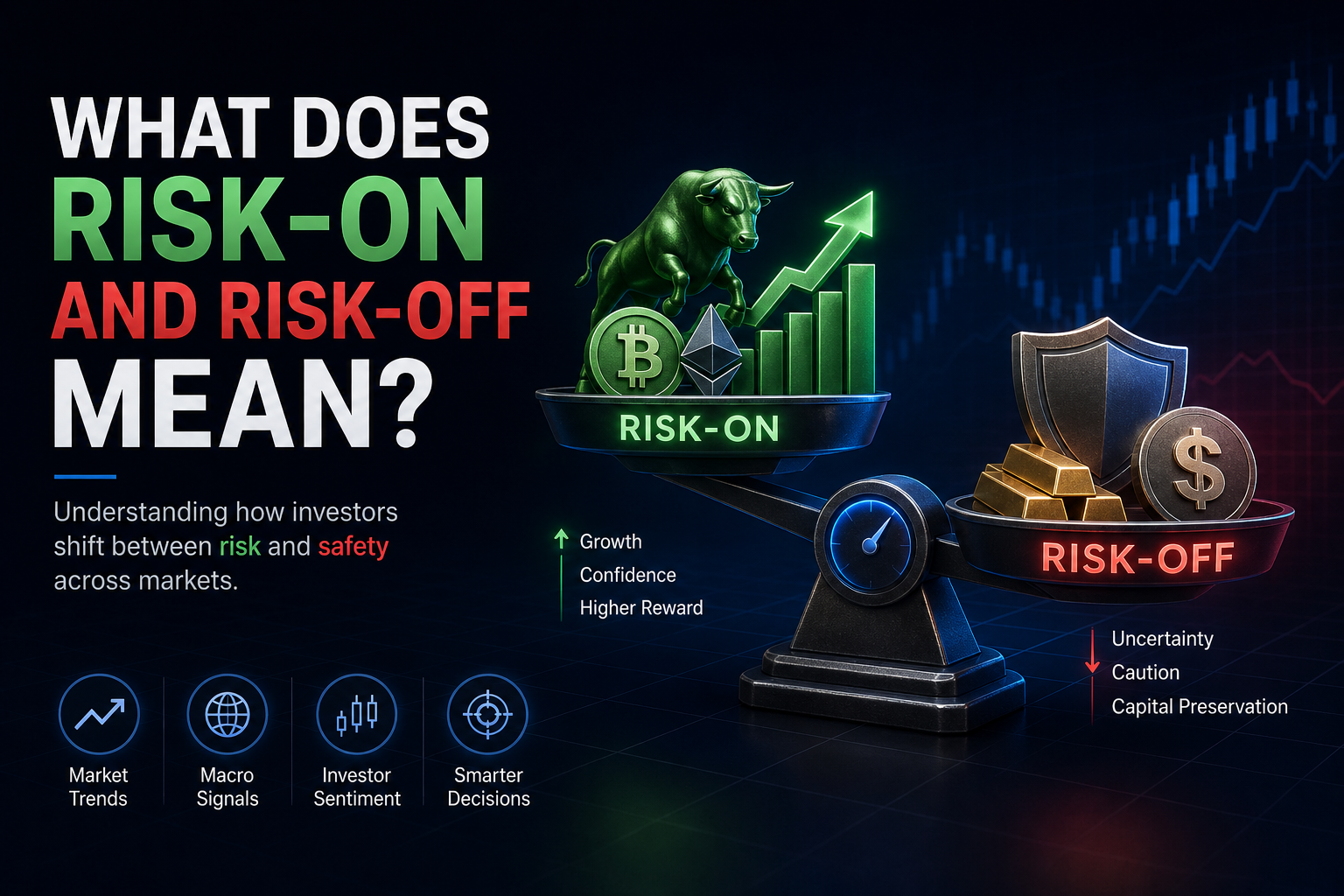
What Is Risk-On Risk-Off?
Risk-on and risk-off are market terms used to describe how investors are behaving. In a risk-on environment, investors are more willing to buy assets that can move higher but also carry more risk. In a risk-off environment, investors usually become more cautious and move toward safer assets.
Simple definition
Risk-on means investors are more comfortable taking risk.
Risk-off means investors are trying to reduce risk.
These terms are not only used in crypto. They are also used across stocks, bonds, currencies, commodities, and global markets.
What risk-on usually looks like
A risk-on market usually happens when investors feel more confident about growth, liquidity, interest rates, earnings, or the broader economy.
In a risk-on environment, assets like stocks, Bitcoin, Ethereum, altcoins, and other higher-risk markets may perform better because investors are more willing to seek upside.
What risk-off usually looks like
A risk-off market usually happens when investors become more worried about inflation, interest rates, recession risk, policy uncertainty, geopolitical tension, or financial stress.
In a risk-off environment, investors may reduce exposure to volatile assets and move toward cash, government bonds, the U.S. dollar, or other defensive positions.
Why risk-on and risk-off matter for crypto
Crypto often reacts strongly to changes in risk appetite. When investors feel comfortable taking risk, Bitcoin and other crypto assets may attract more demand.
When investors become cautious, crypto can face pressure because it is still treated by many market participants as a higher-risk asset class.
Risk-on does not mean everything goes up
A risk-on market does not guarantee that every crypto asset will rise. Sometimes Bitcoin leads while altcoins lag. Other times, stocks may rise while crypto stays range-bound.
This is why traders usually look at several signals together, including Bitcoin dominance, ETF flows, volume, liquidity, yields, and market sentiment.
Risk-off does not mean everything crashes
A risk-off market also does not mean prices must fall sharply. Sometimes risk-off conditions lead to slower trading, lower volume, or sideways price action instead of a major drop.
The important question is whether buyers are still willing to step in when uncertainty rises.
Common risk-on signals
- Stocks moving higher
- Volatility falling
- Yields easing when markets see it as supportive
- Bitcoin holding or moving higher
- ETF inflows improving
- Altcoins participating beyond Bitcoin
Common risk-off signals
- Stocks selling off
- Volatility rising
- The U.S. dollar strengthening sharply
- Yields rising in a way that pressures risk assets
- Bitcoin losing key support levels
- Investors moving away from higher-risk assets
Example in a market update
If Bitcoin is rising, stocks are higher, volatility is falling, and ETF inflows are improving, analysts may describe the market as risk-on.
If Bitcoin is falling, volatility is rising, and investors are moving toward defensive assets, analysts may describe the market as risk-off.
Key takeaway
Risk-on and risk-off describe whether investors are leaning toward risk or caution, and these shifts can strongly influence crypto market direction.
Comments (0)
Join the discussion
Sign in or create a free account to leave a comment.
No comments yet. Be the first to comment!