What Is Risk Control?
What Is Risk Control?
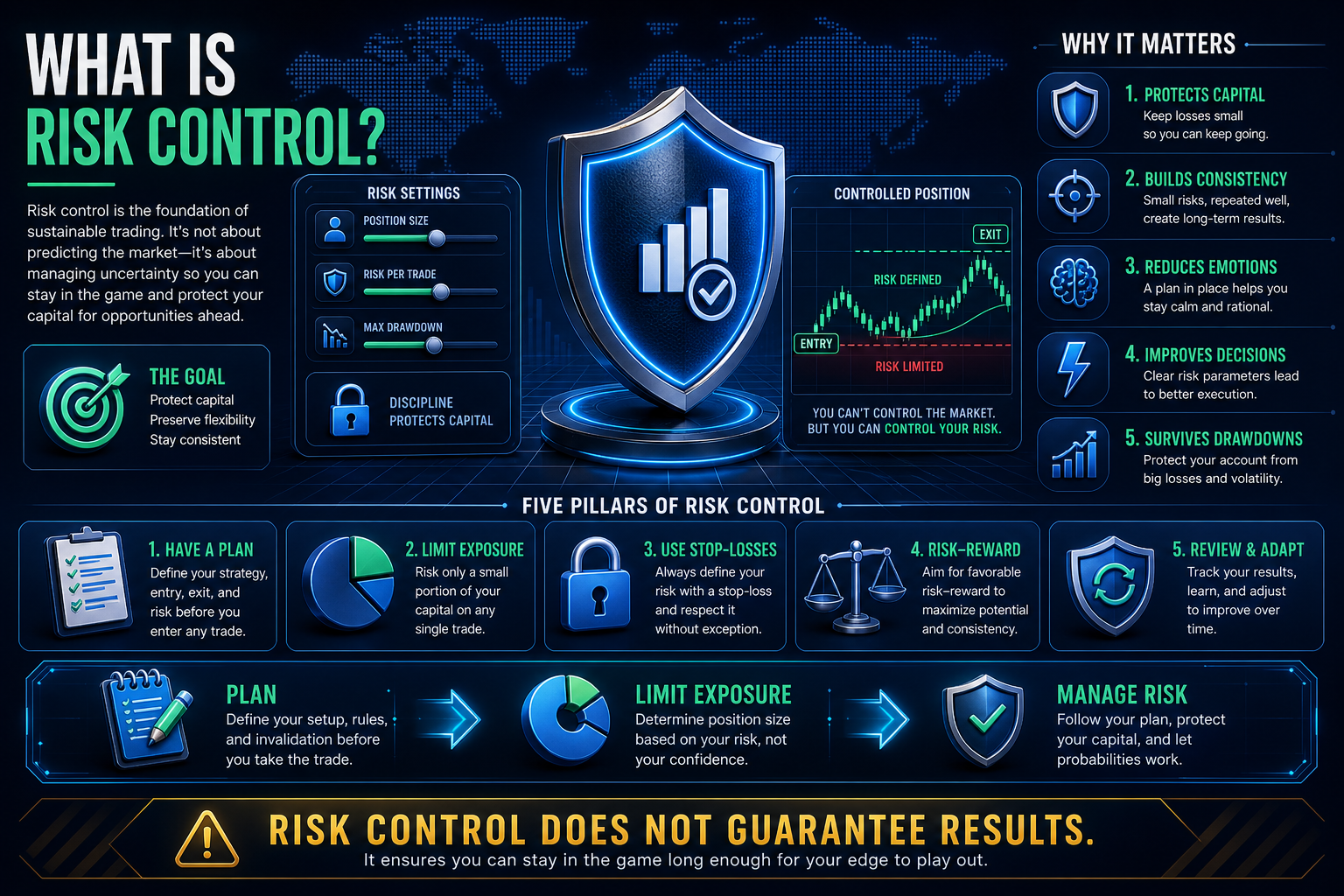
Risk control is the process of limiting how much damage an unfavorable market move, operational problem, or unexpected event can cause. In crypto, it helps participants manage uncertainty rather than assume every trade or investment will work.
Simple definition
Risk control means setting boundaries before taking exposure. These boundaries can relate to position size, leverage, liquidity, custody, diversification, or the conditions that would cause someone to reassess a decision.
Why risk control matters
Markets are uncertain, and crypto can be especially volatile. A sound idea can still lose value in the short term. Risk control aims to make a setback manageable so that one event, error, or rapid move does not determine the whole outcome.
How it is usually applied
Participants may decide how much capital to place at risk, avoid excessive leverage, use liquid markets, and keep assets secure. The appropriate approach differs by goal, timeframe, experience, and financial circumstances; no single rule suits everyone.
Why it matters for crypto
Crypto markets can operate continuously, experience sudden gaps in liquidity, and use leveraged products. Risk control also includes non-price risks such as smart-contract exposure, platform risk, private-key security, and stablecoin risk.
Risk control is not a prediction tool
Risk control cannot remove risk or guarantee an outcome. It is a framework for responding to uncertainty. It works best when the plan is realistic, understood beforehand, and reviewed as conditions change.
Common elements people consider
- Position size and concentration
- Leverage and liquidation exposure
- Liquidity and exit flexibility
- Custody and platform security
- Time horizon and downside tolerance
Putting it in context
Risk control is most useful before a stressful move occurs, because decisions made in advance can be less influenced by panic or excitement. It should be reviewed when position size, liquidity, volatility, or the underlying thesis changes. The goal is consistency and awareness of trade-offs, not eliminating uncertainty entirely.
Key takeaway
No single tool captures every source of uncertainty. Combining market, liquidity, security, and operational considerations can give a more complete picture of potential exposure.
For that reason, the process is usually ongoing rather than a single decision. Conditions, exposure, and available information can change. Being clear about the limits of a plan can support more deliberate choices when markets become volatile or uncertain.
Risk control is about managing potential losses and operational risks before they become unmanageable. It does not predict prices or guarantee results.
Comments (0)
Join the discussion
Sign in or create a free account to leave a comment.
No comments yet. Be the first to comment!