What Is Risk Capital?
What Does Risk Capital Mean?
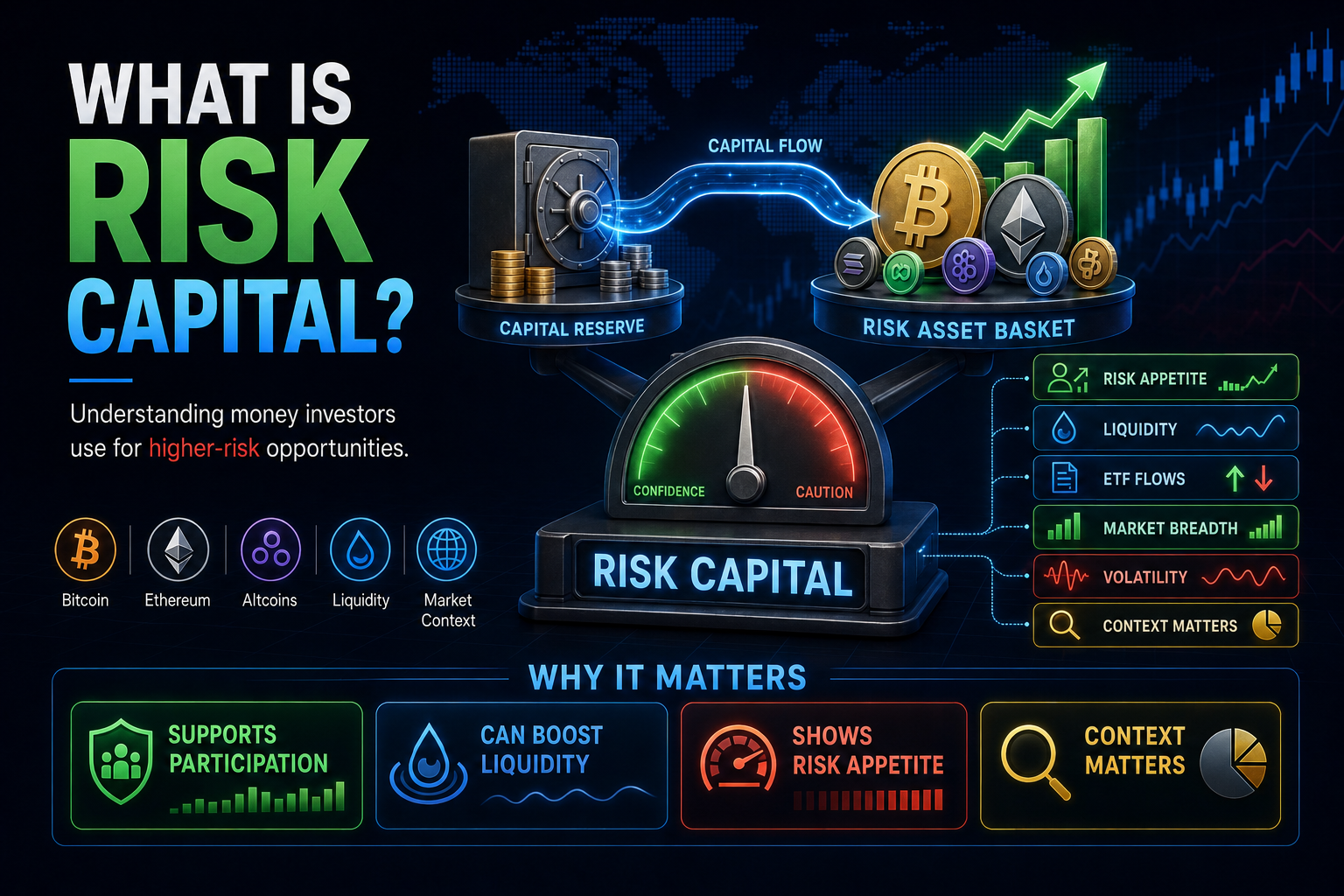
Risk capital is money that traders or investors are willing to put into assets with higher uncertainty. Crypto readers watch risk capital because it can affect Bitcoin, Ethereum, altcoins, ETF flows, liquidity, sentiment, and broader market behavior.
Simple definition
Risk capital means money that is available for higher-risk opportunities, with the understanding that losses are possible.
In market updates, the term usually describes how willing investors are to move money into risk assets instead of staying defensive or holding safer assets.
Why risk capital matters
Risk capital matters because many markets depend on whether investors feel comfortable taking risk. When risk capital is active, traders may be more willing to buy growth assets, crypto, equities, or newer market themes.
When risk capital is cautious, traders may reduce exposure, avoid weaker assets, or wait for clearer confirmation. This can affect liquidity, market breadth, volatility, and how strongly a rally spreads beyond the largest assets.
How traders usually read it
Active risk capital usually suggests traders are more willing to take risk. That can support stronger participation across Bitcoin, Ethereum, altcoins, equities, or other risk assets.
Weak or cautious risk capital usually suggests a more defensive market. The meaning depends on context because money can stay concentrated in a few stronger assets while the broader market remains selective.
Why it matters for crypto
Crypto can be sensitive to risk capital because Bitcoin, Ethereum, and altcoins often react when investors become more confident or more cautious. When risk appetite improves, more money may move into crypto themes, ETF flows, and higher-beta assets.
Crypto traders may use risk capital as part of a broader market read. They may compare Bitcoin strength, BTC dominance, ETF flows, liquidity, VIX, Treasury yields, the U.S. dollar, and market sentiment to see whether risk-taking is broad or narrow.
Risk capital is not a standalone signal
Risk capital should not be used as a standalone price signal. More willingness to take risk does not guarantee higher crypto prices, and cautious risk capital does not guarantee lower prices.
It is most useful when read alongside price action, volume, volatility, ETF flows, liquidity, macro signals, regulation, Bitcoin dominance, and market structure.
Example in a market update
If Bitcoin is holding firm, equities are rising, VIX is falling, and altcoins are participating, a market update may say risk capital is returning to the crypto market.
If Bitcoin is stable but altcoins are weak, VIX is rising, and policy headlines are weighing on sentiment, a market update may say risk capital remains selective.
Common signals traders watch
- Whether Bitcoin and Ethereum are attracting steady demand
- Whether altcoins are participating or lagging
- Whether ETF flows and liquidity are supportive or weak
- Whether VIX, yields, and the U.S. dollar are helping or pressuring risk assets
- Whether market breadth shows broad participation or narrow strength
Key takeaway
Risk capital helps explain how willing investors are to take risk, and that willingness can shape crypto liquidity, sentiment, volatility, and market participation.
Comments (0)
Join the discussion
Sign in or create a free account to leave a comment.
No comments yet. Be the first to comment!