What Does a Reversal Signal Mean?
What Does a Reversal Signal Mean?
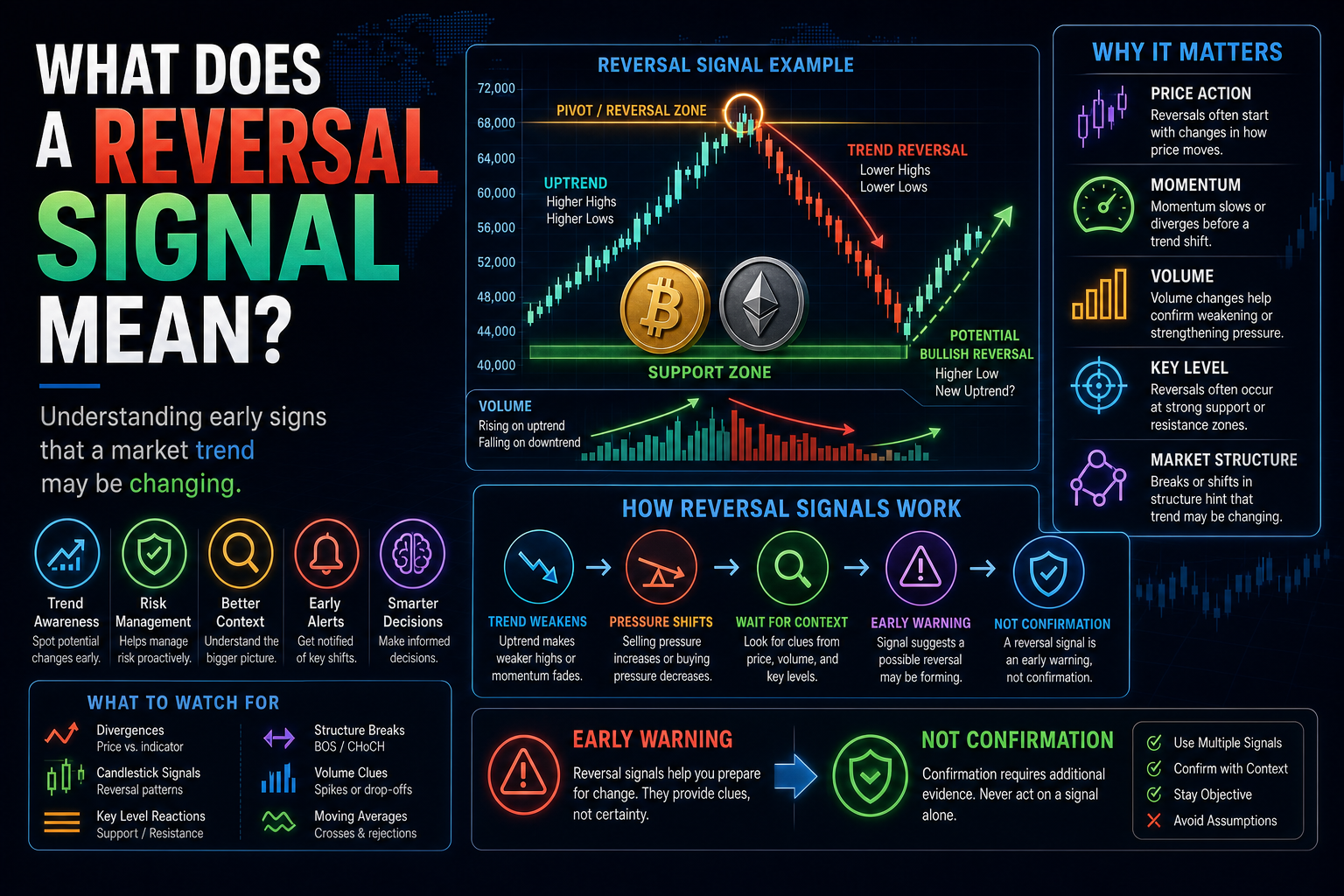
A reversal signal is a sign that a market trend may be losing strength and could be changing direction. In crypto, traders use the term when price action, momentum, volume, or key levels suggest that buyers or sellers may be gaining control.
Simple definition
A reversal signal is an indication that the current price trend may be changing.
It can appear after an uptrend or a downtrend. A possible bearish reversal signal may appear when buying momentum weakens, while a possible bullish reversal signal may appear when selling momentum starts to fade.
Why reversal signals matter
Reversal signals matter because markets do not trend in one direction forever. They help traders describe when the balance between buyers and sellers may be shifting and when a prior trend deserves closer attention.
A signal is not the same as confirmation. Markets can pause, consolidate, or resume the original trend after showing an early warning sign.
Common types of reversal signals
Price patterns can provide possible reversal signals. For example, price may reject a key resistance area after a rally, or it may reject lower prices at a support area after a decline.
Other signals can include a change in highs and lows, weaker momentum, unusual volume, or a break through an important support or resistance level.
How traders usually read them
Traders often look for several pieces of evidence instead of relying on one signal. A possible reversal may be treated more seriously when price structure, volume, momentum, and key levels all point to a changing market balance.
The timeframe also matters. A reversal signal on a short chart can be a small pause within a larger trend on a longer chart.
Reversal signal versus reversal
A reversal signal is an early indication that a trend may be changing. A reversal is the larger price move that becomes visible if the trend actually changes direction.
Not every signal leads to a reversal. Some signals fail, and price can continue in the same direction after a brief pause or pullback.
Why reversal signals matter in crypto
Crypto markets can move quickly, so possible reversal signals often attract attention around important Bitcoin and Ethereum levels. A change in momentum or structure in major assets can also influence how traders read altcoin participation and market sentiment.
Because volatility is common, a signal can appear quickly and then fade. Reading it alongside wider market conditions adds important context.
Reversal signals are not standalone signals
A reversal signal does not guarantee that price will change direction. It only highlights that the current trend may be weakening or that market pressure may be shifting.
Reversal signals are most useful when read alongside market structure, volume, momentum, support and resistance, and the broader market environment.
Example in a market update
If Bitcoin rallies into resistance, shows a sharp rejection, and buying volume begins to fade, a market update may say that traders are watching for a possible reversal signal.
If Ethereum stops making lower lows, holds support, and begins to show improving momentum, an update may describe this as an early signal that selling pressure is easing.
Common signals traders watch
- Rejection at support or resistance
- A change in higher highs or lower lows
- Momentum weakening or improving
- Changes in trading volume
- A break of an important price level
Key takeaway
A reversal signal is a sign that buying or selling pressure may be shifting, but it does not confirm that a market trend has changed.
Comments (0)
Join the discussion
Sign in or create a free account to leave a comment.
No comments yet. Be the first to comment!