What Does Retail Sentiment Mean?
What Does Retail Sentiment Mean?
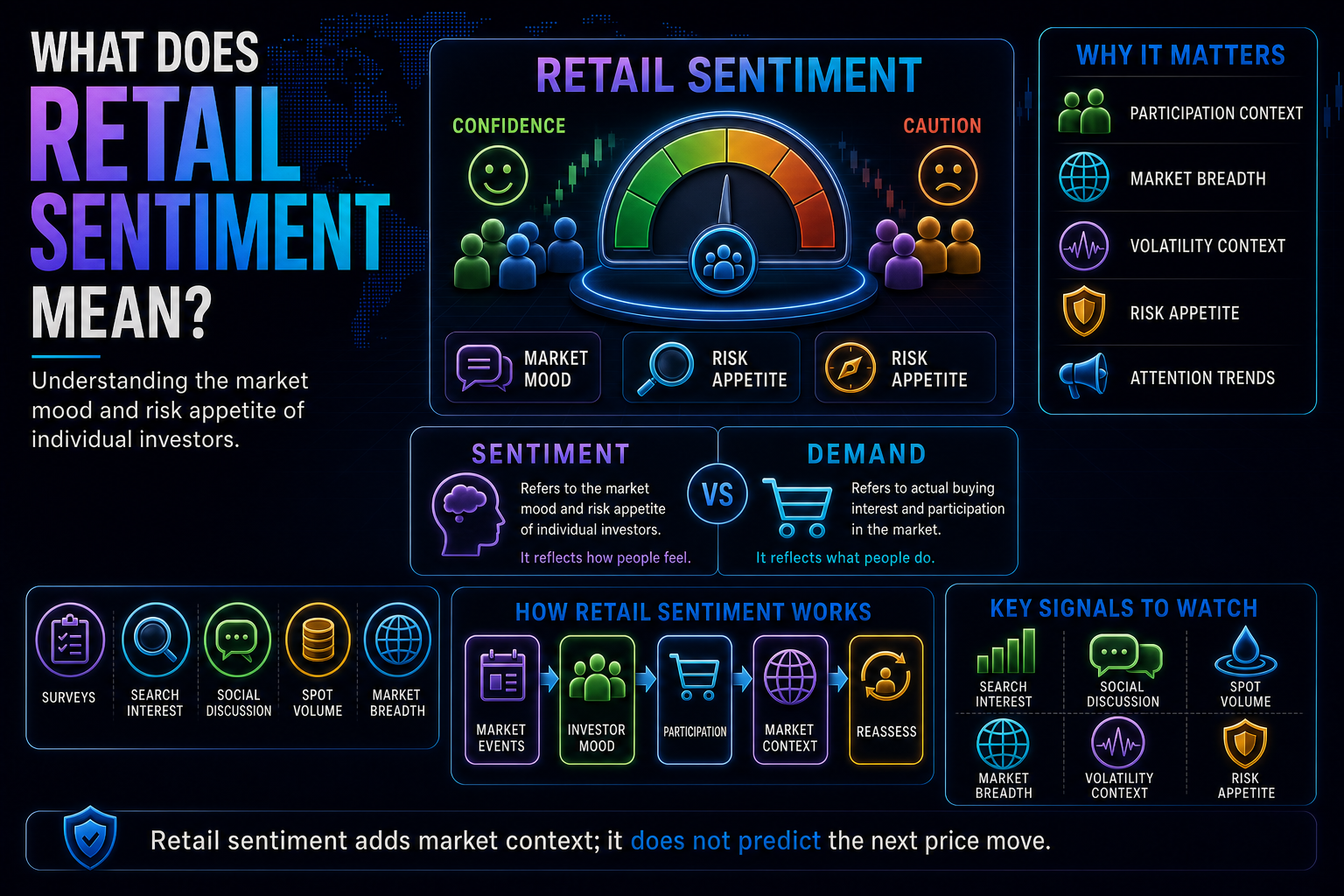
Retail sentiment describes the overall mood, expectations, and risk appetite of individual investors. In crypto, it can range from confident and optimistic to cautious or fearful, and it may influence how retail participants trade, hold, or avoid digital assets.
Simple definition
Retail sentiment is the general market attitude of individual investors.
It reflects how retail participants feel about market conditions, not only what they are buying or selling. Optimistic sentiment may encourage more risk-taking, while cautious sentiment may lead investors to reduce activity or focus on larger, more familiar assets.
Why retail sentiment matters
Retail sentiment matters because crypto markets are highly influenced by participation, attention, and changing risk appetite. A shift in the mood of individual investors can affect trading volume, market breadth, token interest, and short-term volatility.
Sentiment can spread quickly through online discussions, headlines, and price movements. This can make it useful for context, but it can also make it emotional and unstable.
How retail sentiment is measured
Retail sentiment is usually estimated from surveys, market commentary, social activity, search interest, exchange behavior, and broader indicators of risk appetite. Some measures track whether discussion is more positive or negative, while others track how actively individuals are participating.
These measures are imperfect. Online attention can be loud without representing most investors, and sentiment can change faster than underlying market conditions.
How traders usually read it
Improving retail sentiment may be read as a sign of growing confidence or willingness to take risk. More cautious sentiment may be read as a sign that participants are prioritizing capital preservation or waiting for clearer market conditions.
Traders often look for extremes and changes in sentiment rather than relying on a single reading. They compare sentiment with spot demand, price structure, liquidity, and institutional activity.
Retail sentiment versus retail demand
Retail sentiment describes how individual investors feel about the market. Retail demand describes whether they are actively buying and participating.
The two can move together, but not always. Investors may feel optimistic while waiting to buy, or they may continue buying during a cautious period for reasons that are not visible from sentiment alone.
Why it matters for crypto
Crypto markets operate continuously and attract a global audience of individual participants. Retail sentiment can therefore shift rapidly as prices, market news, and online discussion change.
Because crypto can be volatile, sentiment is most useful as a context tool. It helps explain participation and market mood but should be combined with liquidity, spot activity, derivatives data, and broader market structure.
Retail sentiment is not a standalone signal
Optimistic sentiment does not guarantee that prices will rise, and cautious sentiment does not guarantee they will fall. Sentiment can reverse quickly and may reflect reactions to moves that have already happened.
Retail sentiment is most useful when read alongside retail demand, spot volume, volatility, price structure, stablecoin activity, and institutional flow data.
Example in a market update
If online interest and spot volume are increasing across a broader group of crypto assets, a market update may describe retail sentiment as improving while noting that market conditions can change quickly.
If traders are focusing on large assets and reducing activity in smaller tokens, an update may describe retail sentiment as more cautious or selective.
Common signals traders watch
- Retail surveys and sentiment indicators
- Search interest and social discussion
- Spot volume and market breadth
- Stablecoin activity and exchange participation
- Price volatility and broader risk appetite
Key takeaway
Retail sentiment is the overall mood of individual investors and helps explain shifts in confidence, risk appetite, and market participation.
Comments (0)
Join the discussion
Sign in or create a free account to leave a comment.
No comments yet. Be the first to comment!