What Are Retail Sales?
What Are Retail Sales?
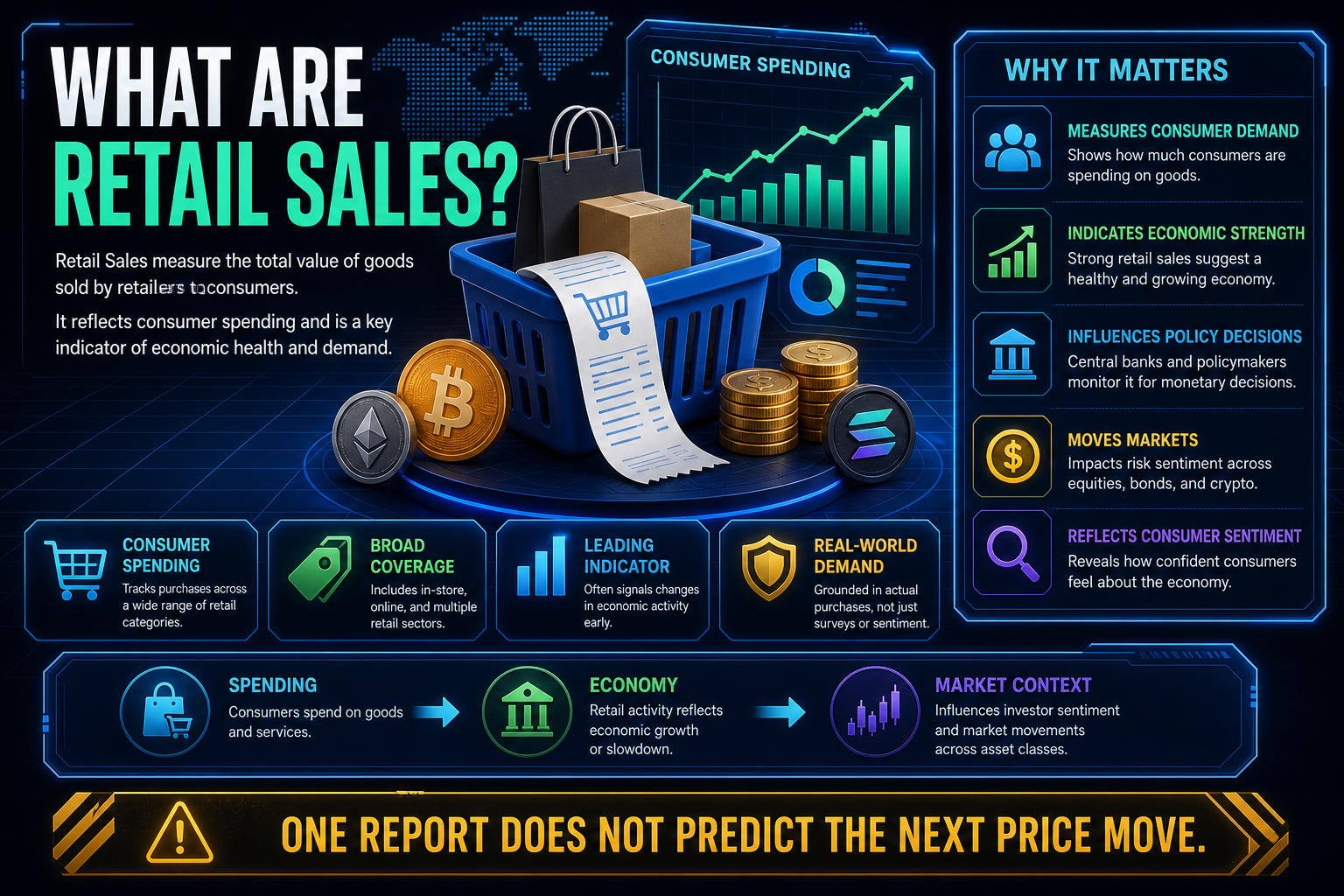
Retail sales are a measure of spending by consumers at stores and online retailers. Crypto traders watch them because consumer spending can help show how active the broader economy may be.
Simple definition
Retail sales summarize how much people are spending on many everyday goods and services. They are one way of reading household demand, although they do not capture every kind of spending or explain why it changed.
Why retail sales matter
Consumer activity is a large part of economic activity. Stronger spending can suggest households are still willing and able to buy, while softer spending can point to a more cautious consumer. Markets also consider inflation, wages, credit conditions, and seasonal factors before drawing a conclusion.
How markets usually read it
A stronger reading may be viewed as supportive of economic demand, but it can also affect expectations for inflation and interest rates. A weaker reading can be read as cooling demand, yet the broader response depends on what investors had expected and on other economic releases.
Why it matters for crypto
Crypto can react to shifts in risk appetite, interest-rate expectations, the dollar, and equity-market tone. Retail sales may contribute to that macro picture, especially when it changes views about growth or policy, but it is not a direct measure of crypto demand.
Retail sales are not a standalone signal
One release can be revised, distorted by unusual purchases, or outweighed by other data. Traders commonly compare retail sales with inflation reports, labor data, bond yields, and price action rather than treating one number as a forecast.
Common signals people watch
- Whether spending is broad or concentrated
- How the result compares with expectations
- Revisions to earlier reports
- Related labor and inflation data
- The reaction in yields, equities, and the dollar
Reading the wider context
Retail sales are commonly compared with the previous trend, not viewed only as one isolated update. A change in spending may reflect income, prices, borrowing costs, seasonal patterns, or shifts between goods and services. The broader pattern and the reaction across rates, equities, and currencies often matter more than the headline alone.
Key takeaway
For that reason, readers often focus on the evolving backdrop rather than using the release as a one-step explanation for market behavior. Strong and weak data can both create volatility when they alter expectations. Context, confirmation, and the capacity of markets to absorb new information remain important.
Retail sales help describe consumer spending and economic demand. For crypto, they are best used as one piece of wider macro context, not a standalone trading signal.
Comments (0)
Join the discussion
Sign in or create a free account to leave a comment.
No comments yet. Be the first to comment!