What Is Retail Demand?
What Is Retail Demand?
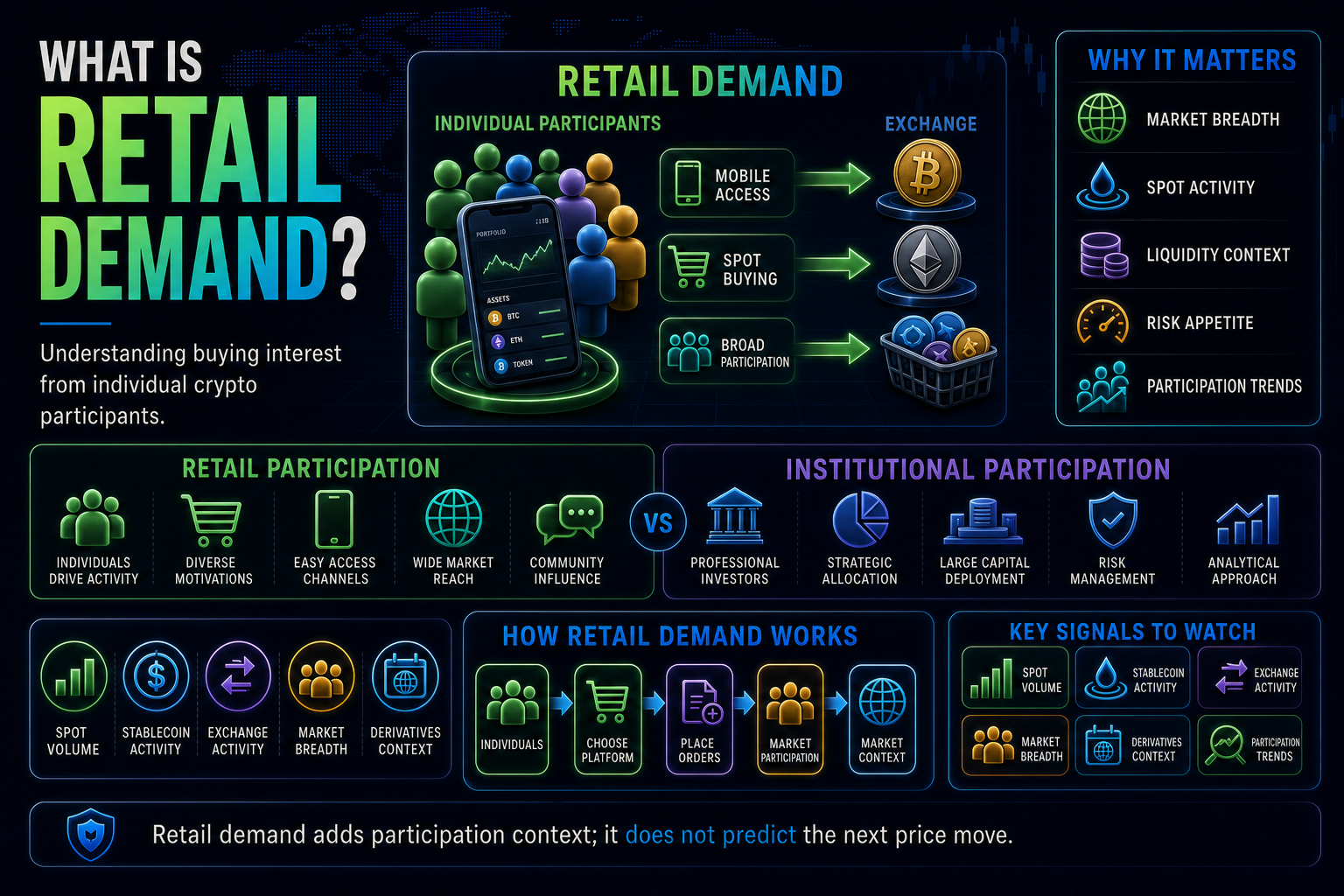
Retail demand describes buying interest from individual investors rather than large institutions or professional funds. In crypto, it refers to the participation of everyday traders and investors buying coins, tokens, or crypto-related products.
Simple definition
Retail demand is buying interest from individual market participants.
Retail investors can participate through crypto exchanges, wallets, payment apps, ETFs, or other investment platforms. Their trades are usually smaller than institutional trades, but many individual participants together can have a meaningful effect on activity and liquidity.
Why retail demand matters
Retail demand matters because individual investors make up an important part of crypto market participation. Changes in their buying interest can influence trading volume, token liquidity, market breadth, and short-term sentiment.
Retail activity can be especially visible in smaller or newer assets, where broad individual participation may have a larger influence than it would in a deep and highly liquid market.
How retail demand is estimated
Retail demand is difficult to measure directly because markets do not label every buyer by investor type. Traders often use proxy signals such as smaller trade sizes, exchange volume, app activity, stablecoin use, search interest, or broad participation across tokens.
Each proxy has limits. Higher volume may come from professional traders, while social interest may not lead to actual purchases. A group of signals is usually more useful than one measure alone.
How traders usually read it
Improving retail demand may be read as broader market participation, particularly when activity expands beyond a small group of large assets. Fading retail demand may be read as a more selective or cautious market backdrop.
Retail participation can change quickly, so traders usually compare it with price structure, spot liquidity, institutional flows, derivatives positioning, and wider risk appetite.
Retail demand versus institutional demand
Retail demand comes from many individual participants, often through exchanges and consumer-facing platforms. Institutional demand comes from professional investors using products such as funds, ETFs, custody services, or derivatives venues.
Both matter, but they can appear through different data sources and may respond differently to volatility, market news, liquidity, and macro conditions.
Why it matters for crypto
Crypto markets are accessible to individual participants around the world, which makes retail demand especially relevant. Retail activity can be seen in direct spot buying, stablecoin usage, exchange participation, and interest in a wider range of crypto assets.
At the same time, crypto market conditions also depend on institutional products, market makers, and derivatives. Retail demand is one part of the overall participation picture.
Retail demand is not a standalone signal
Strong retail demand does not guarantee that prices will rise, and weaker retail activity does not guarantee they will fall. Liquidity, selling pressure, institutional activity, macro conditions, and market structure can all influence the outcome.
Retail demand is most useful when read alongside spot volume, market breadth, stablecoin activity, ETF flows, derivatives positioning, and price action.
Example in a market update
If trading activity is improving across Bitcoin, Ethereum, and a wider group of altcoins, a market update may describe participation as showing stronger retail-demand context.
If activity remains concentrated in large assets while smaller tokens have thin volume, an update may describe retail participation as selective rather than broad.
Common signals traders watch
- Spot trading volume and smaller trade activity
- Participation across Bitcoin, Ethereum, and altcoins
- Stablecoin use and exchange activity
- Consumer-platform and search-interest trends
- Institutional flows and derivatives-market context
Key takeaway
Retail demand is buying interest from individual investors and helps explain how broadly everyday participants are engaging with crypto markets.
Comments (0)
Join the discussion
Sign in or create a free account to leave a comment.
No comments yet. Be the first to comment!