What Is Relative Strength?
What Is Relative Strength?
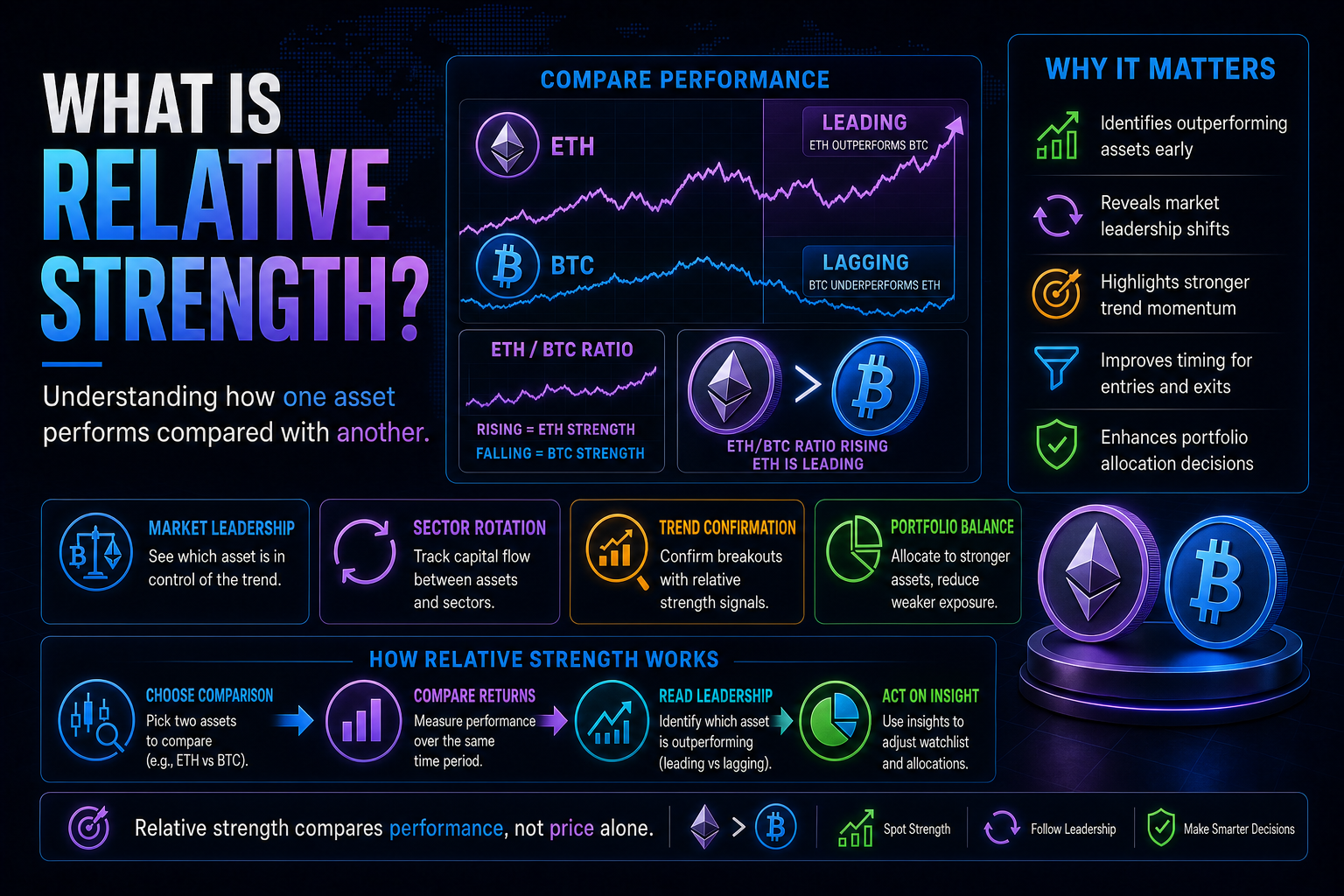
Relative strength describes how one asset is performing compared with another asset or a broader market benchmark. In crypto, traders use it to see whether an asset is leading, keeping pace with, or lagging behind Bitcoin, Ethereum, or the wider market.
Simple definition
Relative strength shows performance in comparison, not performance in isolation.
For example, an altcoin can rise in dollar terms but still show weak relative strength if Bitcoin rises more over the same period. An asset can also fall less than Bitcoin and be described as relatively strong during a market decline.
Why relative strength matters
Relative strength matters because it helps show where market participation is concentrated. It can help traders distinguish between a broad market move and an asset that is performing better or worse than its peers.
This can add useful context when traders are trying to understand leadership, rotation, and the overall tone of the market.
How relative strength is measured
Relative strength is often viewed by comparing two price charts over the same time period. A trader might compare an altcoin with Bitcoin, Ethereum with the broader crypto market, or one sector with another sector.
A ratio chart is another common tool. It divides one asset’s price by another asset’s price, making it easier to see which one is gaining ground relative to the other.
How traders usually read it
Improving relative strength can suggest that an asset is attracting more interest than the comparison asset. Weakening relative strength can suggest that the asset is falling behind, even if its own price is still rising.
Traders often compare relative strength across several timeframes because short-term performance can look different from a broader trend.
Why relative strength matters in crypto
Relative strength is especially useful in crypto because Bitcoin often influences the wider market. Comparing altcoins with Bitcoin or Ethereum can help show whether interest is broadening beyond the largest assets or remaining concentrated in them.
It can also help describe sector rotation, such as whether DeFi, infrastructure, or other groups are gaining or losing market attention relative to the broader market.
Relative strength is not a standalone signal
Relative strength does not guarantee that an asset will continue to outperform or underperform. Performance can change quickly as liquidity, sentiment, and broader market conditions change.
It is most useful when read alongside price structure, volume, market trend, Bitcoin and Ethereum performance, and overall market participation.
Example in a market update
If Ethereum rises more than Bitcoin over the same period, a market update may say that Ethereum is showing relative strength against Bitcoin.
If smaller assets fall faster than Bitcoin during a broader decline, an update may describe altcoin relative strength as weak.
Common signals traders watch
- Performance against Bitcoin or Ethereum
- Ratio charts between two assets
- Which sectors are leading or lagging
- Volume and participation behind the move
- Performance across short and longer timeframes
Key takeaway
Relative strength shows how an asset performs compared with another asset or the wider market, helping traders identify leadership and lagging performance.
Comments (0)
Join the discussion
Sign in or create a free account to leave a comment.
No comments yet. Be the first to comment!