What Does Rejection Mean?
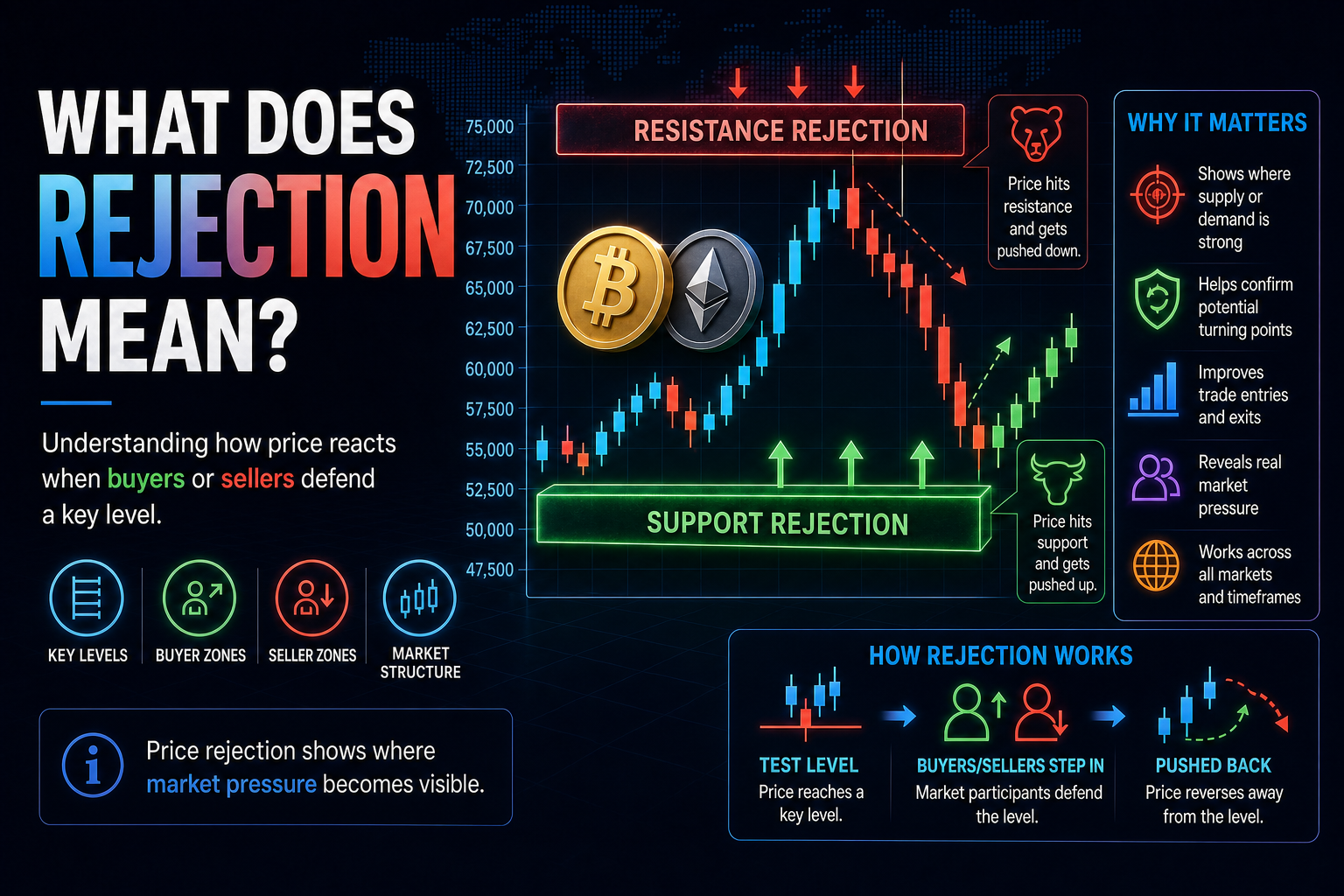
What Does Rejection Mean in Crypto?
In crypto chart analysis, rejection happens when price reaches an important level but cannot continue through it. The market then moves away from that area, showing that buyers or sellers became more active there.
Simple definition
A price rejection is when the market tests a level and is pushed back in the opposite direction.
At resistance, rejection usually means sellers became more active and pushed price lower. At support, rejection usually means buyers became more active and pushed price higher.
Why rejection matters
Rejection matters because it can show where the balance between buyers and sellers is becoming visible. It helps traders describe whether an important price area is currently being defended or challenged.
One rejection does not guarantee that a level will keep holding. Price may return later and test the same area again.
How traders usually spot rejection
Traders often look for candles with long wicks near a key level. A long upper wick can show that price moved higher but was pushed back down. A long lower wick can show that price moved lower but was pushed back up.
They may also watch volume, the speed of the reaction, and whether price closes back inside a prior range or remains near the level.
Rejection at support and resistance
A rejection at resistance can suggest that sellers are still active near an upper price area. A rejection at support can suggest that buyers are still active near a lower price area.
These reactions provide context, but price may still eventually break through the level if market pressure changes.
Why rejection matters in crypto
Crypto can move quickly around visible chart levels, so rejection is commonly used to describe abrupt reactions in Bitcoin, Ethereum, and altcoins. A rejection at a key level can also influence how traders read broader market momentum and sentiment.
Because volatility is high, traders often compare the reaction across more than one timeframe before deciding how meaningful it is.
Rejection is not a standalone signal
A rejection does not guarantee that price will continue moving away from the level. The level can be tested again, broken later, or become part of a wider range.
Rejection is most useful when read alongside market structure, volume, momentum, support and resistance, and the broader market environment.
Example in a market update
If Bitcoin rises into a key resistance area but quickly falls back below it, a market update may say that price was rejected at resistance.
If Ethereum briefly falls below support but buyers push it back above the level, an update may describe that as a rejection of lower prices.
Common signals traders watch
- Long wicks near a key level
- Price closing back away from the level
- Trading volume during the reaction
- Whether price tests the level again
- The broader trend and market structure
Key takeaway
Rejection is when price tests an important level and is pushed back, showing that buyers or sellers became more active in that area.
Comments (0)
Join the discussion
Sign in or create a free account to leave a comment.
No comments yet. Be the first to comment!