What Is Realized Volatility?
What Does Realized Volatility Mean?
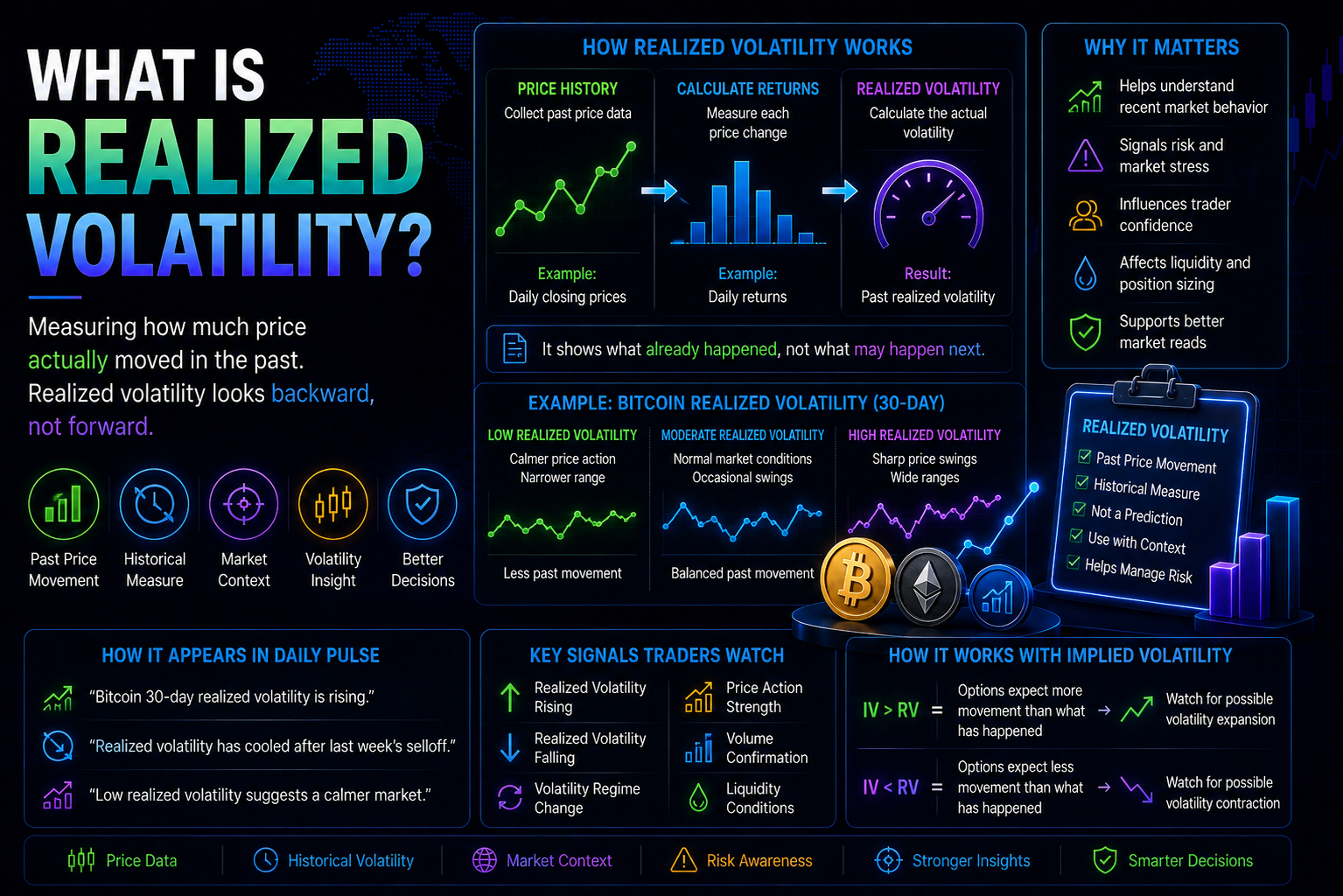
Realized volatility describes how much an asset actually moved over a past period. Crypto readers watch realized volatility because it helps explain whether Bitcoin, Ethereum, or the broader market has been calm, choppy, or moving sharply.
Simple definition
Realized volatility means the amount of price movement that already happened.
It looks backward, not forward. Instead of asking what traders expect next, realized volatility measures how much price actually moved during a recent window, such as a day, week, or month.
Why realized volatility matters
Realized volatility matters because it helps traders understand the market’s recent behavior. A market that has moved sharply may feel more unstable than one that has stayed in a narrow range.
When realized volatility is high, traders may become more cautious, adjust position sizes, or watch for liquidity stress. When it is low, traders may read the market as calmer, but not necessarily stronger.
How traders usually read it
Rising realized volatility usually means price action has become more active or unstable. Falling realized volatility usually means price movement has become calmer or more compressed.
The meaning depends on context. High realized volatility after a sharp selloff may signal stress, while high realized volatility after a strong recovery may simply show that the market has been moving quickly.
Why it matters for crypto
Crypto can move quickly, so realized volatility is useful when reading Bitcoin, Ethereum, altcoins, liquidations, ETF flows, and market structure. It can help show whether recent price action has been calm or disorderly.
Crypto traders may use realized volatility alongside implied volatility, volume, liquidity, funding rates, open interest, macro signals, and Bitcoin dominance to understand whether the market is becoming more active or more stable.
Realized volatility is not a standalone signal
Realized volatility should not be used as a complete market signal. It tells traders how much price has moved, but it does not explain why the move happened or what price will do next.
It is most useful when read alongside price direction, volume, liquidity, ETF flows, macro signals, options pricing, liquidation data, and broader market sentiment.
Example in a market update
If Bitcoin sells off sharply and realized volatility rises, traders may read the tape as more unstable and risk-sensitive.
If Bitcoin trades sideways and realized volatility falls, traders may read the market as calmer, but still wait for confirmation from volume, liquidity, and macro signals.
Common signals traders watch
- Whether realized volatility is rising or falling
- Whether price movement is sharp or contained
- Whether Bitcoin and Ethereum are moving together or diverging
- Whether volume and liquidity confirm the move
- Whether implied volatility is higher or lower than realized volatility
Key takeaway
Realized volatility helps traders understand how much the market has actually moved, but it should be read with price action, liquidity, volume, and market context.
Comments (0)
Join the discussion
Sign in or create a free account to leave a comment.
No comments yet. Be the first to comment!