What Are Real-World Assets?
What Are Real-World Assets?
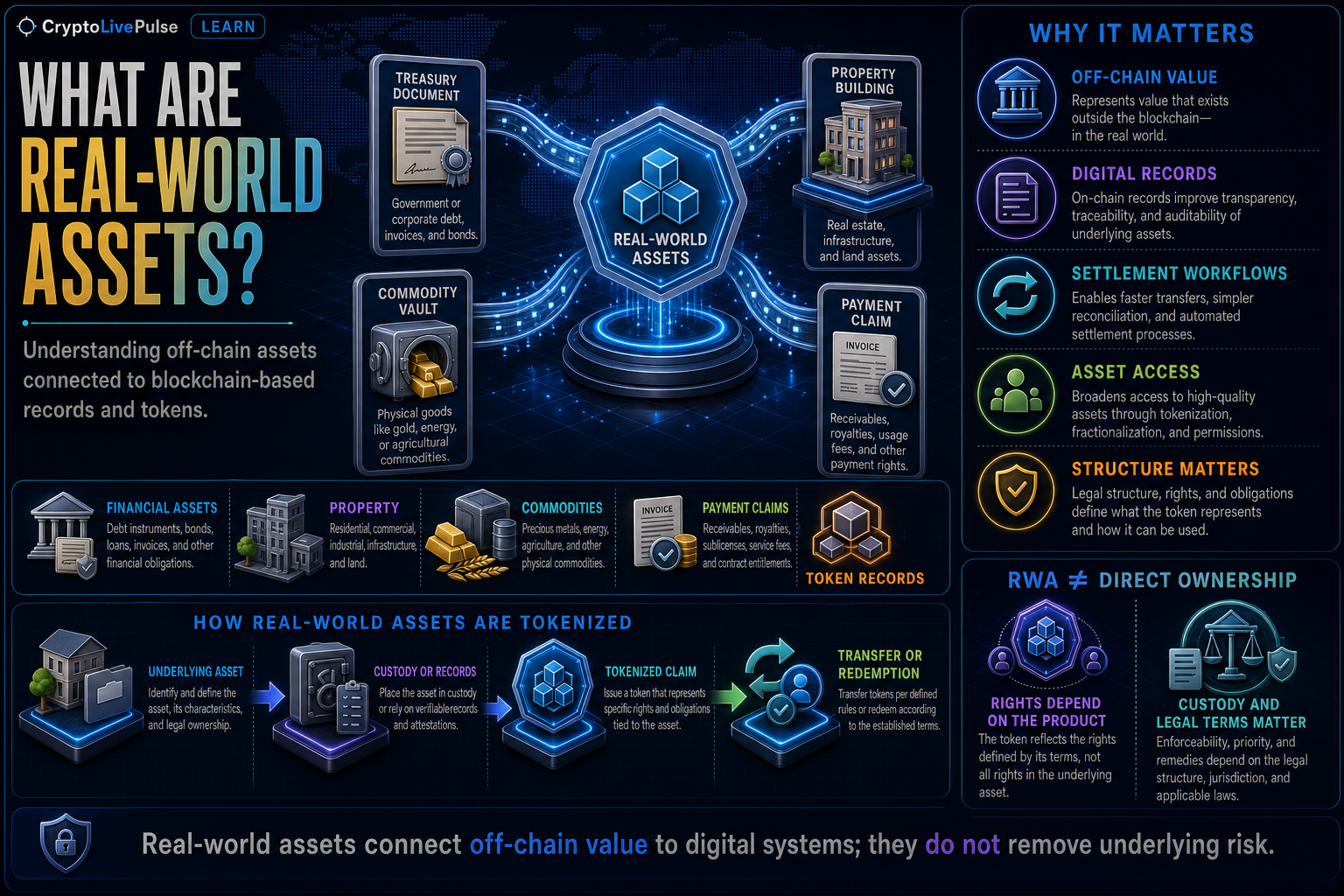
Real-world assets are assets that exist outside the blockchain, such as financial instruments, property, commodities, or payment claims, that may be connected to digital systems.
Simple definition
In crypto, the term often refers to an off-chain asset that is represented, tracked, or accessed through a token or blockchain-based record. The underlying asset remains subject to its own legal and operational structure.
Why real-world assets matter
They are one way blockchain infrastructure can connect with established financial and commercial activity. They may support digital ownership records, settlement workflows, and new access models where permitted.
How people usually read them
A real-world asset project should be understood through the underlying asset first. People look at who owns or holds it, what the token represents, how redemption works, and which rules apply.
Why it matters for crypto
Real-world assets can bring familiar asset types into blockchain-based workflows. They also introduce practical issues such as legal enforceability, custodians, data quality, and the link between the token and the off-chain asset.
Not a standalone signal
A token tied to a real-world asset does not remove the underlying asset’s risks. It may also have transfer limits, liquidity constraints, or different rights than direct ownership.
Example in a market update
If a project uses blockchain records to represent a financial instrument or property-related claim, an update may describe it as a real-world asset application.
Common signals people watch
- Type of underlying asset
- Rights attached to the token
- Custody and legal structure
- Redemption and settlement process
- Access and transfer restrictions
The off-chain connection
The key feature of a real-world asset is the link between an on-chain record and something outside the blockchain. That link may rely on issuers, custodians, registries, administrators, legal agreements, and other real-world processes.
If that connection is unclear, the token may be difficult to understand. The blockchain can make transfers or records visible, but it cannot by itself verify every off-chain fact or enforce every obligation.
Questions to keep in mind
What asset exists outside the blockchain, who holds or administers it, and what claim does the token give its holder? These questions help explain an RWA product clearly.
The connection should be verifiable and understandable to participants. Clear documentation about the asset, the parties involved, and the transfer process is therefore an important part of any RWA design.
Key takeaway
Real-world assets are off-chain assets connected to blockchain-based systems, and understanding the underlying structure matters as much as the token.
Comments (0)
Join the discussion
Sign in or create a free account to leave a comment.
No comments yet. Be the first to comment!