What Is Quantitative Easing?
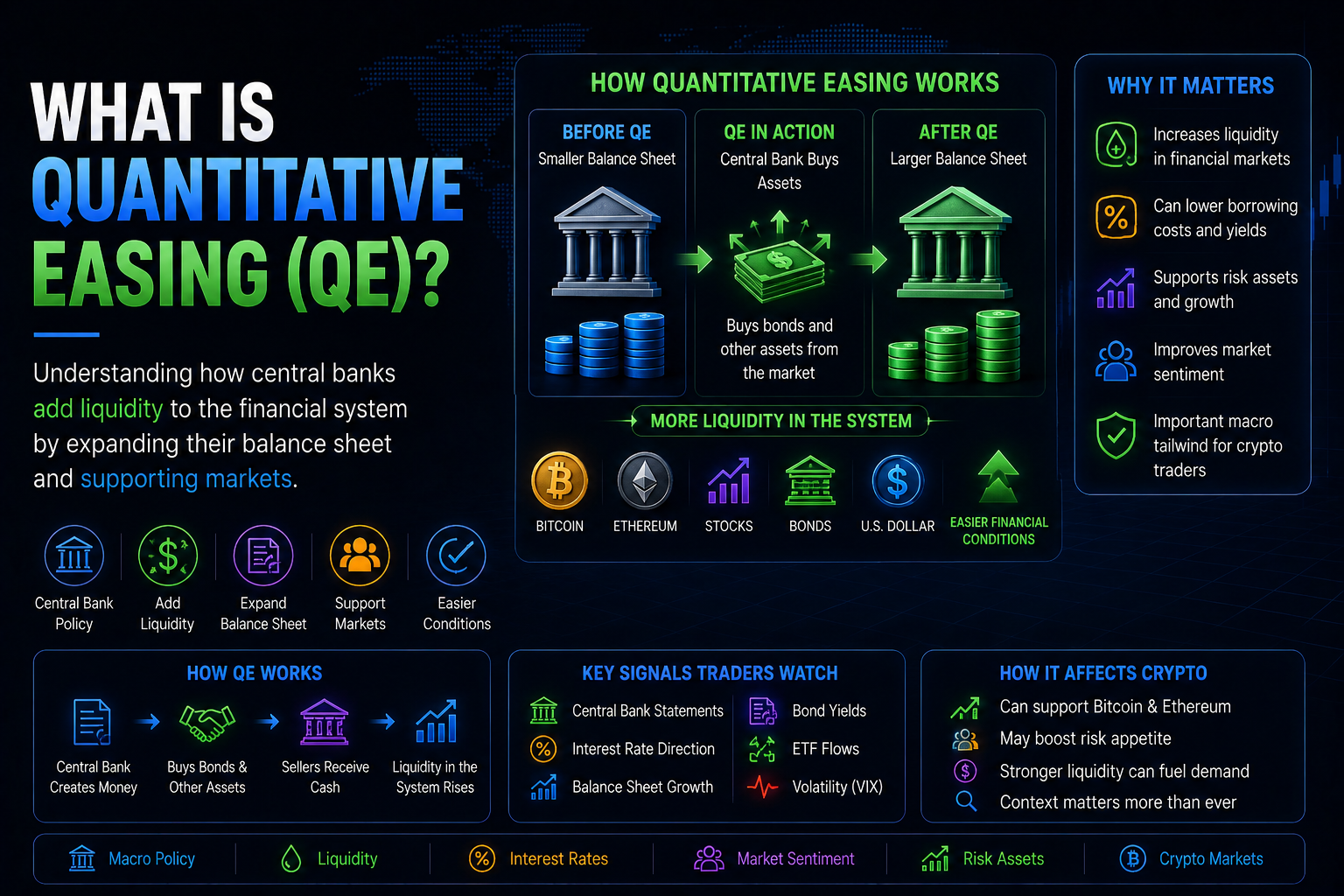
What Does Quantitative Easing Mean?
Quantitative easing describes a period when a central bank adds liquidity to the financial system. Traders watch quantitative easing because it can affect risk appetite, interest rate expectations, Bitcoin, Ethereum, ETF flows, market sentiment, and broader financial conditions.
Simple definition
Quantitative easing means a central bank is adding support to markets by expanding its balance sheet and increasing liquidity in the financial system.
In simple terms, quantitative easing usually means more liquidity is being pushed into the system. It is often discussed as the opposite of quantitative tightening, which reduces or removes liquidity over time.
Why quantitative easing matters
Quantitative easing matters because liquidity can influence how willing investors are to hold risk assets. When liquidity is easier, traders may become more comfortable with stocks, crypto, and other assets that can move sharply.
It can also affect how markets read bond yields, the U.S. dollar, interest rate expectations, and overall financial conditions. Even when price moves are driven by other factors, quantitative easing can shape the background tone.
How traders usually read it
Traders usually read quantitative easing as a liquidity tailwind because it can make financial conditions feel more supportive.
That does not mean every market must rise during quantitative easing. The meaning depends on context, including inflation, economic growth, rate expectations, investor confidence, ETF demand, and whether traders already expected the policy backdrop.
Why it matters for crypto
Crypto can be sensitive to quantitative easing because Bitcoin, Ethereum, and altcoins often react when liquidity and risk appetite change. When liquidity feels more supportive, traders may become more willing to hold risk assets or add exposure.
Crypto traders may use quantitative easing as part of a broader macro read, especially when it appears alongside ETF flows, Bitcoin dominance, Treasury yields, the U.S. dollar, volatility, and market structure.
Quantitative easing is not a standalone signal
Quantitative easing should not be used by itself to explain every move in Bitcoin, Ethereum, or broader crypto markets. Easier liquidity can matter, but price action may still be driven by ETF flows, regulation, leverage, sentiment, or coin-specific news.
It is most useful when read alongside rate expectations, bond yields, the U.S. dollar, volatility, equity behavior, ETF demand, liquidity conditions, Bitcoin dominance, and crypto market structure.
Example in a market update
If quantitative easing is supporting liquidity while Treasury yields are easing and Bitcoin is holding higher levels, traders may read the macro backdrop as more constructive for risk assets.
If quantitative easing is in focus but Bitcoin is fading, ETF flows are weak, and volatility is rising, traders may read liquidity as supportive but not strong enough to offset other market pressures.
Common signals traders watch
- Whether central bank balance sheet support is rising or shrinking
- Whether liquidity conditions are becoming easier or tighter
- Whether Treasury yields and the U.S. dollar are supporting or pressuring risk assets
- Whether Bitcoin and Ethereum are responding to the liquidity backdrop
- Whether ETF flows and market sentiment confirm or weaken the broader macro read
Key takeaway
Quantitative easing helps traders understand when liquidity may be more supportive, but it should always be read alongside price action, ETF flows, rates, sentiment, and market structure.
Comments (0)
Join the discussion
Sign in or create a free account to leave a comment.
No comments yet. Be the first to comment!