What Are Put Options?
What Do Put Options Mean?
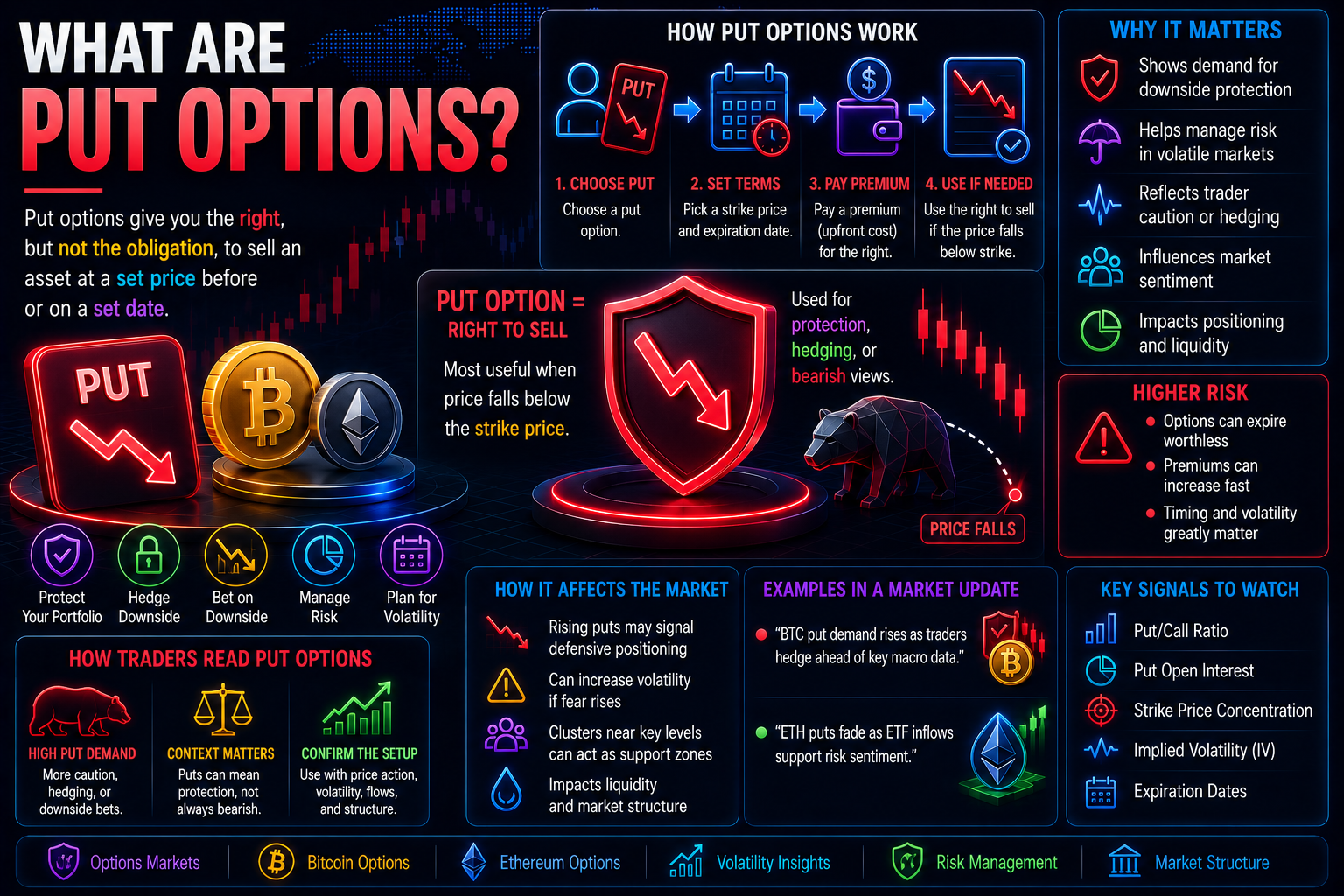
Put options are contracts that give a trader the right, but not the obligation, to sell an asset at a set price before or on a set date. Crypto traders watch put options because they can show demand for downside protection, bearish positioning, or caution around Bitcoin, Ethereum, and broader market risk.
Simple definition
Put options give the holder the right to sell an asset at a specific price by a specific expiration date.
A put option can become more useful when the asset price falls below the agreed price, often called the strike price. The buyer pays a premium for this right, and the option may expire with little or no value if the market does not move in a useful direction.
Why put options matters
Put options matter because they can help traders manage downside risk or express a cautious view without selling the asset directly.
When demand for put options rises, traders may read it as a sign that the market is hedging, preparing for volatility, or becoming more defensive. The signal depends on context because puts can be used for protection, speculation, or portfolio management.
How traders usually read it
Heavy put option demand usually suggests traders are more focused on downside protection or possible price weakness.
That does not always mean traders expect prices to fall. Sometimes investors buy puts to protect existing positions while staying invested, so put activity should be read alongside price action, volume, volatility, and broader market sentiment.
Why it matters for crypto
Crypto can move quickly, so put options can become important when traders want protection around Bitcoin, Ethereum, ETF flow shifts, macro events, liquidation pressure, or regulatory headlines.
Crypto traders may use put options as part of a broader market read. Rising put demand, higher implied volatility, and weak spot price action can suggest a more cautious tape, while calmer put activity may suggest less immediate demand for downside hedging.
Put options are not a standalone signal
Put options should not be used as a complete market signal. More put demand does not guarantee lower prices, and lower put demand does not guarantee a stronger market.
Put options are most useful when read alongside Bitcoin and Ethereum price action, implied volatility, open interest, ETF flows, liquidity, macro signals, and overall market structure.
Example in a market update
If Bitcoin is falling, volatility is rising, and put demand increases, traders may read the setup as more defensive.
If Bitcoin is stable, ETF flows are supportive, and put demand fades, traders may read the market as less focused on downside protection.
Common signals traders watch
- Whether put option demand is rising or falling
- Whether put activity is concentrated near key price levels
- Whether implied volatility is increasing or decreasing
- Whether Bitcoin and Ethereum are holding support or fading
- Whether traders appear to be hedging risk or speculating on downside moves
Key takeaway
Put options help traders understand downside protection, caution, and positioning, but they should be read alongside price action, volatility, liquidity, and broader market context.
Comments (0)
Join the discussion
Sign in or create a free account to leave a comment.
No comments yet. Be the first to comment!