What Is Portfolio Rebalancing?
What Does Portfolio Rebalancing Mean?
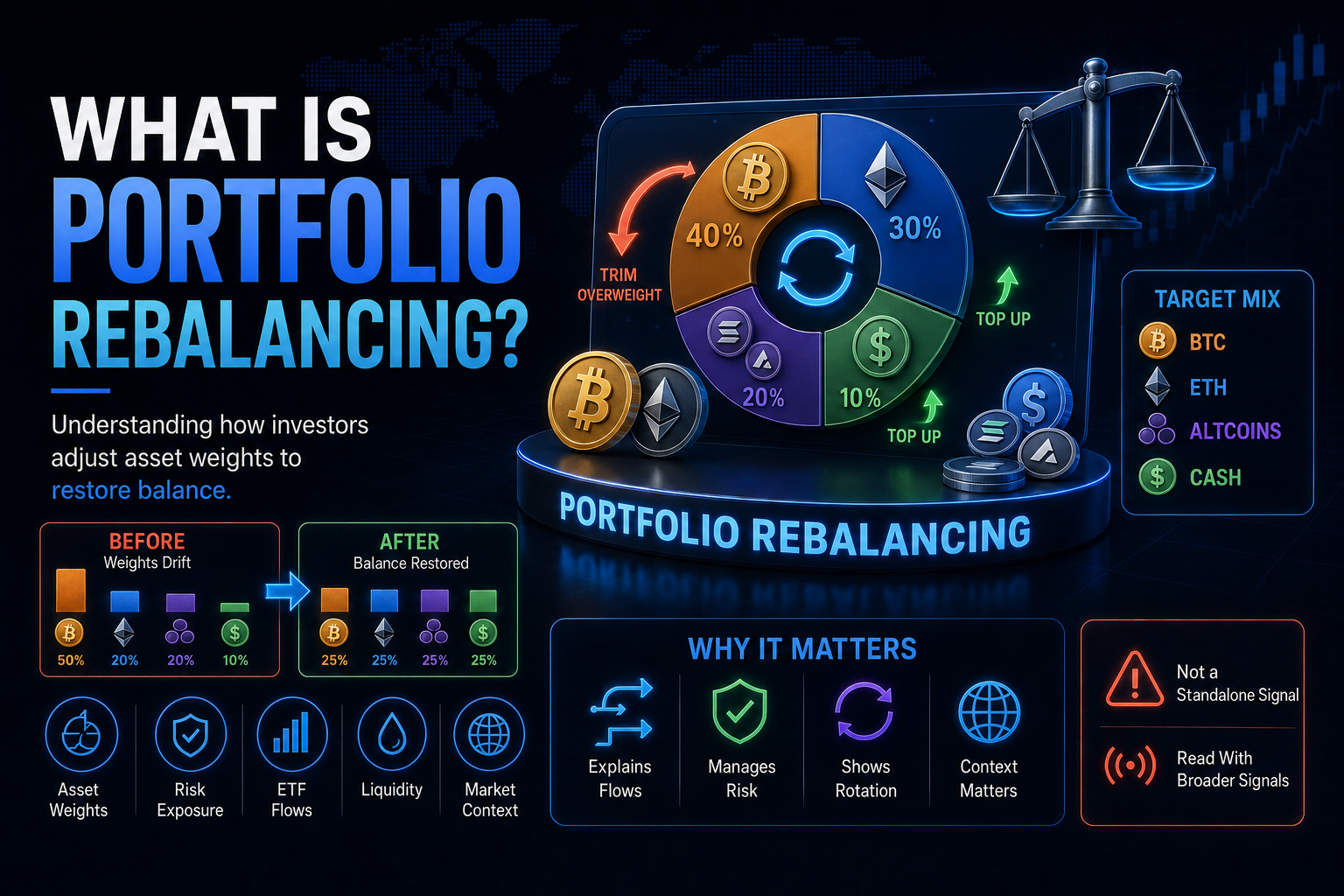
Portfolio rebalancing means adjusting a portfolio so it moves closer to a chosen mix of assets. Traders and investors watch portfolio rebalancing because it can affect flows, risk exposure, Bitcoin, Ethereum, altcoins, and broader market behavior.
Simple definition
Portfolio rebalancing means changing the size of different positions so a portfolio returns closer to its intended balance.
For example, if one asset rises much faster than the rest of a portfolio, it may become a larger share than intended. Rebalancing may involve reducing that larger position, adding to smaller positions, or adjusting exposure based on a planned structure.
Why portfolio rebalancing matters
Portfolio rebalancing matters because markets are always moving. When prices change, the weight of each asset in a portfolio can change too.
This can affect how much risk a portfolio carries. Rebalancing may also help explain why some assets see buying or selling pressure even when there is no new headline directly tied to that asset.
How traders usually read it
Traders may read portfolio rebalancing as a flow signal. If strong assets are being trimmed after a large move, it may show that some investors are reducing concentration or locking in balance.
Rebalancing is not automatically bullish or bearish. The meaning depends on what is being reduced, what is being added, the size of the move, and the broader market backdrop.
Why it matters for crypto
Crypto can be affected by portfolio rebalancing because Bitcoin, Ethereum, altcoins, ETF flows, and stablecoin liquidity can all shift when investors adjust risk exposure.
Crypto traders may use portfolio rebalancing as part of a broader market read, especially near month-end, quarter-end, after large price moves, or when macro signals change risk appetite.
Portfolio rebalancing is not a standalone signal
Portfolio rebalancing should not be used as a complete market explanation. It may help explain flows, but it does not tell traders exactly where prices will go next.
It is most useful when read alongside price action, volume, ETF flows, liquidity, volatility, Bitcoin dominance, macro signals, sentiment, and market structure.
Example in a market update
If Bitcoin has strongly outperformed while altcoins lag, a market update may say some traders are watching for portfolio rebalancing between Bitcoin, Ethereum, and higher-risk assets.
If crypto weakens while equities stay firm, a market update may say portfolio rebalancing or risk reduction could be part of the flow backdrop, depending on ETF flows, liquidity, and broader sentiment.
Common signals traders watch
- Whether Bitcoin or Ethereum has moved much faster than the rest of the market
- Whether ETF flows are showing buying or selling pressure
- Whether altcoins are gaining or losing participation
- Whether liquidity conditions are supportive or tightening
- Whether market sentiment is confident, cautious, or mixed
Key takeaway
Portfolio rebalancing helps explain how changing asset weights can affect flows, risk exposure, and market behavior, but it should always be read alongside broader crypto and macro signals.
Comments (0)
Join the discussion
Sign in or create a free account to leave a comment.
No comments yet. Be the first to comment!