What Is Policy Friction?
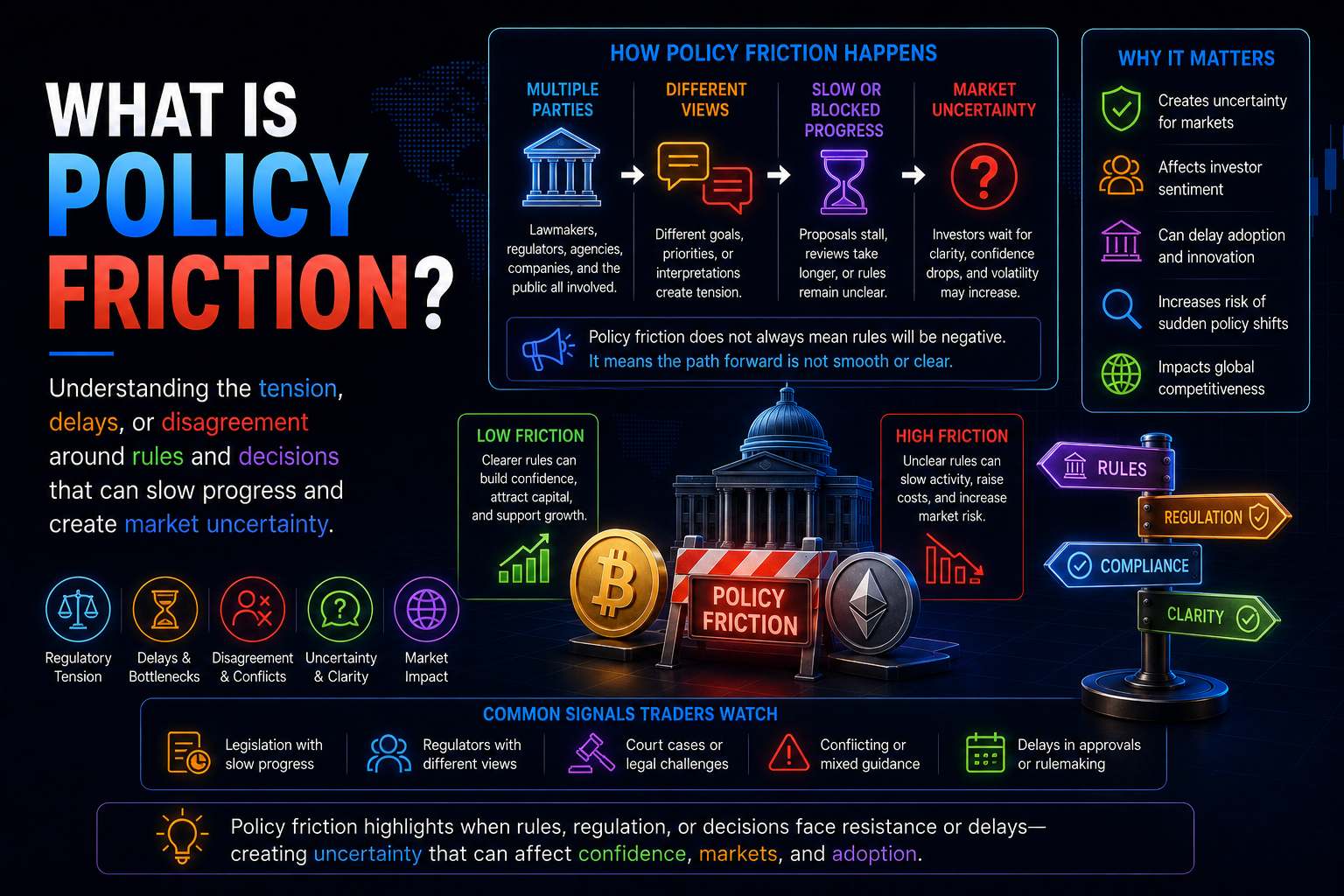
What Does Policy Friction Mean?
Policy friction means tension, delays, disagreement, or uncertainty around rules and government decisions. Crypto readers watch policy friction because it can affect regulation, market sentiment, investor confidence, Bitcoin, Ethereum, stablecoins, exchanges, and broader digital asset market structure.
Simple definition
Policy friction means rules or policy decisions are not moving smoothly.
It can happen when lawmakers, regulators, companies, courts, or agencies disagree, move slowly, or create uncertainty around what rules should apply.
Why policy friction matters
Policy friction matters because markets prefer clarity. When rules are unclear or delayed, traders may become more cautious until they understand the possible impact.
It can affect confidence, investment decisions, business planning, and how investors read future adoption or regulatory risk.
How traders usually read it
High policy friction is usually read as a cautious signal because it can create uncertainty around rules, approvals, enforcement, or market access.
Lower policy friction may feel more constructive if it suggests clearer rules or smoother adoption. The meaning depends on context and should not be read alone.
Why it matters for crypto
Policy friction matters for crypto because digital assets are still being defined across many areas, including exchanges, stablecoins, custody, ETFs, payments, and market structure.
Crypto traders may use policy friction as part of a broader market read, especially when it appears alongside Bitcoin price action, ETF flows, liquidity, regulation headlines, risk appetite, and market sentiment.
Policy friction is not a standalone signal
Policy friction should not be used as a standalone price signal. A difficult policy environment does not guarantee lower prices, and clearer policy does not guarantee stronger prices.
Policy friction is most useful when read alongside price action, volume, ETF flows, enforcement actions, regulation headlines, liquidity, macro signals, and broader market sentiment.
Example in a market update
If Bitcoin is steady but policy friction remains high, traders may read the setup as cautious but not necessarily weak.
If crypto prices are falling while policy friction increases, traders may see regulatory uncertainty as one factor adding pressure to sentiment.
Common signals traders watch
- Whether policy headlines are creating clarity or uncertainty
- Whether regulators and lawmakers appear aligned or divided
- Whether exchanges, stablecoins, ETFs, or custody rules are affected
- Whether Bitcoin and Ethereum react strongly or stay stable
- Whether market sentiment becomes more confident or more cautious
Key takeaway
Policy friction helps traders understand when rulemaking, regulation, or government decisions are creating uncertainty that may affect crypto confidence and market sentiment.
Comments (0)
Join the discussion
Sign in or create a free account to leave a comment.
No comments yet. Be the first to comment!