What Are Payment Rails?
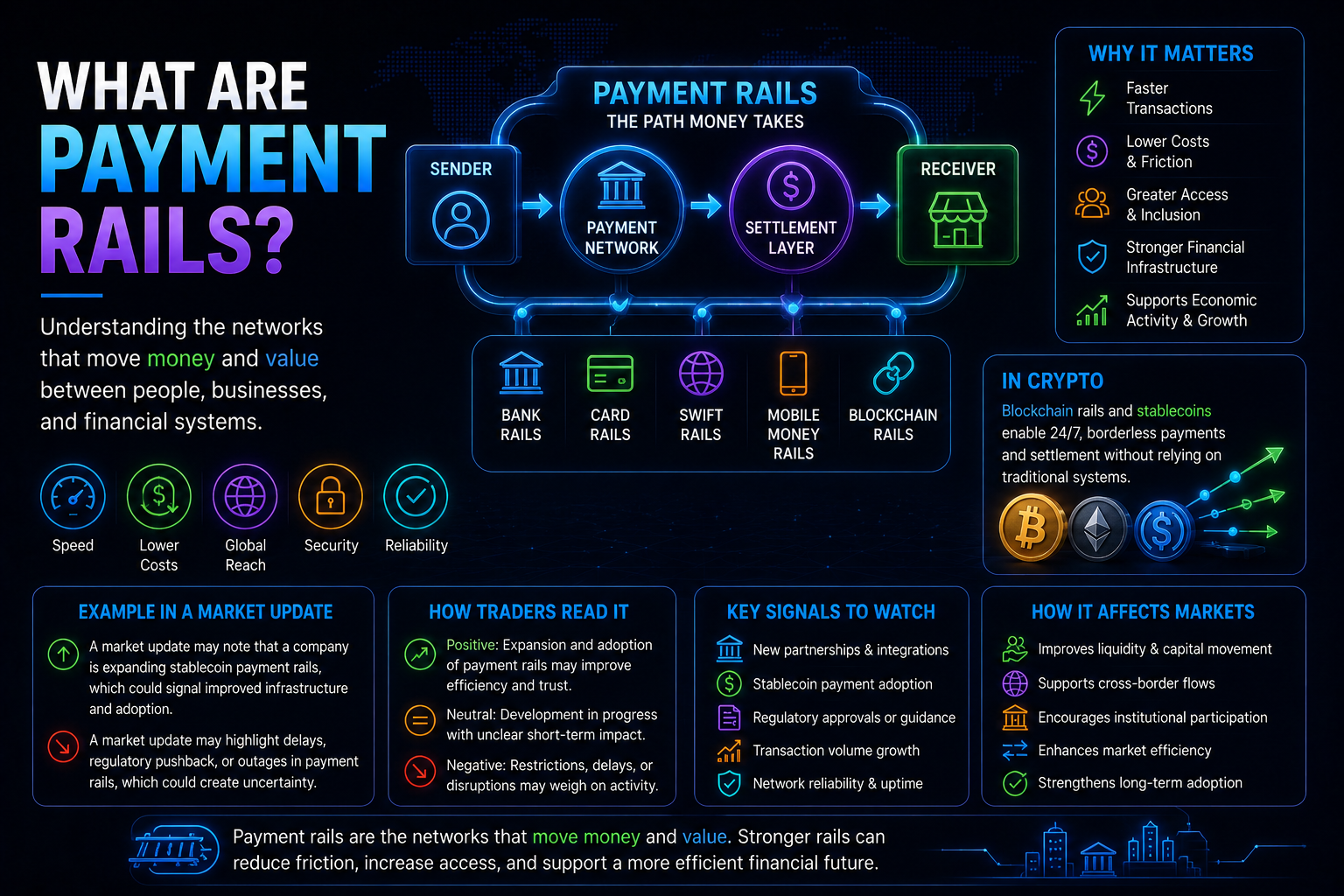
What Do Payment Rails Mean?
Payment rails are the systems and networks that move money from one person, business, or institution to another. Crypto readers watch payment rails because they help explain how money, stablecoins, and digital assets can move through the financial system.
When payment rails become faster, more efficient, or more widely adopted, they can influence how digital payments and financial infrastructure evolve over time.
Simple definition
Payment rails are the underlying networks that transfer value between parties.
They work like transportation routes for money. Just as roads move vehicles, payment rails move funds between accounts, institutions, businesses, and users.
Why payment rails matter
Payment rails matter because they help determine how quickly, securely, and efficiently money can move.
Better payment infrastructure can improve transaction speed, reduce friction, expand access, and support broader economic activity.
How traders usually read it
Announcements involving payment rails are usually read as infrastructure developments rather than direct price signals.
Traders may view expanding payment networks as supportive for adoption and utility, but the significance depends on context, scale, regulation, and actual usage.
Why it matters for crypto
Payment rails are important for crypto because stablecoins and blockchain networks are increasingly discussed as tools for moving value across borders and between financial systems.
Crypto traders may pay attention when payment providers, financial institutions, or technology companies adopt new digital payment rails, especially when stablecoins, tokenized assets, or blockchain-based settlement are involved.
Why context matters
Payment rails should not be viewed as a standalone market signal. New infrastructure does not automatically lead to higher adoption, greater activity, or stronger asset prices.
Payment rails are most useful when considered alongside adoption trends, transaction activity, regulation, liquidity conditions, and broader market sentiment.
Example in a market update
A market update may note that a financial company is expanding support for stablecoin payment rails, which could be viewed as a sign of growing digital payment infrastructure.
Another update may mention delays, restrictions, or uncertainty around payment rails, which could be interpreted as a headwind for adoption even if crypto prices remain stable.
Common signals traders watch
- Adoption of new payment networks or settlement systems
- Stablecoin integration into payment platforms
- Partnerships between financial and technology companies
- Regulatory developments affecting digital payments
- Growth in payment volume or transaction activity
Key takeaway
Payment rails are the networks that move money and value, making them an important part of how traditional and digital payment systems operate.
Comments (0)
Join the discussion
Sign in or create a free account to leave a comment.
No comments yet. Be the first to comment!