What Is Payment Infrastructure?
What Is Payment Infrastructure?
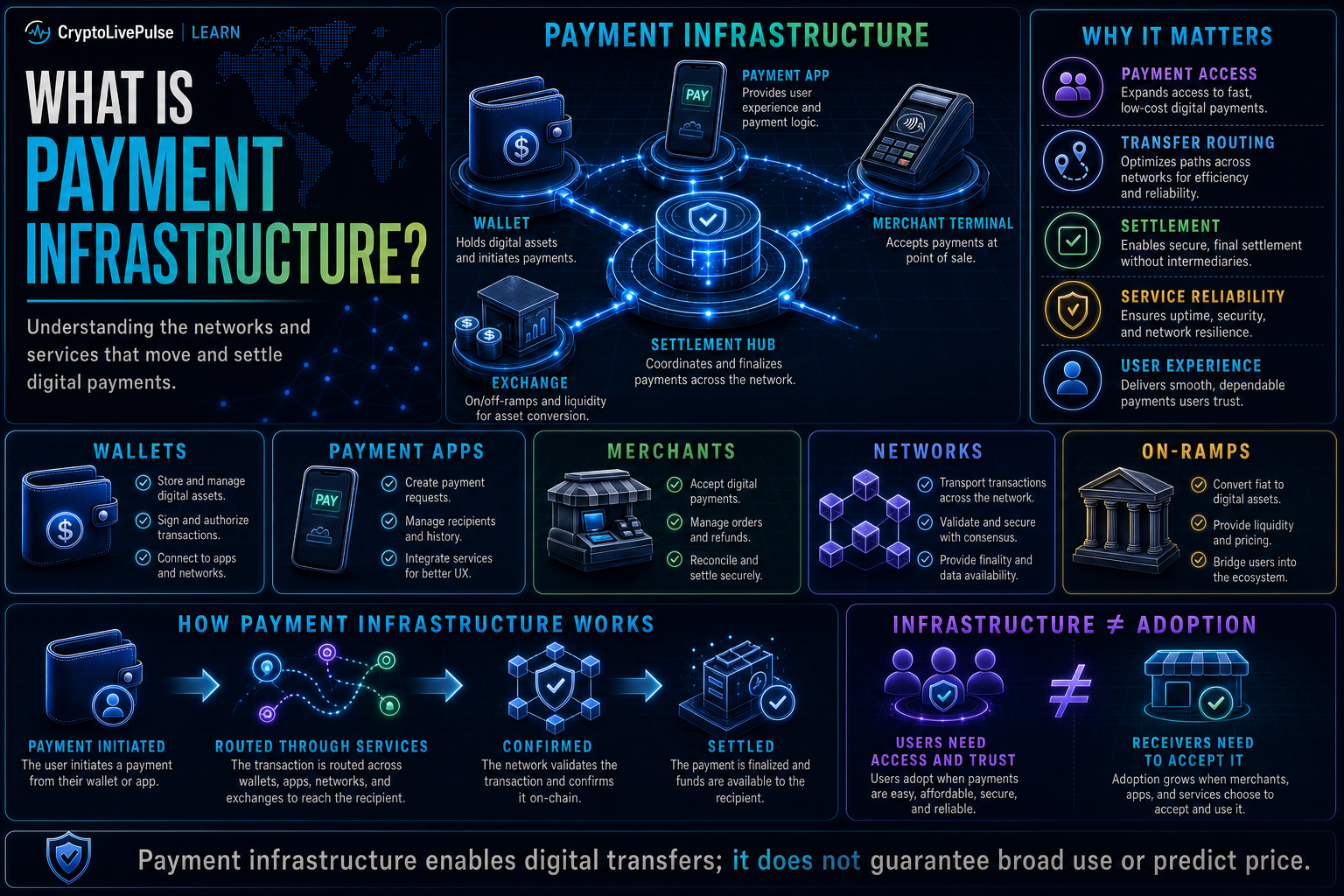
Payment infrastructure is the collection of networks, software, institutions, and processes that allow money or digital value to move between people and businesses.
Simple definition
It includes the systems behind starting, routing, confirming, settling, and recording a payment. In crypto, it can include blockchains, wallets, payment applications, exchanges, and conversion services.
Why it matters
Good payment infrastructure helps transfers work reliably between different participants. Its design can affect accessibility, transaction costs, settlement timing, user experience, and the ability to connect with other systems.
How people usually read it
People look at whether users can send and receive value easily, how the system handles confirmation and errors, what networks it supports, and what practical limits apply.
Why it matters for crypto
Crypto payment infrastructure can support stablecoin transfers, merchant payments, exchange settlement, cross-border movement, and on-chain applications. The infrastructure is broader than one token or blockchain.
Not a standalone signal
A new payment system does not automatically mean people will use it. Adoption depends on trust, access, liquidity, legal requirements, integrations, and whether it is useful to both sender and receiver.
Example in a market update
If wallets, merchants, and payment applications are becoming more connected, an update may describe payment infrastructure as expanding.
Common signals people watch
- Wallet and merchant integrations
- Transaction completion and reliability
- Supported payment networks
- Conversion and settlement access
- Actual payment activity
Payments use connected services
A complete payment experience may involve several participants. A wallet starts the payment, a network routes or records it, and a merchant or payment provider receives, accepts, or converts it. Each link affects the experience.
Infrastructure also needs to work when something goes wrong. Support processes, transaction status, user authentication, and interoperability are all important parts of a system that people can actually use.
Questions to keep in mind
Can the sender and receiver access the same service, how is the transfer completed, and what support exists if it fails? These questions show whether payment infrastructure is practical.
Reliable infrastructure is often invisible when it works well. Its value becomes clearer when many different users, wallets, merchants, and services can complete payments without complicated extra steps.
The surrounding support and conversion services are part of that experience, because a payment must be understandable and usable for both sides of the transaction.
Key takeaway
Payment infrastructure is the system that enables payments to move, settle, and be recorded across users, services, and networks.
Comments (0)
Join the discussion
Sign in or create a free account to leave a comment.
No comments yet. Be the first to comment!