What Is Order Flow?
What Does Order Flow Mean?
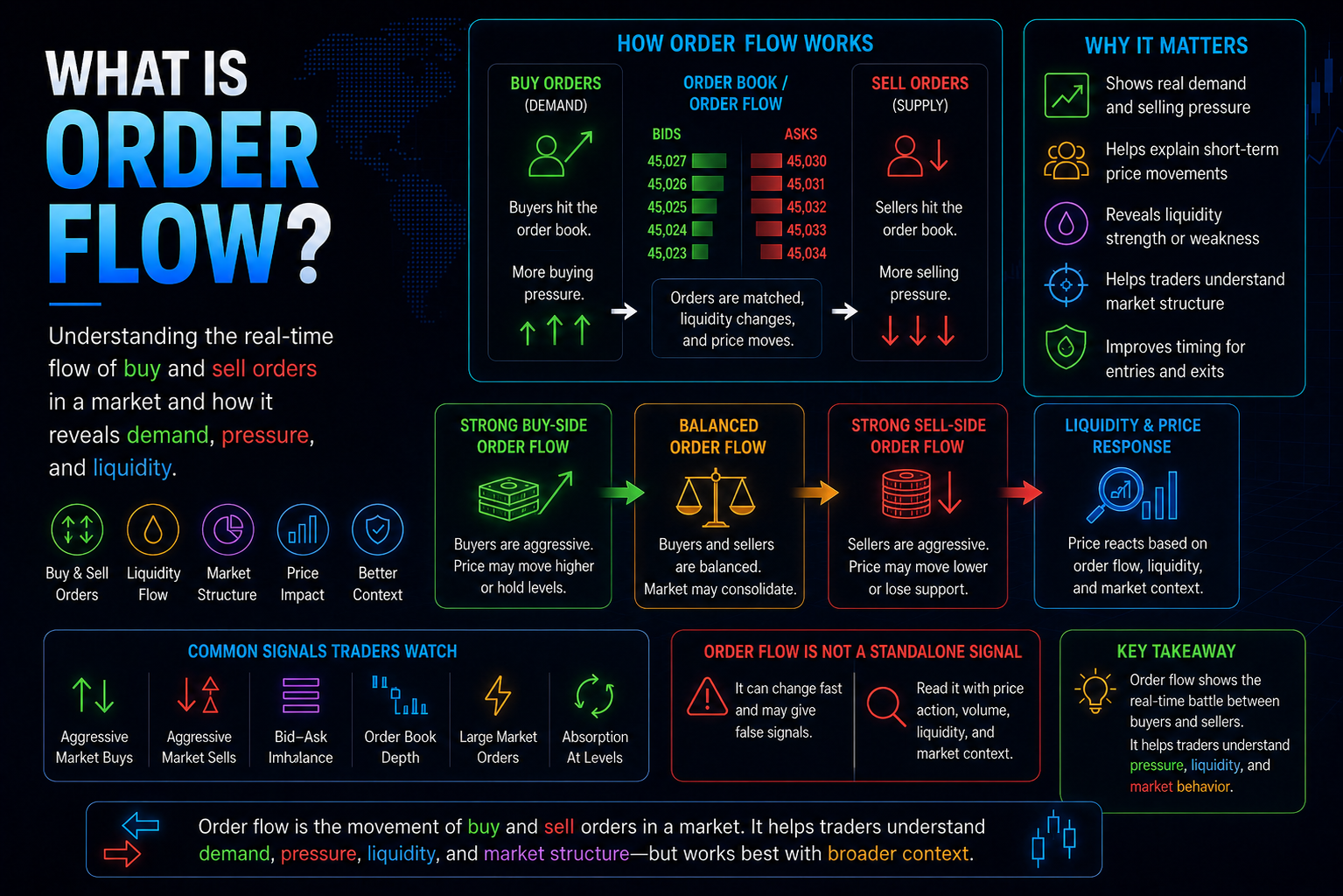
Order flow describes the stream of buy and sell orders moving through a market. Crypto readers watch order flow because it can help explain short-term demand, selling pressure, liquidity, Bitcoin, Ethereum, volatility, and broader market structure.
Simple definition
Order flow means the movement of buy orders and sell orders in a market.
When more aggressive buyers are active, price may feel supported. When more aggressive sellers are active, price may feel pressured.
Why order flow matters
Order flow matters because price moves when buyers and sellers interact. It helps traders understand whether demand or supply is stronger at a given moment.
It can also affect how traders read liquidity, volatility, support levels, resistance levels, and whether a market move looks strong or fragile.
How traders usually read it
Strong buy-side order flow is usually read as a sign that buyers are more active or willing to pay higher prices.
Strong sell-side order flow may suggest pressure or caution. The meaning depends on context because order flow can shift quickly around news, liquidations, ETF flows, macro signals, or key price levels.
Why it matters for crypto
Order flow matters for crypto because Bitcoin, Ethereum, and altcoins can move quickly when liquidity is thin or traders react aggressively.
Crypto traders may use order flow as part of a broader market read, especially when it appears alongside exchange flows, ETF flows, liquidation pressure, Bitcoin dominance, volatility, and market sentiment.
Order flow is not a standalone signal
Order flow should not be used as a standalone price signal. A burst of buying does not guarantee a lasting move, and selling pressure does not always mean a deeper decline.
Order flow is most useful when read alongside price action, volume, liquidity, exchange flows, ETF flows, volatility, support and resistance, and broader market sentiment.
Example in a market update
If Bitcoin is holding near support and buy-side order flow improves, traders may read the setup as more stable.
If Bitcoin is falling while sell-side order flow remains heavy, traders may read the market as cautious until selling pressure fades.
Common signals traders watch
- Whether buy orders or sell orders are more aggressive
- Whether price reacts strongly or weakly to order flow
- Whether liquidity is deep or thin near key levels
- Whether volume confirms or weakens the move
- Whether order flow supports or challenges the broader market structure
Key takeaway
Order flow helps traders understand buying and selling pressure, but it should be read with liquidity, volume, price action, and broader market context.
Comments (0)
Join the discussion
Sign in or create a free account to leave a comment.
No comments yet. Be the first to comment!