What Is On-Chain Data?
What Does On-Chain Data Mean?
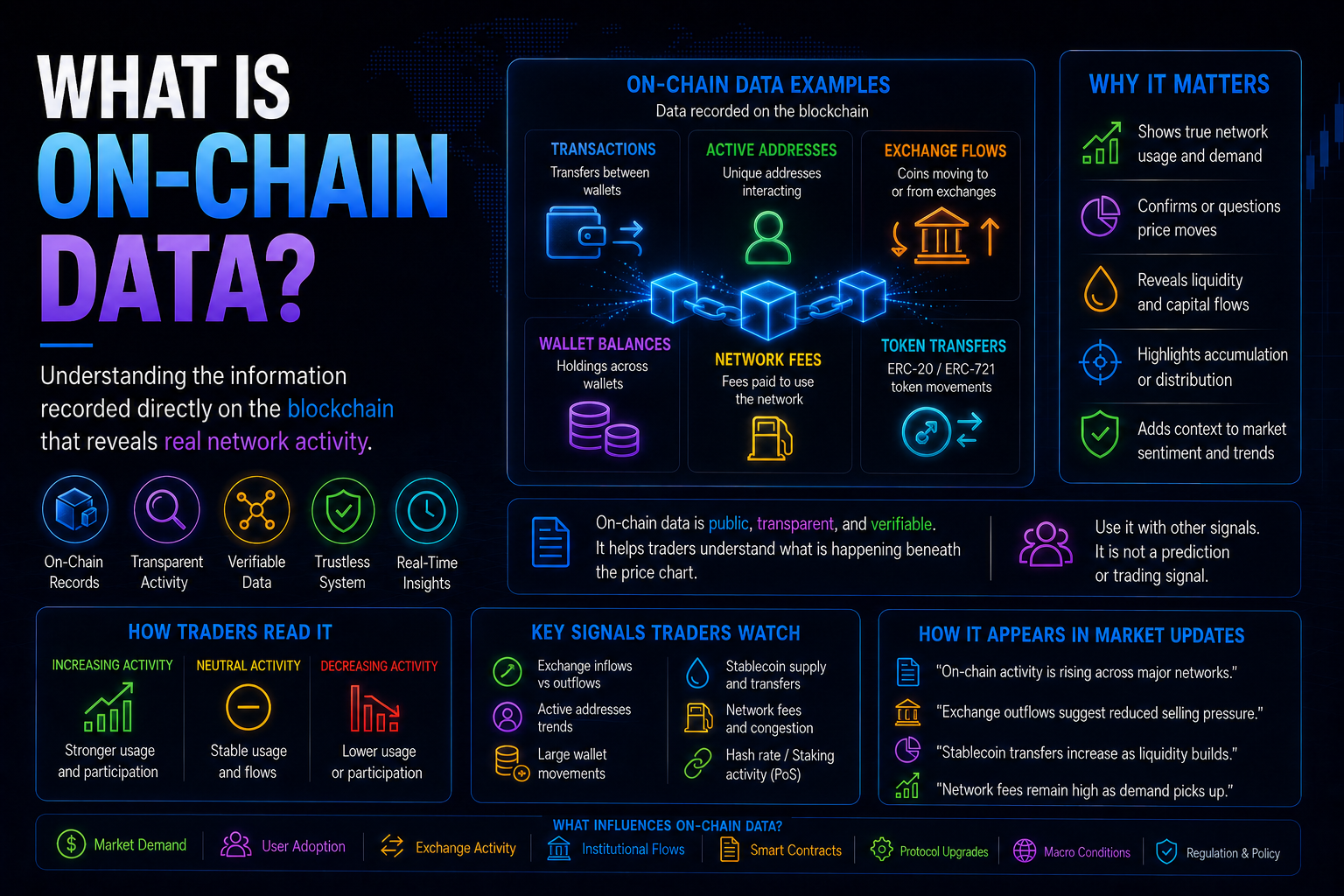
On-chain data is information recorded directly on a blockchain. Crypto traders watch on-chain data because it can show how Bitcoin, Ethereum, stablecoins, wallets, exchanges, and networks are being used.
It can help readers understand activity beneath the price chart, such as transfers, wallet movement, network usage, and exchange-related flows.
Simple definition
On-chain data means information that is publicly recorded on a blockchain.
This can include transactions, wallet balances, token transfers, network fees, active addresses, and movement between wallets and exchanges. It does not explain every market move, but it can add useful context.
Why on-chain data matters
On-chain data matters because blockchains leave a public record of activity. That record can help traders see whether a network is active, whether coins are moving, and whether market behavior is broad or limited.
It can affect interpretation because price alone does not always show what is happening underneath. A move supported by stronger activity may be read differently from a move with weak participation or thin liquidity.
How traders usually read it
Rising on-chain activity usually suggests more network use or more movement across wallets. Traders may read this as a sign that attention, demand, or market activity is increasing.
Falling on-chain activity may suggest quieter network use or lower participation. The meaning depends on context because transfers can happen for many reasons, including exchange movement, custody changes, stablecoin settlement, or normal wallet management.
Why it matters for crypto
On-chain data matters for crypto because Bitcoin, Ethereum, and many other networks operate on public blockchains. This gives traders a way to study network activity beyond price, volume, ETF flows, macro signals, and sentiment.
Crypto traders may use on-chain data to understand wallet behavior, exchange flows, stablecoin liquidity, network fees, and whether activity is concentrated in a few areas or spreading across the market.
On-chain data is not a standalone signal
On-chain data should not be used as a complete market explanation. A large transfer does not automatically mean buying, selling, accumulation, or distribution.
On-chain data is most useful when read alongside price action, trading volume, liquidity, ETF flows, derivatives positioning, macro signals, market sentiment, and broader market structure.
Example in a market update
If Bitcoin is holding steady while on-chain activity and stablecoin transfers rise, traders may read the market as more active beneath the surface.
If Ethereum price action is quiet and on-chain fees, active addresses, and token transfers are also lower, traders may read network activity as softer or more selective.
Common signals traders watch
- Whether active addresses are rising or falling
- Whether coins are moving toward or away from exchanges
- Whether network fees are increasing or decreasing
- Whether stablecoin transfers suggest stronger or weaker liquidity
- Whether large wallet movements match or conflict with price action
Key takeaway
On-chain data helps traders understand blockchain activity beneath the price chart, but it works best when read with price, liquidity, sentiment, and market structure.
Comments (0)
Join the discussion
Sign in or create a free account to leave a comment.
No comments yet. Be the first to comment!