What Does Miner Capitulation Mean?
What Does Miner Capitulation Mean?
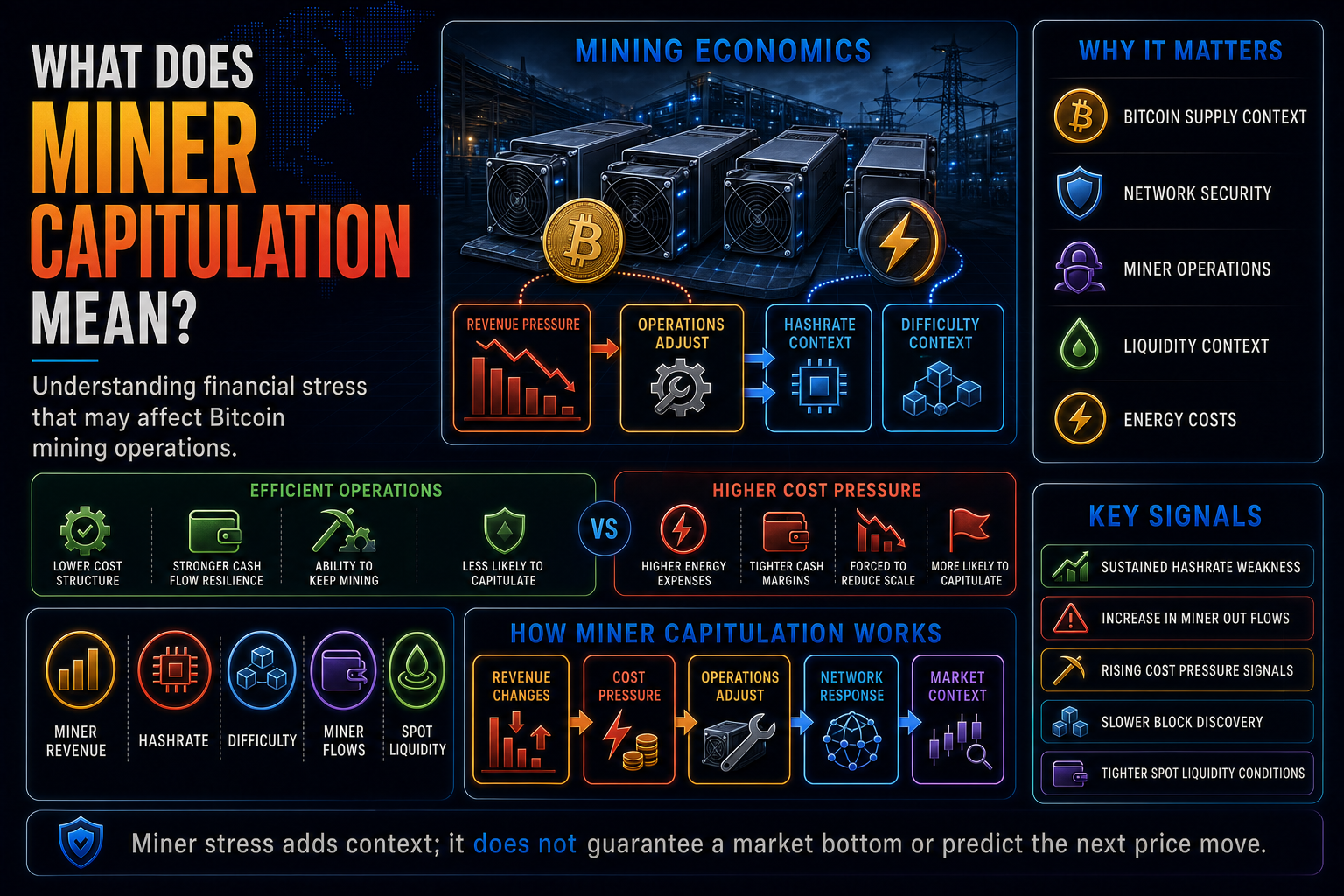
Miner capitulation describes a period of financial stress in Bitcoin mining when some miners may reduce operations, shut down less efficient equipment, or sell Bitcoin to cover costs. The term is market shorthand, not a formal event with one universal definition.
Simple definition
Miner capitulation is when mining becomes difficult enough financially that some Bitcoin miners reduce activity or sell assets to manage costs.
Mining profitability depends on several factors, including Bitcoin's price, block rewards, transaction-fee income, mining difficulty, machine efficiency, and electricity costs. Stress can rise when revenue falls or operating costs become harder to cover.
Why miner capitulation matters
Miner capitulation matters because miners are part of Bitcoin's supply and network-security system. Their financial conditions can affect whether some operators keep machines running, sell a portion of their Bitcoin holdings, or delay investment in new equipment.
It can also provide context for changes in hashrate, difficulty, mining-company activity, and Bitcoin moving from miner-related addresses. These indicators should be interpreted together rather than in isolation.
How miner capitulation can happen
When mining revenue is not enough to cover costs, less efficient miners may switch off machines or reduce their activity. Some miners may also sell mined Bitcoin or other assets to fund electricity, debt, maintenance, or operations.
As less efficient capacity leaves the network, Bitcoin's difficulty-adjustment process can eventually respond to changes in mining activity. The timing and scale of any adjustment depend on network conditions.
How traders usually read it
Traders may watch for declining hashrate, lower miner revenue, shifts in difficulty, or increased transfers from miner-related wallets as signs of mining-sector stress. None of these signals alone confirms miner capitulation.
They also compare miner conditions with Bitcoin spot demand, exchange liquidity, broader risk appetite, and price structure. Mining stress may affect supply context, but the market can be influenced by many other forces.
Miner capitulation versus a difficulty adjustment
Miner capitulation describes the financial and operational pressure faced by miners. A difficulty adjustment is Bitcoin's automatic network mechanism that changes mining difficulty in response to prior block-production conditions.
A difficulty adjustment can occur without broad miner capitulation, and mining stress can exist before a visible adjustment. The two concepts are connected through network activity but are not the same thing.
Why it matters for Bitcoin
Bitcoin miners secure the network by validating blocks and competing for rewards. Their operating conditions connect Bitcoin's market price, energy costs, machine efficiency, and network security in one system.
Watching miners can therefore add context to Bitcoin market updates, especially when there are visible changes in hashrate, difficulty, miner balances, or miner-related exchange flows.
Miner capitulation is not a standalone signal
Miner capitulation does not guarantee that Bitcoin has reached a market bottom or that price will reverse. Mining companies and independent miners have different costs, hedging practices, financing arrangements, and Bitcoin-holding policies.
It is most useful when read alongside hashrate, difficulty, miner revenue, miner-related wallet flows, spot liquidity, and broader market conditions.
Example in a market update
If mining revenue is weakening while hashrate and miner-related balances also change, a market update may note rising mining-sector stress and watch for further network or liquidity developments.
If difficulty adjusts after a period of reduced mining activity, an update may explain that the network is responding to changing mining conditions without treating the adjustment as a price forecast.
Common signals traders watch
- Miner revenue and estimated mining profitability
- Network hashrate and mining difficulty
- Miner-related wallet and exchange flows
- Bitcoin price structure and spot liquidity
- Energy costs, machine efficiency, and broader risk conditions
Key takeaway
Miner capitulation is a period of mining-sector financial stress that can affect miner operations and Bitcoin supply context, but it does not predict the next price move.
Comments (0)
Join the discussion
Sign in or create a free account to leave a comment.
No comments yet. Be the first to comment!