What Is a Market Volatility Index?
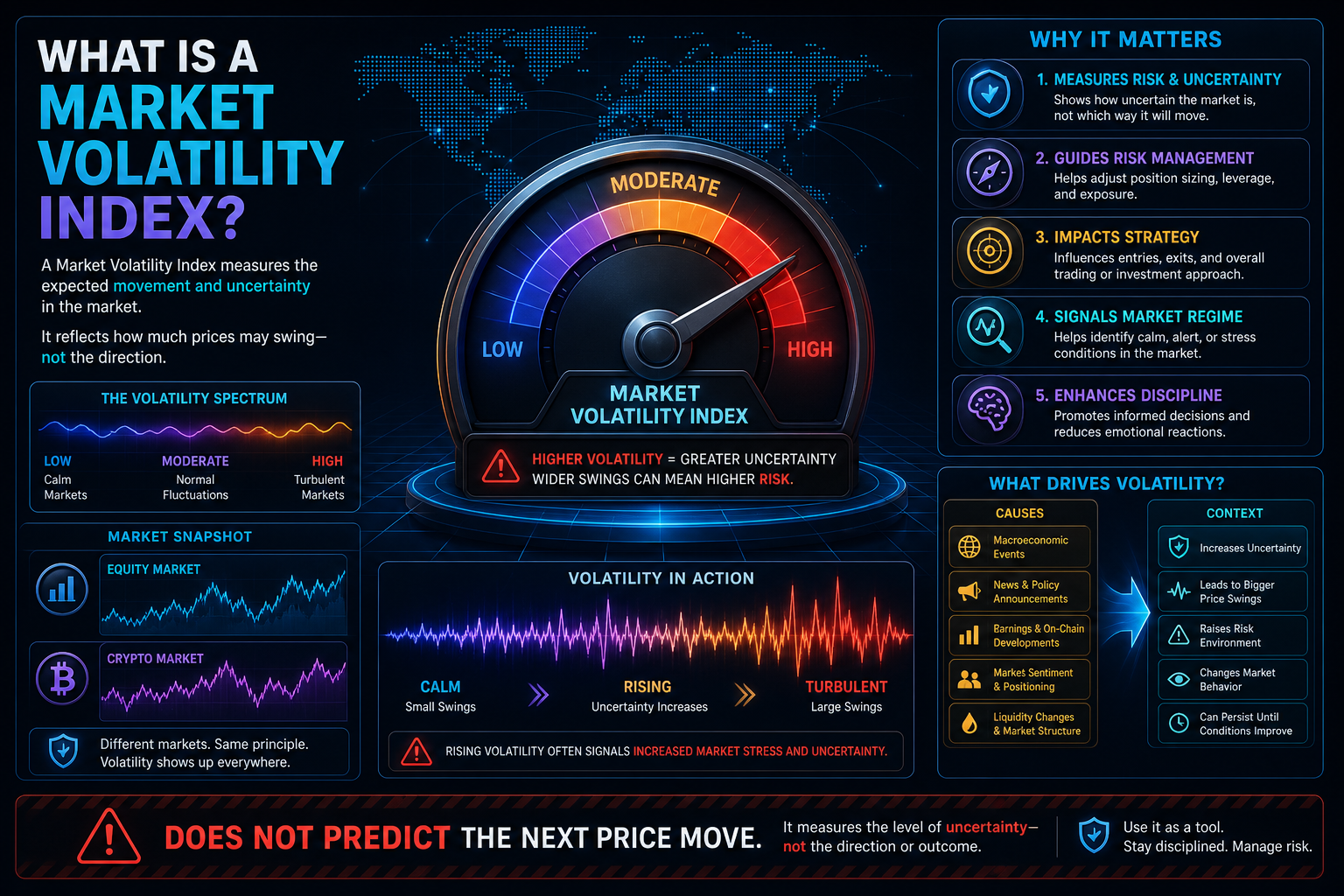
What Is a Market Volatility Index?
A market volatility index is a measure that estimates how much investors expect prices to move over a future period. It commonly uses option prices to summarize expected market uncertainty.
Why it matters
Higher expected volatility can show greater uncertainty or demand for protection. Lower expected volatility can show calmer conditions, but it does not mean risk has disappeared. Volatility indexes describe expectations, not certainty.
Crypto context
Equity volatility can influence broad risk appetite, while crypto has separate volatility measures and market-specific drivers. Comparing both can help describe the wider market backdrop.
Key takeaway
A volatility index summarizes expected market movement and uncertainty. It is useful context, not a prediction of price direction.
Reading the wider context
Volatility indexes are usually forward-looking because option prices reflect what participants are willing to pay for protection. They can rise before a known event or after an unexpected shock. A high reading does not identify the direction of the expected move, only that larger movement is being priced in.
Crypto has its own volatility, which may differ from equity-market expectations. Comparing realized price movement, options positioning, liquidity, and broader risk sentiment helps create a more complete picture than relying on one volatility gauge alone.
Common signals people watch
- Implied versus realized volatility
- Options demand and positioning
- Equity-market breadth
- Scheduled event risk
- Crypto liquidity and price confirmation
A practical way to use the concept
Rather than reacting to one headline or one market session, many readers follow the trend over several periods. They compare market participation, liquidity, and the reaction in related assets. This makes it easier to tell the difference between a temporary move and a broader change in conditions.
No single market indicator can explain all crypto movements. Macro relationships can change quickly, especially around economic releases and major policy events. The concept is most valuable as a question to investigate, not an answer by itself.
What can change the reading
Market interpretation can change when new inflation or labor data appears, when policy guidance shifts, or when investors adjust their demand for liquidity. This is why volatility expectations are usually read as an evolving backdrop rather than a fixed signal.
It is also useful to distinguish a move in one trading session from a sustained trend. Price action, volume, and the response in related markets can provide confirmation or show that the initial interpretation is changing.
Comments (0)
Join the discussion
Sign in or create a free account to leave a comment.
No comments yet. Be the first to comment!