What Is Market Sentiment?
What Does Market Sentiment Mean?
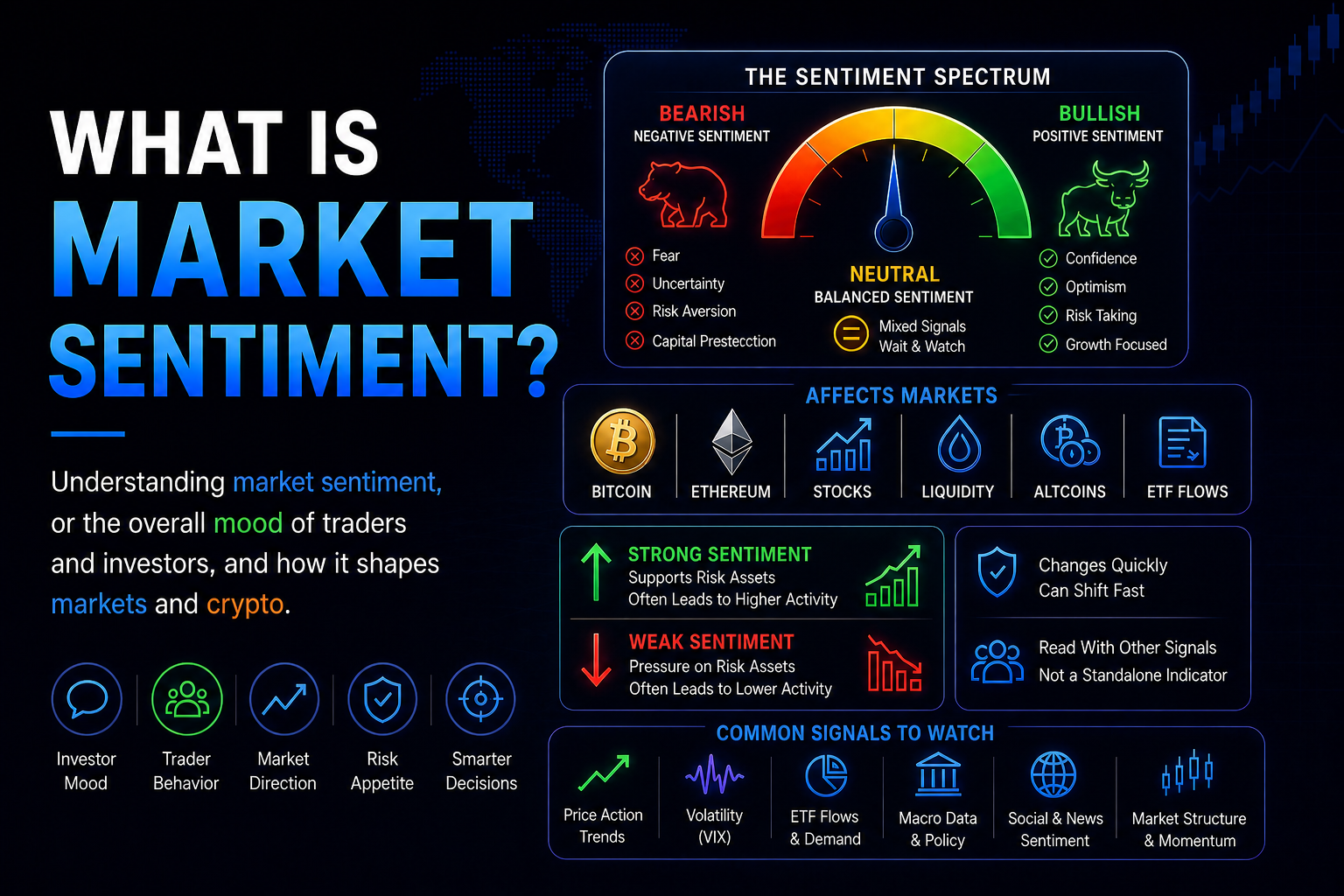
Market sentiment describes the overall mood of traders and investors. Crypto traders watch market sentiment because it can affect risk appetite, volatility, Bitcoin, Ethereum, altcoins, ETF flows, and broader market behavior.
Simple definition
Market sentiment means how positive, negative, cautious, or uncertain the market feels.
It is not one single number. It is a broad read of how traders are reacting to price action, news, macro signals, liquidity, volatility, and market structure.
Why market sentiment matters
Market sentiment matters because markets do not move only on facts. They also move based on how traders interpret those facts.
When sentiment is strong, traders may become more willing to hold risk assets. When sentiment is weak, they may become more cautious, reduce exposure, or wait for clearer confirmation.
How traders usually read it
Positive market sentiment usually means traders are more confident and more willing to take risk.
Negative market sentiment usually means traders are more cautious or defensive. The meaning depends on context because sentiment can shift quickly when price action, volatility, macro data, regulation, or liquidity conditions change.
Why it matters for crypto
Crypto can be especially sensitive to market sentiment because Bitcoin, Ethereum, and altcoins often react strongly when risk appetite changes.
Crypto traders may use market sentiment as part of a broader read, especially when it appears alongside ETF flows, Bitcoin dominance, VIX, Treasury yields, the U.S. dollar, liquidity, and price structure.
Market sentiment is not a prediction
Market sentiment should not be used as a standalone price signal. A positive mood does not guarantee higher prices, and a cautious mood does not guarantee lower prices.
Market sentiment is most useful when read alongside price action, volume, volatility, ETF flows, macro signals, liquidity, Bitcoin dominance, and market structure.
Example in a market update
If Bitcoin is holding higher levels, VIX is falling, and equities are firm, traders may read market sentiment as more constructive.
If Bitcoin is fading, VIX is rising, and policy headlines are weighing on confidence, traders may read market sentiment as more cautious.
Common signals traders watch
- Whether Bitcoin and Ethereum are rising or falling
- Whether volatility is increasing or decreasing
- Whether ETF flows are supportive or weak
- Whether macro signals are helping or pressuring risk assets
- Whether traders are acting confident, cautious, or uncertain
Key takeaway
Market sentiment helps traders understand the market’s overall mood, and that mood can shape risk appetite, volatility, liquidity, and crypto market behavior.
Comments (0)
Join the discussion
Sign in or create a free account to leave a comment.
No comments yet. Be the first to comment!