What Is a Market Sell-Off?
What Is a Market Sell-Off?
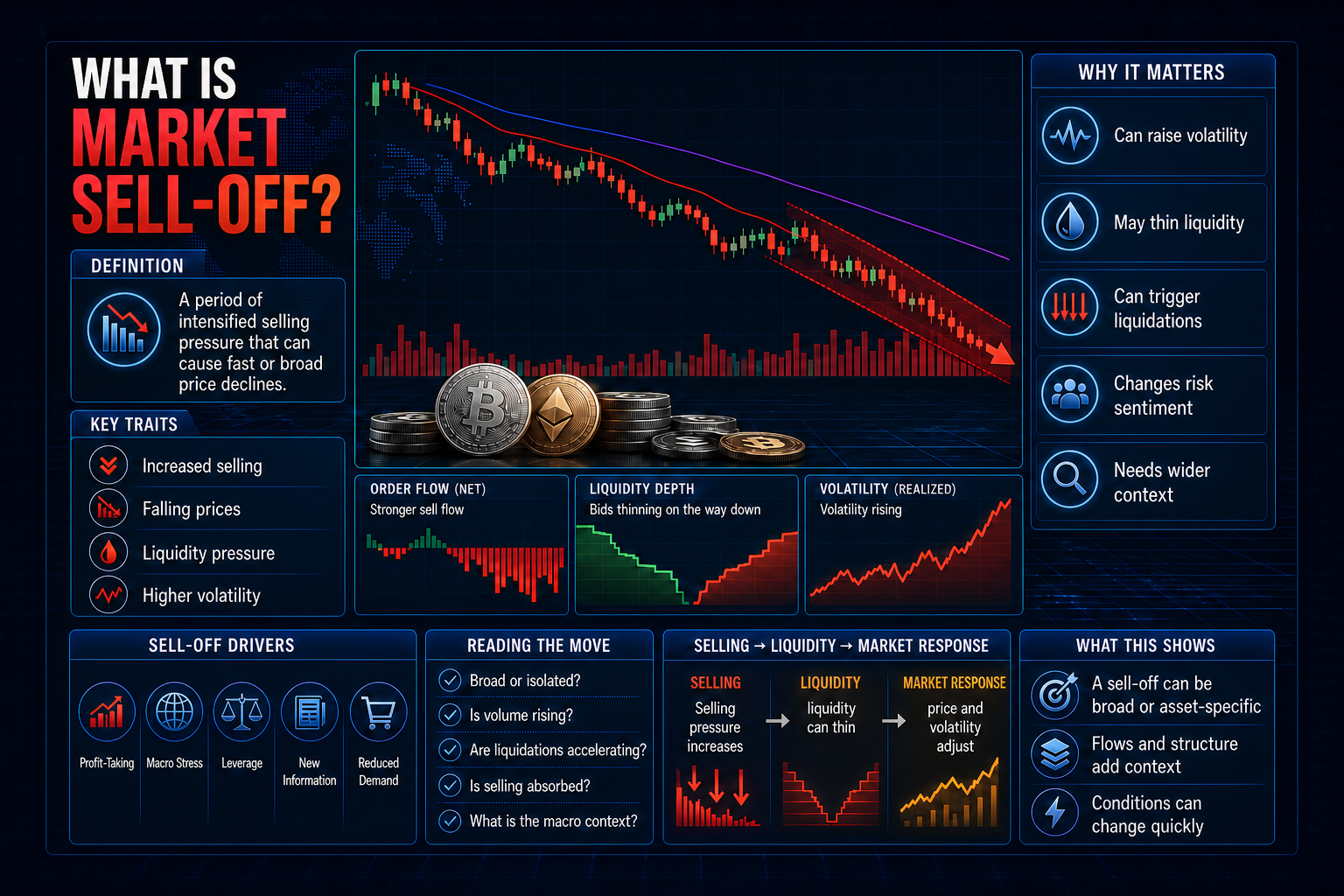
A market sell-off is a period of intensified selling pressure that causes prices to fall. It can be fast or gradual, broad across many assets or concentrated in one sector, asset, or market theme.
Simple definition
A market sell-off happens when more participants are trying to sell than buy, pushing prices lower.
Selling pressure can increase after new information, changing risk appetite, profit-taking, tighter liquidity, or a broader shift in market expectations. The size of a decline alone does not explain why it happened.
Why market sell-offs matter
Sell-offs matter because price changes can accelerate when liquidity becomes thinner. As buyers step back or become more selective, even moderate selling can move the market more sharply.
A sell-off may be broad across stocks, bonds, and crypto, or it may be limited to an asset facing a specific concern. Breadth, trading volume, and the response around key price levels can help provide context.
How traders usually read a sell-off
Traders often look at whether selling is broad or isolated. They may compare the decline with volume, liquidity, market structure, and the performance of related assets.
A fast drop may reflect panic, liquidations, or a sudden change in expectations. A slower decline may reflect steady distribution or a gradual reduction in demand. Neither pattern automatically confirms what prices will do next.
Why it matters for crypto
Crypto sell-offs can be amplified by leverage, liquidations, thin order books, exchange flows, and shifts in wider risk sentiment. Because crypto trades continuously, a move can develop quickly when liquidity is limited.
Bitcoin may lead a broad crypto sell-off, while Ethereum and altcoins may react differently depending on liquidity and market participation. Traders may also compare stablecoin activity, derivatives positioning, macro conditions, and equity-market tone.
Reading the wider context
The quality of a sell-off depends on its speed, breadth, and underlying conditions. A decline caused by one asset-specific event can differ from a broad move tied to macro stress, reduced liquidity, or changing interest-rate expectations.
Fast drops can trigger forced liquidations that extend a move beyond the original catalyst. Once leverage is reduced, price may stabilize, recover, or continue lower depending on demand and the wider market backdrop.
Market sell-offs are not standalone signals
A market sell-off describes current selling conditions. It does not guarantee that weakness will continue or that a reversal will happen immediately.
Market sell-offs are most useful when read alongside volume, liquidity, market structure, leverage, sentiment, and broader economic conditions.
Example in a market update
If Bitcoin falls alongside equities, trading volume rises, and leverage liquidations increase, a market update may describe the move as a broad market sell-off.
If one token declines sharply after a project-specific development while the wider market remains stable, an update may describe the move as an asset-specific sell-off.
Common signals traders watch
- Whether the decline is broad or isolated
- Whether trading volume is rising
- Whether liquidations are accelerating the move
- Whether selling is being absorbed near important levels
- Whether wider macro and liquidity conditions are supportive
Key takeaway
A market sell-off is a period of heavier selling and falling prices. Its meaning depends on breadth, liquidity, volume, leverage, and the wider market context.
Comments (0)
Join the discussion
Sign in or create a free account to leave a comment.
No comments yet. Be the first to comment!