What Is a Market Index?
What Is a Market Index?
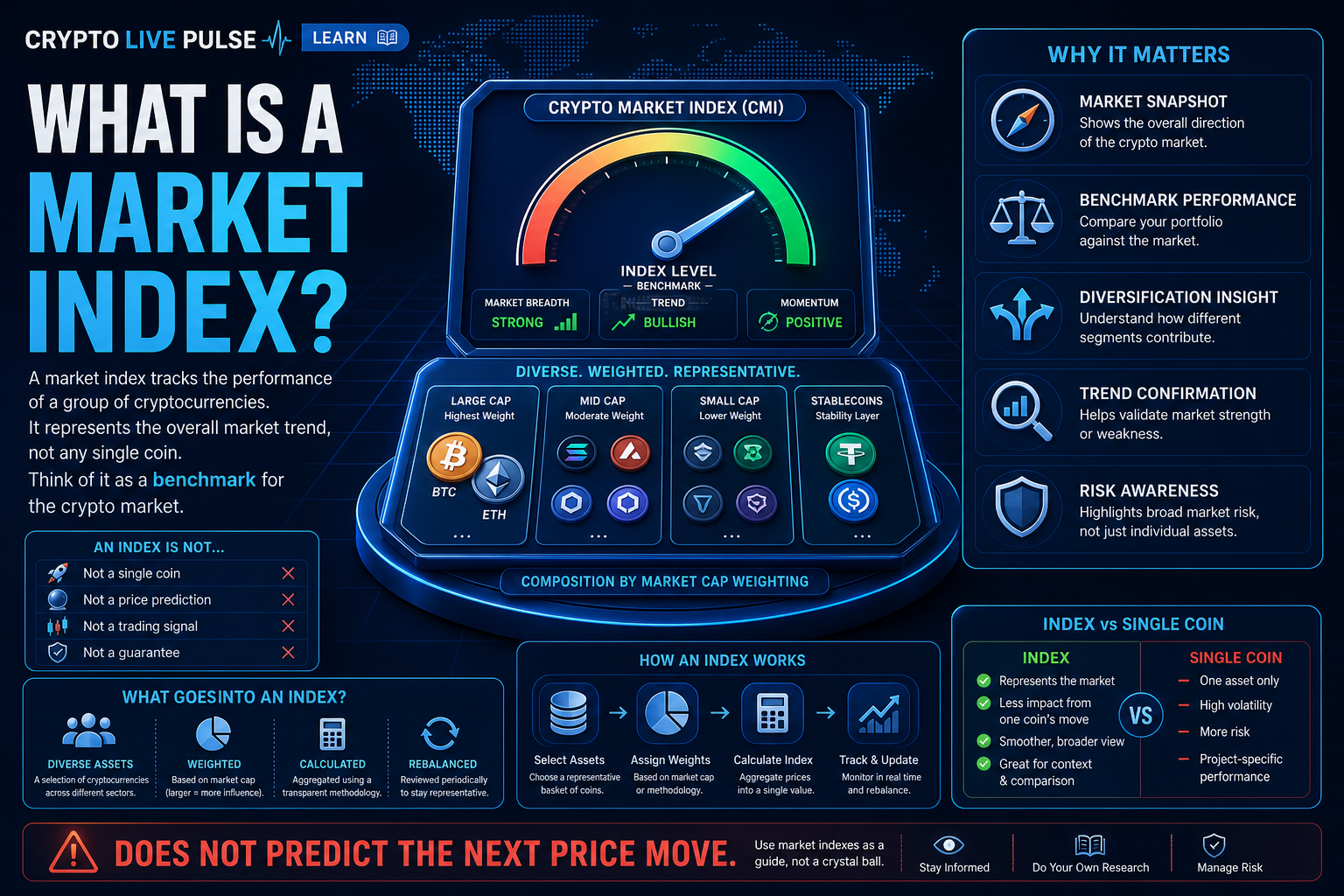
A market index is a measurement that tracks the combined performance of a selected group of assets. It gives investors a simple reference point for whether a market, sector, or group of cryptocurrencies is generally rising, falling, or moving sideways.
Simple definition
An index follows rules for which assets are included and how much each asset influences the result. Some are weighted by market value, while others give every asset a similar weight. An index is a benchmark, not an asset itself.
Why it matters
Individual coins can move for their own reasons. An index can show whether a move is broad across a market or concentrated in a small number of large assets. This helps readers separate overall participation from isolated performance.
How markets use it
Investors compare an asset with a relevant index to judge relative strength or weakness. They may also use an index to monitor market breadth, sector leadership, and changes in risk appetite across time.
Why it matters for crypto
Crypto indexes can represent the total market, Bitcoin, major assets, or a specific segment. They can add context to price moves, though index construction differs between providers and should be understood before making comparisons.
Not a standalone signal
A rising or falling index does not predict the next price move. Readers usually combine it with volume, liquidity, market breadth, macro conditions, and crypto-specific developments.
Key takeaway
A market index is a benchmark for tracking a group of assets. It helps describe broad market behavior but does not guarantee future direction.
Reading the wider context
A benchmark is only as useful as its rules. Readers should know which assets it includes, whether it is weighted by market capitalization, and how often its components are updated. A market-cap-weighted index may be driven mostly by a few large assets, while an equal-weight index may show participation across smaller assets more clearly.
For that reason, one index can be compared with another rather than viewed in isolation. Comparing total-market, Bitcoin, and altcoin benchmarks can help show whether leadership is broad or narrow. Volume, liquidity, price structure, and macro conditions still matter when interpreting the result.
Questions people watch
- Which assets make up the index?
- How are they weighted?
- Is market participation broad or concentrated?
- Does volume support the move?
- Are other market indicators confirming it?
A practical perspective
The most useful approach is to compare a market index with the underlying assets and with other indicators over time. A single session can reflect a temporary flow or news reaction. The pattern of participation, liquidity, and price follow-through is usually more informative than one headline level.
Indexes organize information, but they do not remove uncertainty. They should be used to ask better questions about market conditions rather than to make a directional prediction.
Comments (0)
Join the discussion
Sign in or create a free account to leave a comment.
No comments yet. Be the first to comment!