What Are Market Expectations?
What Are Market Expectations?
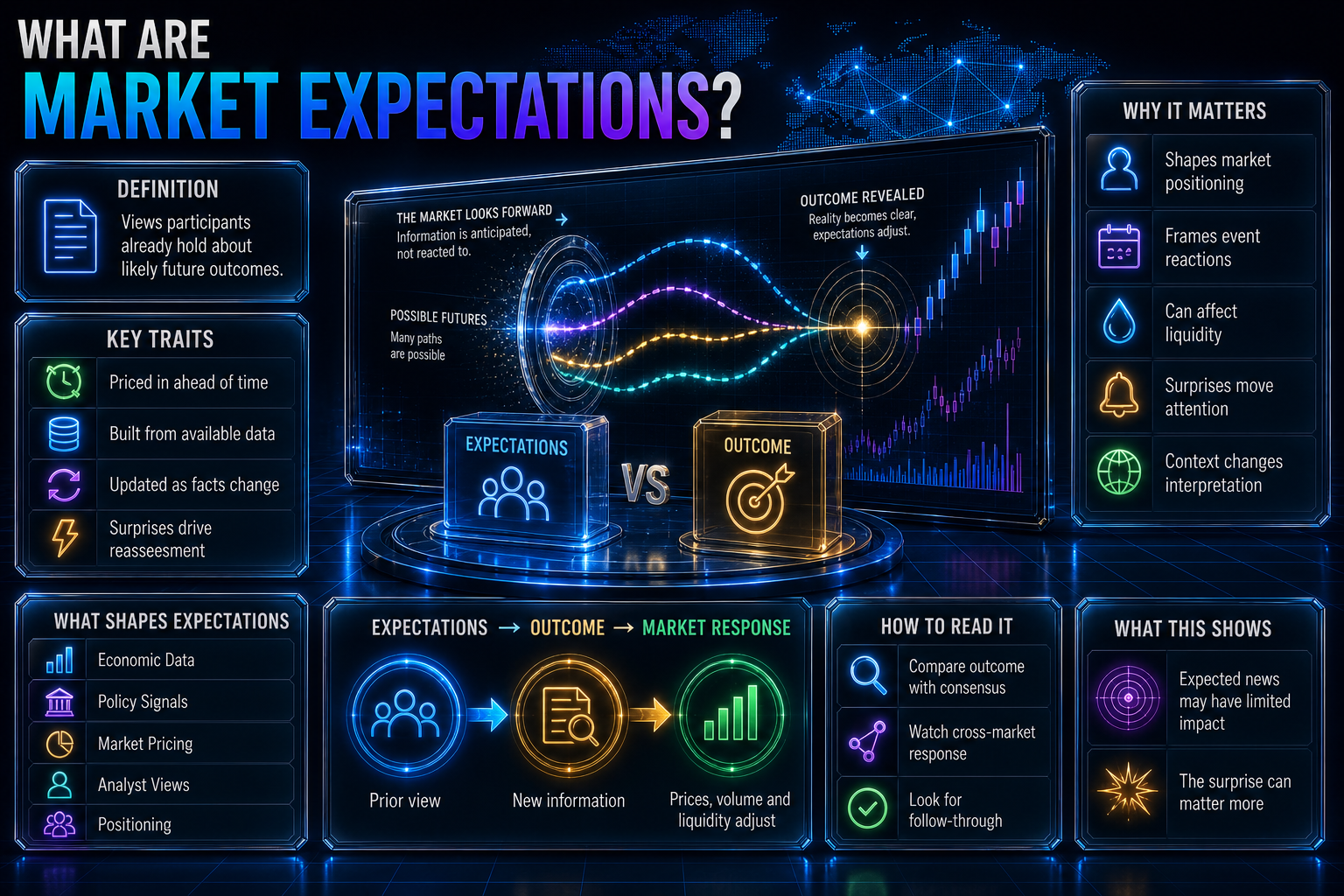
Market expectations are the views participants already hold about what may happen in the future. They can relate to interest rates, inflation, regulation, company results, ETF flows, crypto adoption, liquidity, or the likely outcome of a scheduled event.
Simple definition
Market expectations are the assumptions and forecasts that investors, traders, and institutions use before new information arrives. Prices often reflect these views in advance, which is why the difference between an outcome and expectations can matter more than the outcome by itself.
Why market expectations matter
Markets respond to surprises rather than to information in a vacuum. If an expected event unfolds broadly as anticipated, the market response may be limited. If the result is materially stronger, weaker, earlier, later, or less certain than expected, prices and positioning may adjust more sharply.
How markets usually read them
Expectations are built from available data, public guidance, analyst estimates, market prices, and the recent economic or industry backdrop. They are not fixed. As new information emerges, participants update their views, which can change risk appetite, asset allocation, trading activity, and the interpretation of later events.
Why it matters for crypto
Crypto can react to expectations about monetary policy, dollar strength, regulation, institutional demand, and network developments. A Bitcoin or altcoin move may occur before a scheduled event if participants are positioning in advance. The event-day response can then depend on whether reality confirms or challenges those prior views.
Market expectations are not a standalone signal
Expectations do not guarantee an outcome, and they can be incomplete or quickly revised. They are best used to frame questions about what the market may already have considered. Liquidity, positioning, volume, and confirmation from price action still matter when interpreting a market move.
Common signals people watch
- Consensus forecasts and public market commentary
- Price action before a scheduled event
- Bond yields, currencies, and equity-market reactions
- Derivatives positioning and options activity
- Whether the final outcome differs from the expected range
Reading the wider context
Expectations can vary across participants. One group may focus on growth, another on inflation, and another on liquidity or regulatory conditions. This is why a single estimate rarely captures every possible market response. The balance of views, available liquidity, and existing positions can all shape how a result is received.
A useful approach is to compare what was expected, what occurred, and how markets responded afterward. That comparison can clarify whether a move reflected genuinely new information or a reassessment of a view that was already widely held.
Key takeaway
Market expectations are the views already reflected in participant thinking before new information arrives. Comparing expectations with the actual outcome helps explain a market reaction.
Comments (0)
Join the discussion
Sign in or create a free account to leave a comment.
No comments yet. Be the first to comment!