What Are Market Cycle Phases?
What Are Market Cycle Phases?
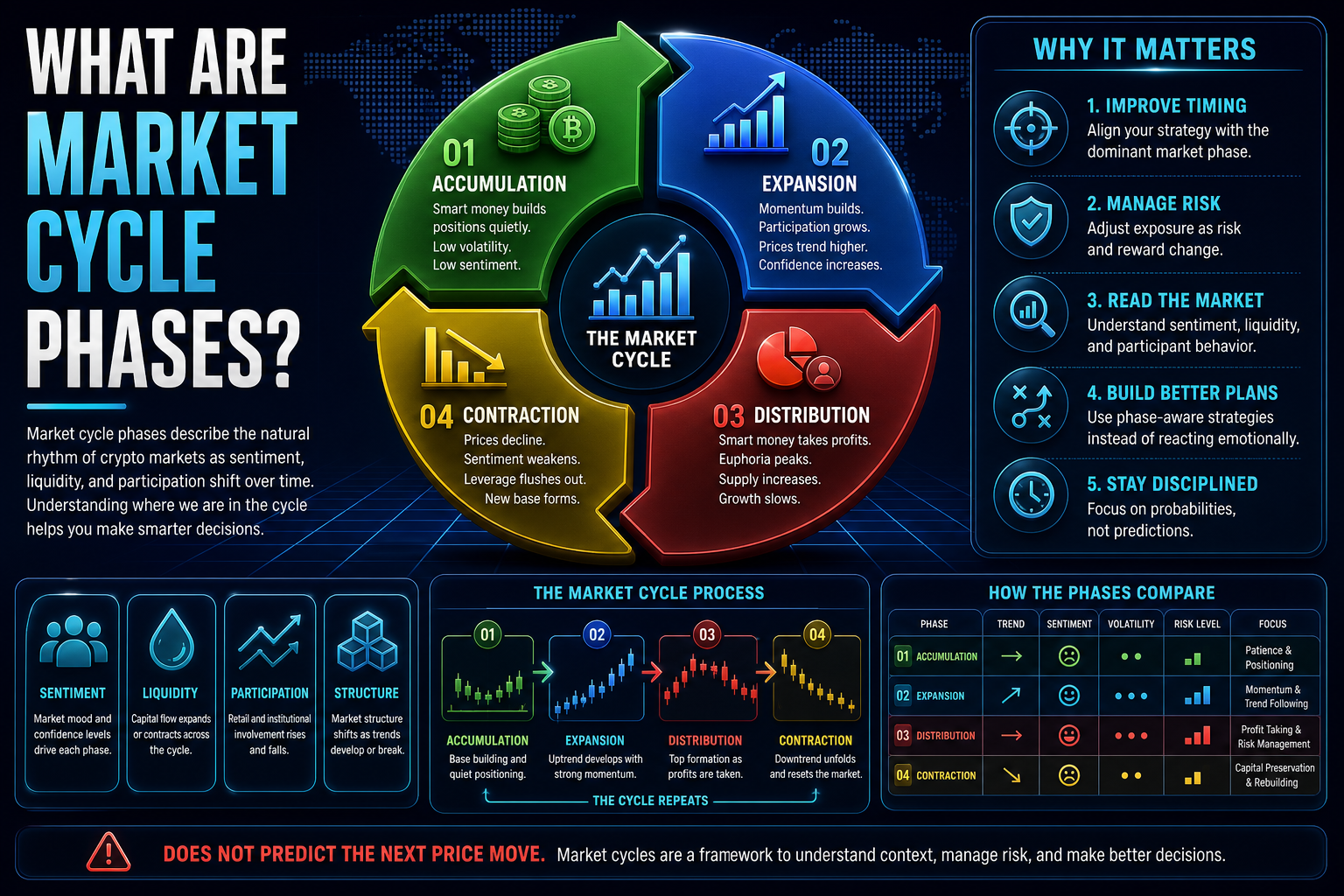
Market cycle phases are broad periods of changing prices, sentiment, participation, and risk appetite. They are commonly described as accumulation, expansion, distribution, and contraction, although real markets do not follow a perfect or fixed sequence.
Simple definition
A market cycle is the way conditions can change over time from caution to optimism and back again. Each phase describes tendencies in behavior, not an exact calendar or a guaranteed price pattern.
Common phases
Accumulation often describes a period of subdued interest after weakness. Expansion can feature improving price trends and participation. Distribution may occur when selling becomes more active after a strong run. Contraction describes deteriorating prices and more defensive behavior.
Why it matters for crypto
Crypto cycles can be influenced by liquidity, Bitcoin performance, network adoption, macro conditions, leverage, and narratives. The speed and shape of a cycle may differ significantly from previous periods.
Not a prediction model
Labelling a phase does not predict what happens next. Markets can reverse, pause, or show mixed signals. Traders usually look for price confirmation, liquidity, volume, and broader conditions rather than relying on a cycle label alone.
Key takeaway
Market cycle phases are a framework for describing changing behavior over time. They provide context, not certainty about future prices.
Reading the wider context
Cycle frameworks are useful because they encourage readers to consider sentiment, participation, liquidity, and price behavior together. They become less useful when they are treated as a timetable. Past crypto cycles had different catalysts, market structures, and macro conditions, so they cannot be copied directly into the future.
A market can show features of more than one phase at the same time. Bitcoin may be strong while many altcoins remain weak, or a broad uptrend may pause without becoming a full contraction. Price confirmation and changes in liquidity help clarify how conditions are evolving.
Questions people watch
- Is participation broadening or narrowing?
- Are spot flows and liquidity improving?
- Is leverage becoming stretched?
- Are prices confirming the apparent phase?
- What macro or crypto-specific factors are changing?
A practical perspective
The most useful approach is to compare apparent cycle behavior with the underlying assets and other indicators over time. A single session can reflect a temporary flow or news reaction. The pattern of participation, liquidity, and price follow-through is usually more informative than one label.
Cycle frameworks organize information, but they do not remove uncertainty. They should be used to ask better questions about market conditions rather than to make a directional prediction.
Comments (0)
Join the discussion
Sign in or create a free account to leave a comment.
No comments yet. Be the first to comment!