What Is a Market Correction?
What Is a Market Correction?
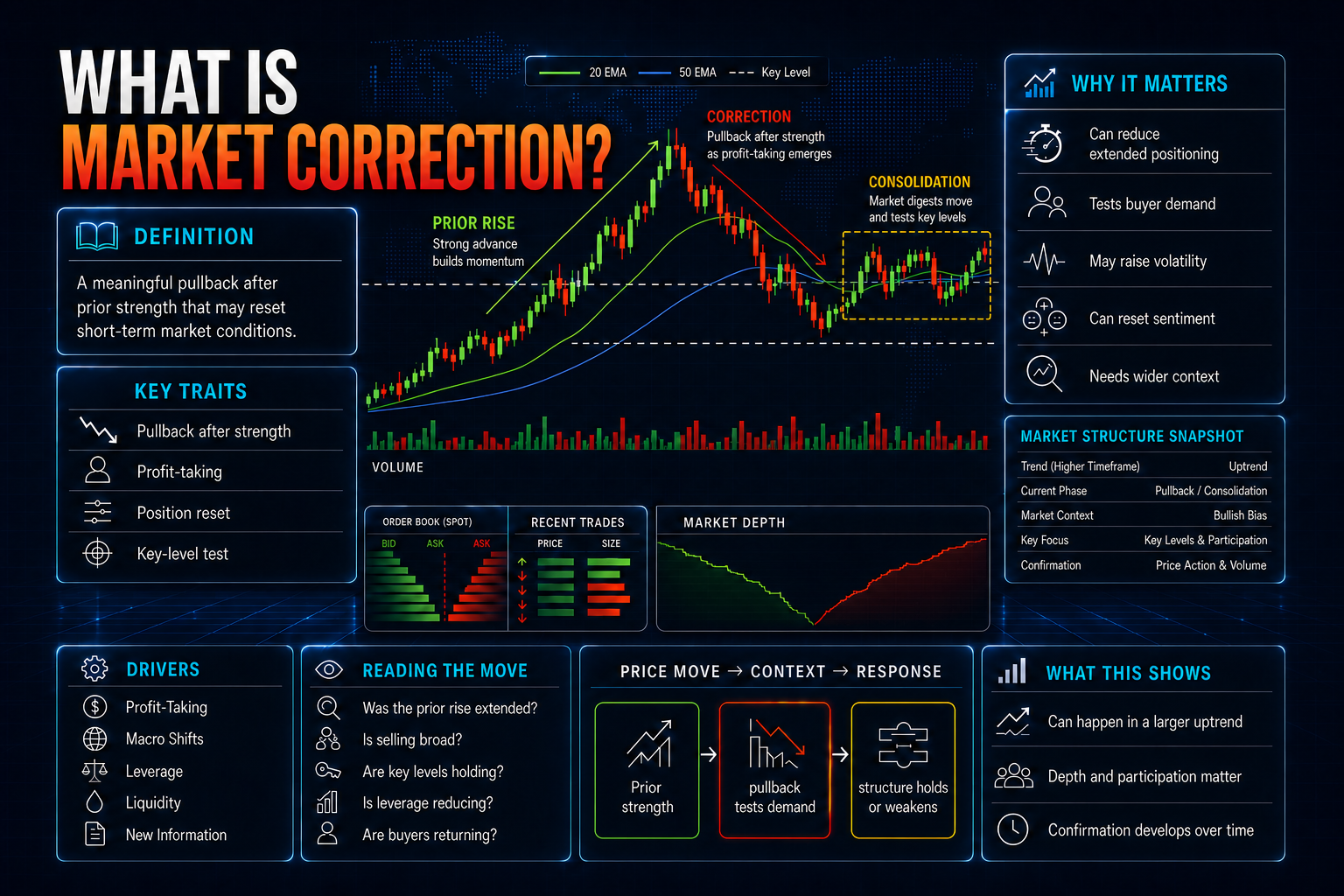
A market correction is a notable decline after prices have risen, often used to describe a pullback that does not necessarily change the longer-term trend. The term is descriptive, not a precise rule.
Why it matters
Corrections can reduce stretched positioning, test demand, and reset short-term sentiment. They may result from profit-taking, changing macro expectations, lower liquidity, or an asset-specific development.
Crypto context
Crypto corrections can be sharp because of volatility and leverage. Readers usually compare the decline with market structure, spot flows, liquidations, and the broader trend rather than using the label alone.
Key takeaway
A correction is a meaningful pullback, not proof of either a reversal or a recovery. It does not predict the next price move.
Reading the wider context
A correction can look different depending on the market that preceded it. After a very fast rise, some profit-taking may be normal. A deeper decline with broad weakness, falling liquidity, and worsening participation may suggest a larger change in conditions. The label alone does not settle that question.
Crypto traders may compare the move with support levels, spot flows, derivatives leverage, and Bitcoin’s relative performance. The reaction after the initial decline can be as important as the decline itself, especially when the market tests whether buyers remain active.
Questions people watch
- Was the prior trend extended?
- Is selling broad or concentrated?
- Are key levels holding?
- Is leverage being reduced?
- Are spot buyers returning?
A practical perspective
The most useful approach is to compare the apparent condition with underlying assets and other indicators over time. A single session can reflect a temporary flow or news reaction. The pattern of participation, liquidity, and price follow-through is usually more informative than one label.
Market labels organize information, but they do not remove uncertainty. They should be used to ask better questions about market conditions rather than to make a directional prediction.
It is also helpful to separate a broad market trend from a short-lived reaction. A stronger reading usually develops through repeated confirmation across price, volume, liquidity, and participation. If those elements weaken, the interpretation can change quickly.
The relationship between price, participation, and risk can change quickly. Treat the term as a description of current conditions, not a promise about the next phase.
Market conditions should be reassessed as new information arrives. A move that looks broad at first can narrow later, while a tentative rebound can gain support through stronger follow-through.
Comments (0)
Join the discussion
Sign in or create a free account to leave a comment.
No comments yet. Be the first to comment!